
Bears Tooth Mushroom: How to Identify It Safely
You've just found a shaggy white mass hanging from a dead hardwood, taken three photos, and searched the name on your phone. Half the results call it bear's tooth mushroom, half call it lion's mane, and a few use a different common name altogether. That confusion isn't your mistake. It's the main risk with this group.
I would slow down at that point. Don't trust a common name or a single bright photo. Check the scientific name, the host tree, and the growth form together, then get a second opinion before you eat or grow anything. That habit prevents most errors.
Bear's Tooth Compared With Its Look-Alikes
When a white, spined fungus grows from a hardwood log, compare its host and growth form before settling on a name. The table gives a practical first check; neither feature alone confirms a species.
Hericium Look-Alikes by Host, Form, Range and Season
Species | Typical host | Known range | Growth form | Season |
|---|---|---|---|---|
Bear's tooth (H. americanum) | Beech, maple, hickory | East of the Great Plains, with records across US and Canada | Long, dangling spines in clusters on wood | Late summer to fall |
Lion's mane (H. erinaceus) | Oak, beech and other hardwoods | Europe, Asia and North America | One dense mass of long, icicle-like spines | Late summer to fall |
Coral tooth (H. coralloides) | Hardwood logs | Northern Hemisphere | Branched, coral-like forms with short spines | Late summer to fall, check regional records |
Western conifer tooth (H. abietis) | Conifers | Western North America and Europe | Spined clusters on conifer wood | Late summer to fall, check regional records |
Bear's tooth is associated with hardwoods such as beech, maple and hickory, and typically forms clusters of dangling spines. A match on host and form is a useful clue, not a final identification.
Lion's mane also grows on hardwoods, but usually forms one dense mass of long spines. Young or poorly developed specimens may make that distinction harder to see, so color alone is not a reliable guide.
The Two Branched Relatives
Coral tooth has an open, branched form with shorter spines. Western conifer tooth grows on conifer wood, a host that separates it from bear's tooth. Seasonal records can vary by region, so consult a local fungal atlas or society list when timing matters.
Two-step test: A conifer host points away from bear's tooth. A dense, single mass on hardwood calls for comparison with lion's mane.
Common names can overlap, and sellers may apply them inconsistently. Match the scientific name when comparing a field guide, photo or culture listing. Careful label reading also matters to shoppers researching food additive concerns for health-conscious shoppers.
For another comparison of pale wood-growing fungi, see this guide to the white cheese polypore and its soft, pale fruiting bodies. Check texture and pore surface as well as color.
What Bear's Tooth Is and Where It Grows
The photo below shows the growth readers usually have in mind, a white cluster emerging directly from wood in a forest setting.
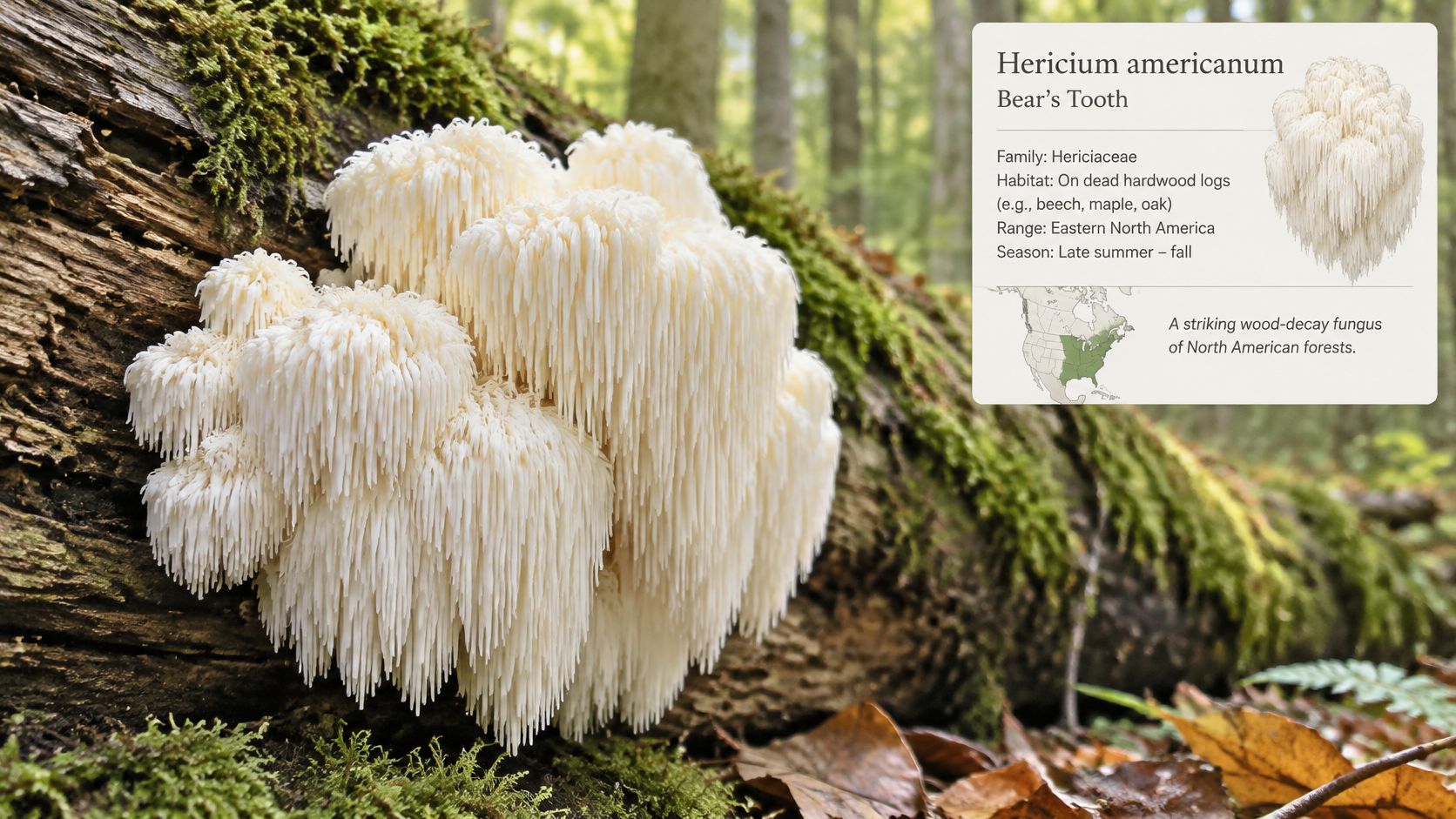
Bear's tooth is Hericium americanum, and the First Nature species account notes Canadian mycologist James Herbert Ginns published the currently accepted species name in 1984. That date matters because older books used overlapping names for related tooth fungi. You can find the same fungus filed differently depending on the age of the guide.
That naming history explains a lot of current confusion. A reader buys a culture, opens an older field guide, and finds a similar photo under another name. Neither source is necessarily careless. They're using different taxonomic snapshots, so you need the accepted name to compare them.
Range, Wood and Season
This is an eastern North American species, primarily east of the Great Plains, with documented occurrences across numerous U.S. states and Canadian provinces. Colorado appears in those distribution records, so Colorado readers shouldn't assume they're automatically out of range, but they should check local records before assuming a find fits. State fungal atlases and local society lists are more useful than a broad continental map.
Recognition of the species is growing locally too. The Vermont Fungi Atlas reports Vermont officially designated bear's head tooth mushroom (Hericium americanum) as the state mushroom in May 2024. A designation like that doesn't confirm your specimen, but it does show why accurate regional records matter.
Watch this short field video after you've noted the host and form, and compare what you see with your own photos rather than copying an identification from the screen.
In the field, look on dead or living deciduous wood, including old logs, dead stubs, and trees with heart rot. It attaches to wood on a trunk or log surface, and it rarely makes sense as a soil find. If your specimen appears to grow from the ground, check for buried wood first, then reconsider the identification.
Fruiting is reported mainly in late summer and fall. A spring find on hardwood isn't impossible to investigate, but it's unusual enough that you should verify it more carefully. Know the wood, the season, and the scientific name before you look closely at the spines.
How to Identify and Confirm Bear's Tooth
A white, dangling-spined mushroom on a log can look convincing in a photo and still be misidentified. Confirm the scientific name by checking the host, growth form, and specimen details together. If one of those checks conflicts, pause and seek an expert opinion before eating or growing it.
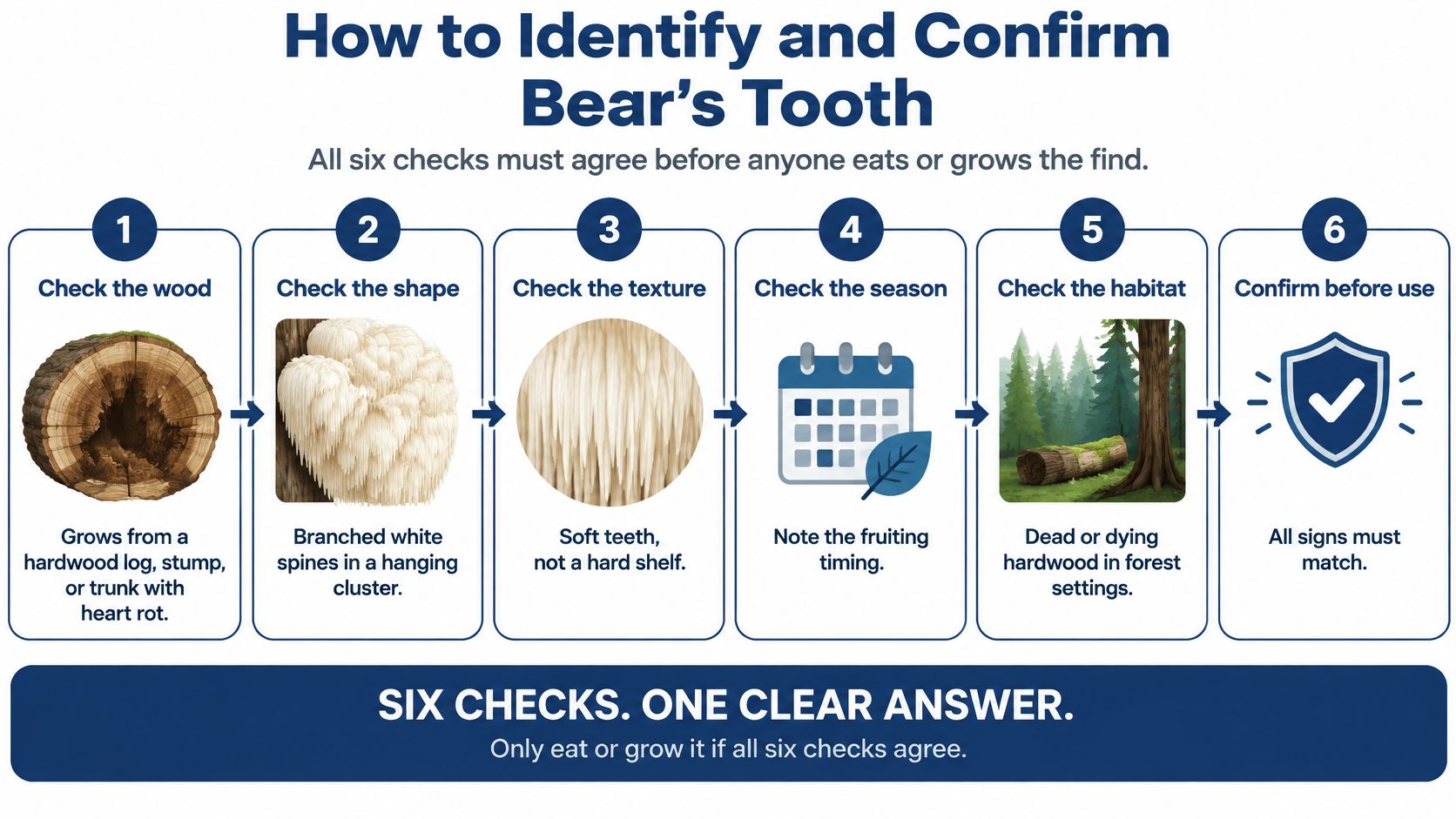
Use this visual summary while reviewing your photos.
Six Checks Before You Decide
Check the wood. Record whether the fungus grows from a hardwood log, stump, or trunk. Photograph the bark, leaves if present, and the cut end of the log. Identifying the tree can help resolve a common-name mix-up; a conifer host calls for reconsidering the identification.
Check the growth form. Look for branched clusters bearing hanging spines. Compare the overall structure, not just its color: age and growing conditions can change how full or stretched a specimen appears.
Measure the spines. Note their approximate length in millimetres or photograph them beside a familiar scale. Long, dangling spines in clusters support the identification; short spines on fine branches warrant another look at similar coral-like fungi.
Check season and region. Compare the date and location with documented records. A specimen outside the expected range or fruiting window needs stronger evidence, not a looser identification.
Photograph and record. Take clear views from above and below, include a ruler or coin for scale, and show where the fungus attaches to the wood. Record the host, date, and location so someone else can assess the same evidence.
Ask for confirmation. Share your photos and notes with a local mycological society or university extension office. A spore print or microscope examination can add evidence when available; an app result alone is not confirmation.
A 2025 multilocus phylogenetic study examined 17 representatives identified as Hericium americanum, which formed a distinct group with 100% bootstrap support. That finding supports treating bear's tooth as a distinct species, rather than assuming it is a regional form of lion's mane.
Do not eat a wild specimen based only on an internet image. If an expert cannot confirm it from your records, you do not have enough information yet.
Why Strain and Conditions Change the Picture
Cultivated specimens can vary, too. A Cornell cultivation evaluation found that three wild H. americanum isolates differed in in-vitro growth rate, and documented malformed mushrooms fruiting inside bags. A photo or growth pattern from one culture, then, is not a reliable template for every strain.
For hands-on practice with photos, host logs, and spore work, you can look at the classes and events Colorado Cultures hosts through its CC Classroom calendar, which is more reliable than guessing alone. Its Genetics Catalog includes Blue Oyster, Lions Mane, Golden Teacher, Reishi, and Turkey Tail. A labeled culture can help you study variation, but it does not replace identifying a wild specimen by its scientific name, host, and growth form.
Three Decisions You Can Make
The checks agree and an expert has reviewed your records: Treat the identification as confirmed. If you plan to eat the mushroom, start with a small test portion.
Any check remains uncertain: Do not eat it. Keep your photos and notes, and ask for another opinion with clearer evidence.
You want to grow it: Start with a small, logged test from a labeled culture rather than tissue from an unconfirmed wild find.
Send your clearest photos, host notes, and date to a local expert for review.
Eating Bear's Tooth Safely and Honestly
Here's the blunt answer. Bear's tooth is treated as a culinary mushroom when fully cooked and correctly identified, but its research base is thin. Don't treat it as a medicine.
That distinction matters because most hype borrows from lion's mane. A review of Hericium species boundaries warns that poorly resolved species boundaries have contributed to misidentification in biomedical and pharmacological research. Results attributed broadly to Hericium or lion's mane shouldn't automatically be generalized to bear's tooth.
A Safe First Meal
Cook it thoroughly. Sauté it in butter, roast it, or fry it until it's fully heated through and tender, and never eat it raw. Raw wild mushrooms are harder to digest and give you no safety benefit.
When it's cooked well, the texture is firm and tender, with a mild flavor that suits garlic, herbs, and cream sauces. Tear it into bite-sized pieces so the spines cook evenly and don't trap grit. Brush debris off first rather than soaking it, since the spines hold water and steam instead of browning.
Start small: Eat a small test portion of any newly identified or newly sourced mushroom.
Skip alcohol on the first trial: It muddies your read on whether the mushroom disagreed with you.
Keep a sample: Save an uncooked piece and your photos until you've confirmed you tolerated the meal.
Discard poor specimens: Throw out anything that smells sour, feels slimy, or shows mould.
If mild, cream-friendly mushrooms appeal to you, the cooking logic in a rich dish like truffle oil pasta from Lello.Store shows how fat and aromatics carry delicate fungi. Use that as a technique reference, not as permission to serve an unconfirmed find. Identification comes before the recipe.
What Not to Claim
Don't promise effects on immunity, memory, or nerves from a plate of bear's tooth. Even for the better-studied lion's mane, human therapeutic evidence remains limited, and bear's tooth has less species-specific research. Treat those claims as unproven hypotheses.
Cook it, taste a small portion, and treat any health claim as a hypothesis.
Never mix species from a shared log in one basket and sort them later at the sink. That's how a correctly identified cluster gets contaminated with an unexamined one. Keep collections separate, label them by host and date, and cook only what an expert confirmed.
Growing Bear's Tooth at Home Without Guesswork
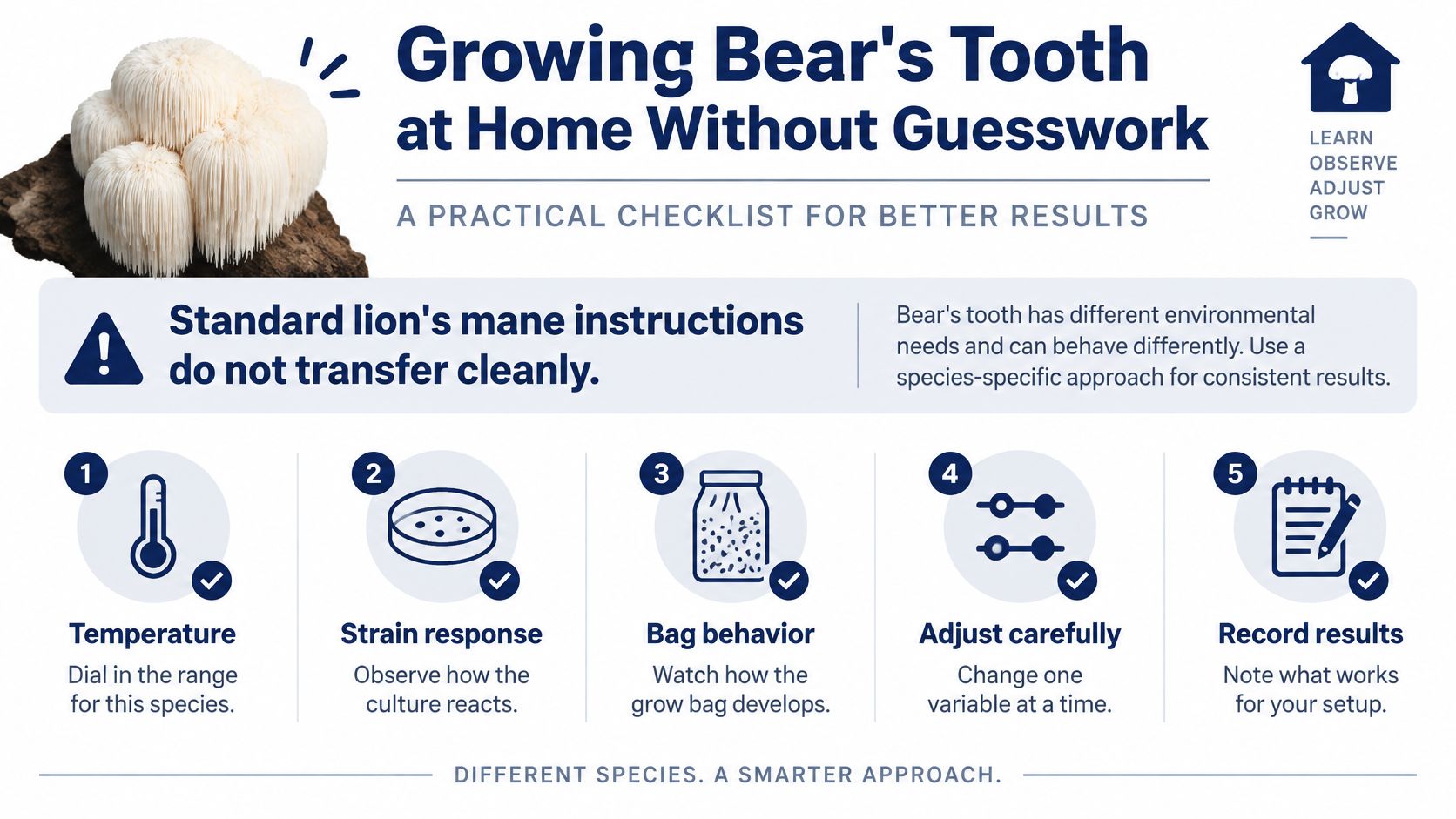
Standard lion's mane instructions don't transfer cleanly to bear's tooth. Temperature, strain response, and bag behavior can all differ, so copying a lion's mane recipe is guesswork dressed up as a method.
This checklist sums up the test-and-log approach I recommend instead of a fixed recipe.
Temperature Is a Trade-Off
A controlled study indexed in the AGRIS record for Hericium isolate testing tested isolates at 15, 20, and 25 °C and found H. americanum could form fruitbodies at 25 °C, while other isolates required lower temperatures. It also reported a noticeable reduction in protein and ash content at 25 °C across tested isolates. Warmer doesn't automatically mean better. You may get fruiting, but you may give up composition or quality.
Bag behavior is the second trap. Some bags produce malformed fruiting bodies inside the bag rather than through intended openings. Check bags early for fruiting against the plastic, and adjust airflow and light before you blame the culture.
Substrate Changes the Harvest
Substrate isn't just support. In a study summarized on PubMed on lignocellulosic wastes for H. americanum, dry-basis protein concentration ranged from 8.5% to 23.7% across substrates. Compare recipes under identical conditions and track what changes.
Substrate nutrient ranges across lignocellulosic wastes
Nutrient | Range across substrates |
|---|---|
Protein (dry basis) | 8.5% to 23.7% |
Phosphorus | 9.9 to 21.2 g/kg |
Potassium | 26.6 to 35.8 g/kg |
Magnesium | 0.63 to 1.33 g/kg |
Iron | 49.5 to 72.2 mg/kg |
Manganese | 6.22 to 10.11 mg/kg |
Zinc | 32.8 to 82.8 mg/kg |
Those are dry-weight research ranges, not guaranteed values for your grow bag. Use them to justify testing, not to label your harvest. If you're comparing mixes, start with a consistent hardwood mushroom substrate for controlled recipe trials and change one ingredient at a time.
Run a Small Logged Test
Run a small number of bags, not one large batch. Test at least two temperatures if you can, change one variable at a time, and test each strain separately. Isolate behavior varies enough that pooling strains hides the answer.
Copy this one-page log for each bag:
Culture: Supplier, scientific name, isolate or lot, inoculation date
Substrate: Recipe, moisture approach, bag size, sterilization or pasteurization method
Conditions: Temperature, humidity, fresh-air exchange, light, opening style
Results: Colonization speed, contamination, flush timing, fruit shape, fresh weight, notes on bag fruiting
Judge recipes by biological efficiency, time to fruiting, contamination rate, and fruit quality, not by colonization speed alone. Fast mycelium that fruits poorly inside the bag hasn't solved your problem.
Legal and Responsible Foraging Rules
A documented range doesn't grant you a right to collect. Rules depend on who owns the land and where it lies, and they can change at a park boundary.
Say a log sits just inside a protected area where collection is prohibited, while the same forest type across the road is private land. In the first case, you leave it. In the second, you need the landowner's permission before you pick anything. National, state, and local rules differ, so check the specific park, forest, or landowner rules first.
Harvest Etiquette That Protects the Site
Take only what you need: Leave some fruiting bodies so the fungus can keep spreading.
Don't strip a whole log: Cut or twist individual clusters cleanly and leave the wood intact.
Record location and date: Good notes help identification and keep you from overharvesting one site.
Keep collections separate: Don't mix finds from different logs until each one is confirmed.
Don't sell foraged bear's tooth without confirming local rules on the sale of wild fungi and food-safety requirements. Selling raises identification, labeling, and liability questions that personal use doesn't. If you can't document the species and source clearly, don't sell it.
Growing from a known, labeled culture avoids most collection questions. It also gives you a repeatable strain and substrate to log, which is more useful than returning to a log and hoping it fruits again.
Visit Colorado Cultures to compare labeled cultures, hardwood substrates, sterilized grain, and lab supplies for a small, well-logged bear's tooth test instead of relying on a common name. You can also use our classes and identification resources to review host, growth form, and photos before you grow or cook a find. Start with the scientific name, keep clear records, and let us help you set up the next step safely.
Comments