
White Cheese Polypore: A Practical Identification Guide
You're on a damp woodland trail when a pale shelf on a fallen birch catches your eye. It looks like a piece of soft cheese pressed against the bark, and a quick search suggests white cheese polypore. Before accepting that name, pause beside the log. The useful question isn't whether your mushroom resembles a photograph, but whether the evidence supports the identification.
Meeting the White Cheese Polypore in the Woods
Start by looking at the fungus where it grows, before moving or collecting anything. Notice how the bracket attaches to the wood, how much of its underside you can see, and whether nearby fruiting bodies appear fresher or more weathered. A close-up can show an attractive cap while leaving out the very details you need to evaluate it.
White cheese polypore, Tyromyces chioneus, is a rewarding teaching mushroom because its fresh fruiting bodies invite careful observation. They're typically stemless, soft, and water-saturated, with a fragrant odor. Those features become more useful when you examine them together, rather than choosing whichever detail seems most memorable.
Observe before naming
Approach the encounter as a small field investigation. You don't need to identify everything immediately, and you don't need to remove the entire bracket to learn from it.
Look at the attachment. Photograph the fungus against the wood so its growth form remains visible.
Find the underside. Use a small mirror or your phone camera if the bracket sits too close to the log for a comfortable view.
Record what you notice. Write “soft when gently pressed” rather than “cheese-like,” which different observers may interpret differently.
Keep the setting in view. Include the log and surrounding habitat, not just the prettiest specimen.
A faint pleasant odor can be worth recording, but don't force a description you're unsure about. If you can't detect anything distinctive, “odor not apparent” is a useful observation. An honest absence of information is better than an expected answer.
Field habit: Describe the specimen before searching for a name. That helps you avoid turning every observation into confirmation of your first guess.
The common name can make this fungus sound more distinctive than it is. Treat it as an invitation to investigate, not a promise that identification will be easy. Your first successful encounter may end with a provisional name and a good set of notes, rather than a confirmed species.
That's still progress. You've preserved evidence someone else can assess, and you've learned to separate what you saw from what you inferred.
How Tyromyces chioneus Got Its Name and Its Place in Taxonomy
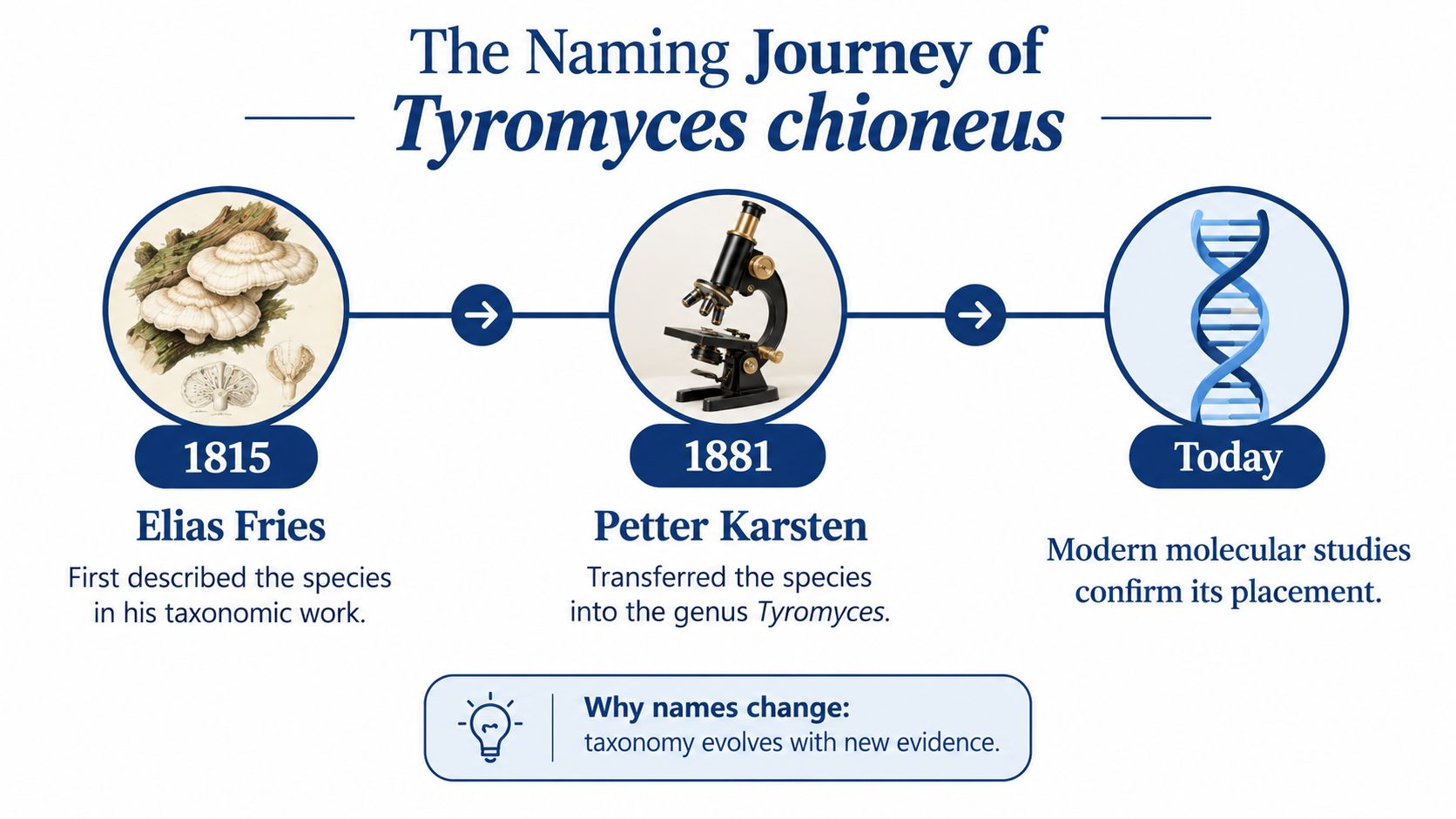
Scientific names can look like obstacles when you're beginning, but they also help connect observations across field guides and older literature. The white cheese polypore has a documented naming history extending back more than two centuries. Elias Fries described it in 1815 as Polyporus chioneus, and Petter Karsten transferred it to Tyromyces in 1881, according to the iNaturalist taxonomic account of Tyromyces chioneus.
Those names refer to the species under different classifications, not necessarily to different mushrooms. If an older reference uses Polyporus chioneus, the changed genus name alone isn't a reason to dismiss it. You need to understand how the name connects to the current usage.
What the name tells you
The epithet chioneus comes from a Greek term associated with snow, referring to the fungus's typically white appearance. It's a memorable connection, but it isn't an identification requirement: an aging specimen needn't remain snow-white to belong to this species.
Tyromyces chioneus is also recognized as the type species of Tyromyces. In plain language, it serves as the formal reference point for the genus. That role concerns naming, not whether it's the largest, most common, or easiest member to recognize.
The naming journey is summarized below.
Why classification can change
Modern DNA-based studies have clarified relationships among polypores, and Tyromyces has been associated with Incrustoporiaceae rather than remaining within the traditional Polyporaceae grouping. The important lesson isn't that an older book is useless. It's that scientists revise classifications when new evidence changes their understanding of relationships.
Use the scientific name when comparing references. Common names can leave you uncertain about which organism a page discusses.
Notice the publication context. A different family placement may reflect an older classification rather than a mistaken field description.
Keep naming separate from identification. Knowing the accepted name doesn't establish that your specimen belongs to it.
For a hobbyist, taxonomy becomes practical when it helps you follow the same organism through different references. You don't have to memorize every historical combination. You do need to recognize that a scientific name represents an evidence-based classification, not an unchangeable label.
Reading the Mushroom in the Field
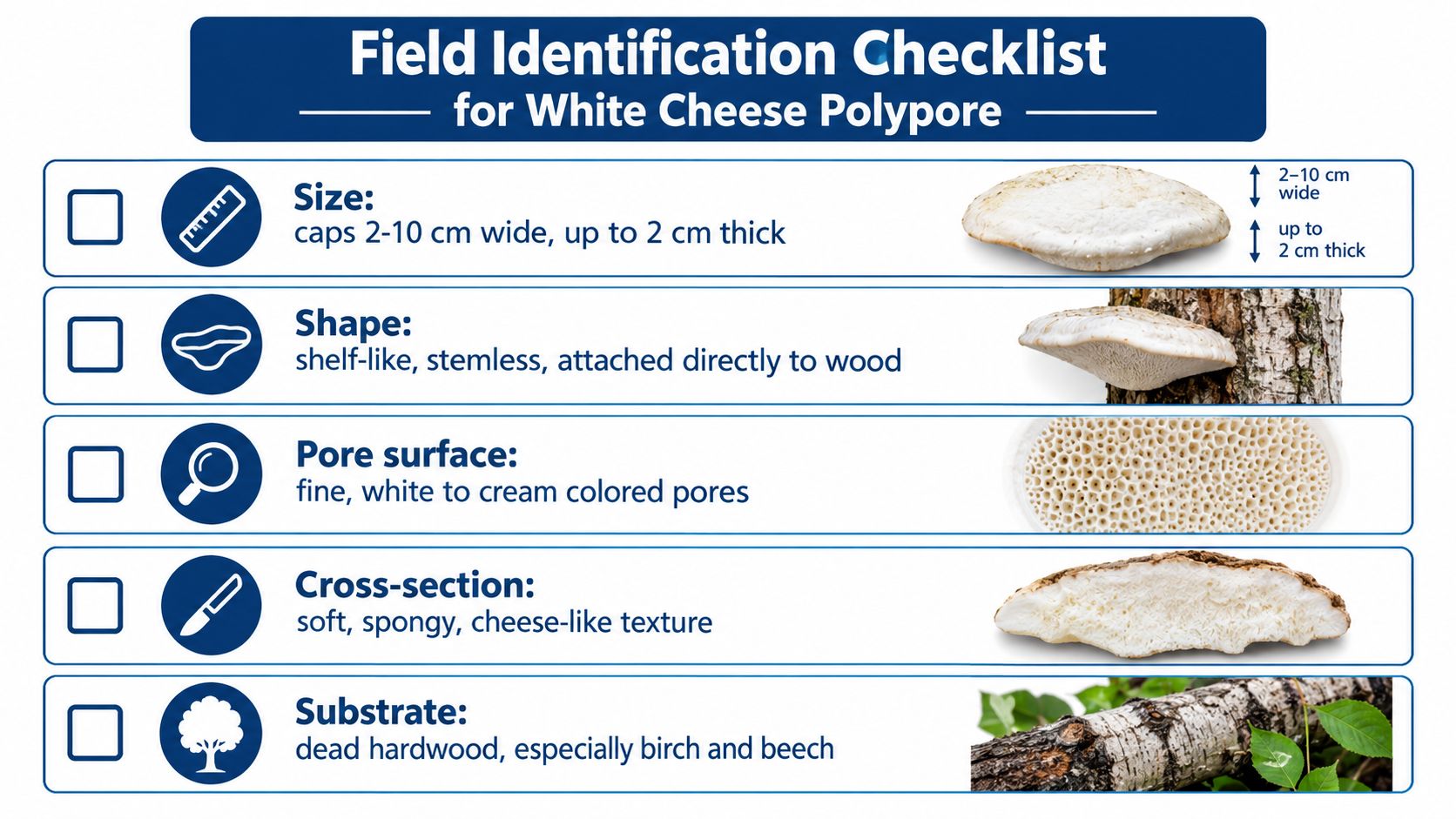
Build your identification from the parts of the specimen you can examine, not from its overall resemblance to an online image. Mature white cheese polypore caps are generally 2–10 cm wide and up to 2 cm thick, with approximately 3–5 pores per millimeter, as described in the previously linked taxonomic account. These are useful reference ranges, not measurements that automatically settle the identification.
A ruler and hand lens make your notes more informative. Measure across the cap, then examine the underside closely enough to distinguish individual pores. If you can't resolve them clearly, record that limitation rather than supplying a count from memory.
Separate fresh traits from aging traits
Fresh material offers the most useful combination of features: a watery texture, white pore surface, fragrant odor, and an appropriate wood substrate. Specimens from dead deciduous wood are more consistent with this species than specimens from conifers, and aging can introduce yellowish or gray tones, as explained in MushroomExpert's identification account.
Young fruiting bodies may be finely hairy and fleshy, while older ones become harder, brittle, and less distinctly white. Don't interpret an old bracket as though it were fresh. Record its condition first, then decide which observations remain useful.
Use the visual checklist as an observation aid, not as a species verdict.
Weigh agreement and disagreement
A confidence assessment doesn't need an invented numerical score. It needs a clear account of what fits, what doesn't, and what you haven't checked.
Evidence status | A useful way to record it |
|---|---|
Supporting | The fresh specimen agrees with the expected combination of features. |
Uncertain | The host tree is unidentified, or the underside wasn't photographed clearly. |
Conflicting | A measured or directly observed feature doesn't fit the proposed identification. |
A specimen can look promising while still lacking decisive evidence. Don't discard a conflicting observation because the cap looks convincing.
A guide to making and understanding a spore print can help you learn another documentation technique. However, collecting a print isn't the same as interpreting it, and a print shouldn't be treated as a stand-alone confirmation. Seek help deciding whether it or microscopy would resolve the particular uncertainty you've encountered.
Look-Alikes and How to Tell Them Apart
“Small white bracket on wood” is a starting description, not a species identification. Other pale polypores, softer crust-like growths, and unrelated bracket fungi can enter the comparison when you rely on a distant view. The first task is to determine which observations distinguish your specimen, rather than compiling a long list of names.
Names you may encounter in comparison graphics include turkey tail, Trametes versicolor, and bitter bracket, Postia stiptica. Treat those as candidates to investigate through appropriate references, not as an exhaustive account of what could occur locally. A short chart can't represent every species, age, or condition you might find.
Compare observations side by side
The most useful comparison starts with the same question for every candidate. Don't compare the cap color of one species with the habitat of another and assume you've made an equivalent assessment.
Observation | What to compare | What leaves the question unresolved |
|---|---|---|
Upper surface | Color, surface texture, and any visible pattern | A photograph showing only the cap |
Underside | Pore appearance and measurable pore density | A shaded or blurred underside |
Flesh | Condition of fresh material | A dried specimen with no earlier notes |
Substrate | Identified tree and wood condition | A guess based only on nearby trees |
Aging | Differences among attached specimens | Assuming every bracket is equally mature |
The comparison graphic provides named examples, but it shouldn't replace direct examination.
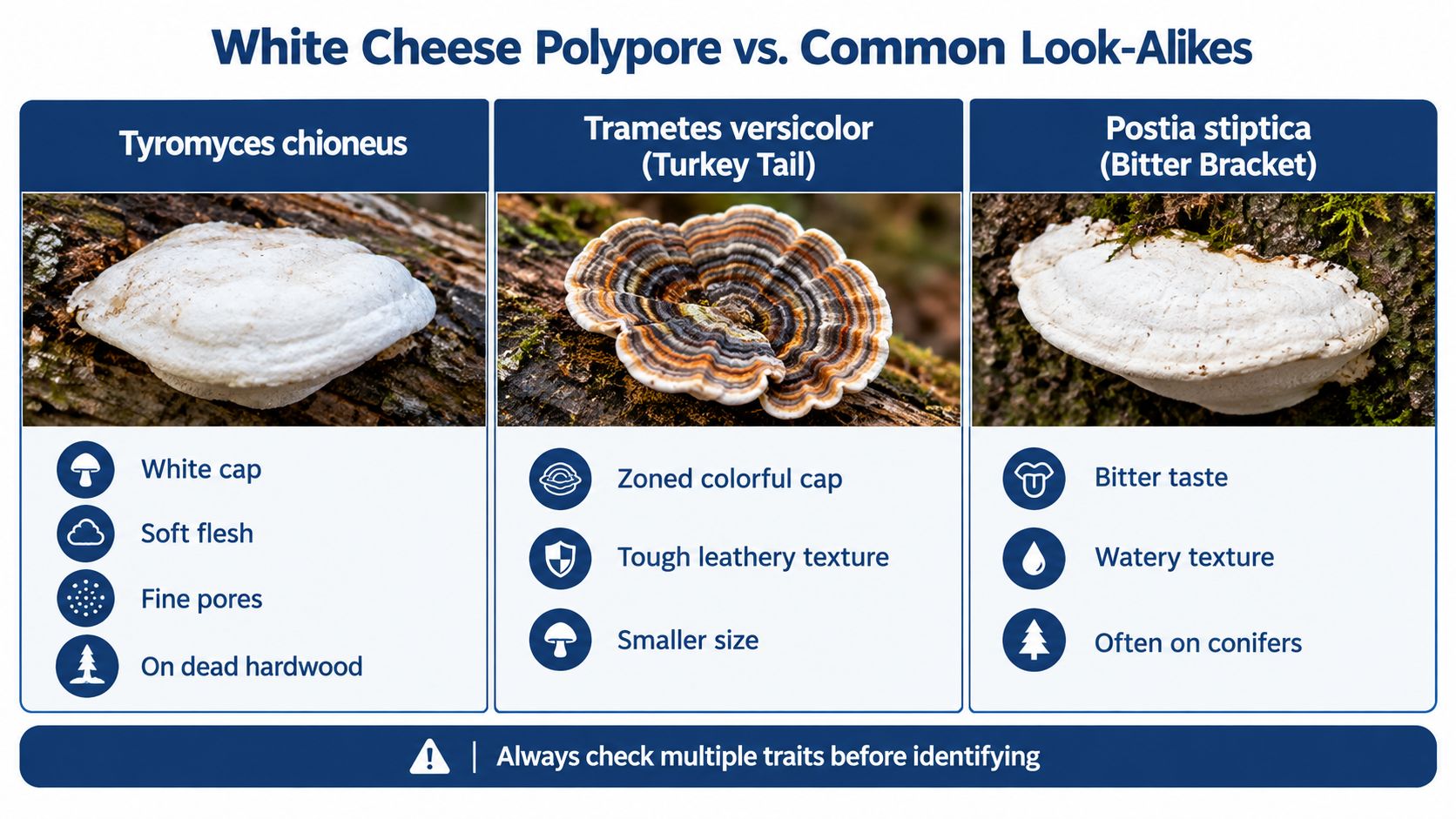
Don't use the graphic's taste description as an instruction to sample an uncertain fungus. For a beginner, tasting isn't a responsible shortcut to a name.
Know when field evidence runs out
Consider an unidentified pale bracket with no underside photograph and no record of its fresh texture. Calling it white cheese polypore would depend mainly on appearance. The appropriate response is to keep the identification tentative and return for the missing observations if possible.
A useful identification explains why the specimen fits and what still prevents you from ruling out alternatives.
Microscopy becomes worth considering when the unresolved distinction depends on microscopic features. Ask an experienced identifier which feature needs examination before preparing slides. A microscope doesn't automatically solve uncertainty, and an unexplained measurement can be as misleading as an unexplained photograph.
For Denver-area hobbyists, local context should remain part of the assessment. A comparison assembled elsewhere may help you ask better questions, but it doesn't establish which alternatives apply to your particular Colorado find.
Where It Grows and the Work It Does in the Forest
A fallen log isn't just a platform holding a mushroom. For white cheese polypore, it's the material the fungus decomposes. The species is a saprotrophic white-rot fungus with a circumpolar distribution across temperate and boreal Asia, Europe, and North America, primarily associated with dead hardwood, especially birch, according to the white cheese polypore ecological account from Out-Grow.
“Saprotrophic” means obtaining nutrients from dead organic material. That's the useful ecological distinction for a beginner: this fungus belongs in an investigation of decaying wood, not a search for mushrooms emerging from soil. Its role is decomposition rather than parasitizing living trees.
What white rot means
Wood contains structural materials, including lignin and cellulose. White cheese polypore breaks down those components, leaving a pale, fibrous residue and helping return carbon and mineral nutrients to the forest ecosystem. “White rot” describes the resulting kind of decay, not only the color of the visible bracket.
The fruiting body is therefore evidence of an ongoing process in the wood. You can learn more from the encounter by examining both the mushroom and the condition of its substrate.
Inspect the wood without overclaiming. Record whether it's firm, fibrous, or breaking apart, but don't assign all visible decay to the bracket you found.
Distinguish the fruiting body from its surroundings. Nearby moss, bark fragments, and other fungal growths deserve separate notes.
Think beyond the photograph. The organism matters as a decomposer even when its bracket isn't especially striking.
For a broader introduction, explore how mushrooms decompose and grow differently from other organisms. That background helps connect a field observation with the larger process occurring inside deadwood.
Use season and host as context
Fruiting has been reported from July through December in at least part of the species' North American range, according to the ecological account linked above. That describes a regional observation window, not a guaranteed schedule for every Colorado woodland.
Occasional records on dead conifers also prevent a rigid hardwood-only rule. Birch remains a strong association, but neither the host nor the month should decide the identification alone.
Choose survey sites thoughtfully: places with decaying woody debris give you something relevant to examine. Record local conditions rather than assuming that a broad continental distribution predicts what you'll find on a particular walk.
Edibility, Medicinal Notes, and Why Online Sources Disagree
Inedible and toxic aren't equivalent terms. A mushroom may be considered unsuitable for food because of its texture or palatability. A claim that it causes poisoning is a different assertion and needs evidence about harm, not merely a repeated description of unpleasant eating.
Online accounts of white cheese polypore are inconsistent: descriptions include inedibility because of texture, claims of severe digestive upset, and statements that toxicity information is unavailable. The Maryland Biodiversity Project species account is a useful identification reference, including age-related changes, but it shouldn't be treated as clinical evidence resolving all competing safety claims.
Ask what each claim actually establishes
A confident-sounding warning can still leave basic questions unanswered. Was the specimen reliably identified? Does the page describe documented poisoning, repeat another website's statement, or discourage eating an unpalatable fungus?
Term or claim | What it means for your decision |
|---|---|
Inedible | Unsuitable as food, without necessarily demonstrating toxicity |
Digestive upset | A claim about an adverse effect that needs supporting evidence |
Toxicity unknown | Insufficient information, not reassurance that consumption is safe |
Uncertain identification | A reason not to consume the specimen |
Those distinctions don't create a reason to experiment. They help you communicate accurately while remaining conservative.
Safety boundary: Don't consume an uncertain specimen. Unpalatability isn't proof of toxicity, and missing toxicity information isn't proof of safety.
Identification and edibility are separate decisions. Even a well-supported species identification doesn't, by itself, establish that a mushroom belongs in a meal.
Keep medicinal interest species-specific
There isn't enough substantiated information in the references discussed here to recommend white cheese polypore for medicinal use. That limitation doesn't prove it has no biologically interesting properties. It means a health recommendation would go beyond the evidence.
For broader context, NexiHerb mushroom insights, from NexiHerb LLC, offers a starting point for exploring functional-mushroom topics. Don't transfer claims about another mushroom to Tyromyces chioneus merely because both are fungi.
Likewise, learning about Fu Ling mushroom is a separate research path, not evidence that this woodland bracket shares its uses. Keep each species attached to its own documentation.
If someone becomes unwell after eating a wild fungus, seek medical or poison-control guidance promptly. Preserve photographs and any remaining specimen for assessment rather than relying on a revised internet identification.
Documenting a Find and Building Real Identification Skills
A useful field record allows another person to understand your encounter without standing beside you. Prepare a notebook, ruler, hand lens, and phone camera before your walk so you're ready to record details while they're available.
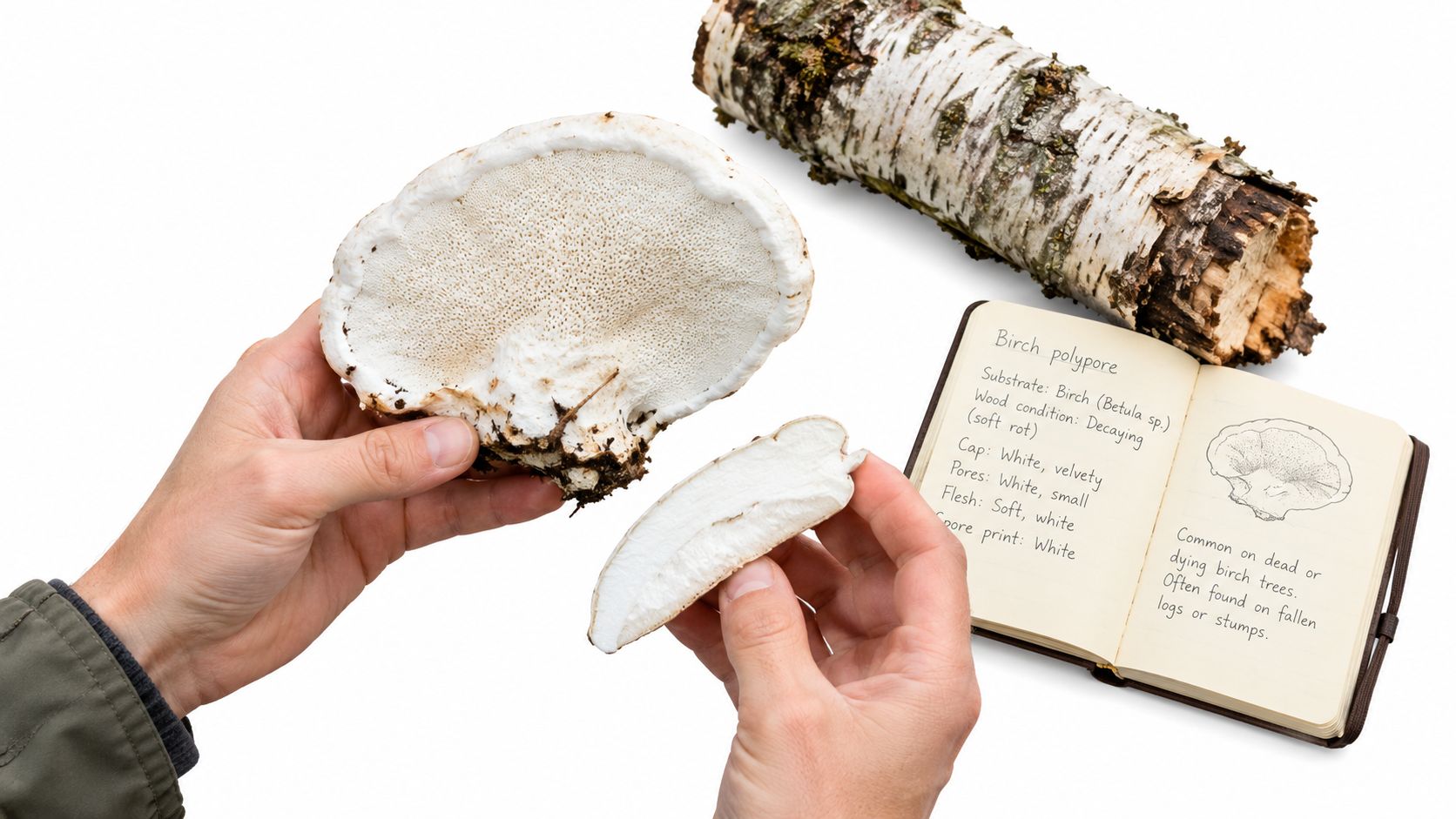
Use this image as a reminder to keep the specimen, its substrate, and your notes connected.
Make the record reproducible
Photograph the cap and pore surface, then document a cross-section if collection is permitted and appropriate. Keep images of the original attachment so a detached piece doesn't lose its context.
Substrate and habitat. Record the tree species if known, whether the wood was dead or living, and the surrounding woodland. Write “unknown hardwood” when that's the limit of your knowledge.
Condition in person. Note texture, apparent maturity, and odor before storage changes what you can observe.
Place and date. Preserve location information at an appropriate level of precision and record when you found it.
Your proposed identification. Separate the name from the observations, and state what remains unresolved.
When sharing an observation on iNaturalist, submit the evidence rather than just the preferred name. Treat suggestions as opportunities to compare reasoning, not as automatic confirmation. If reviewers disagree, ask which additional observation would help distinguish their interpretations.
A video can complement field notes, but your own specimen still needs direct examination.
Choose the next useful action
Don't collect a spore print or prepare a slide to make the record look advanced. First identify the unanswered question, then choose a technique that could answer it.
Your next find doesn't have to end with a definitive label. A carefully documented provisional identification is more valuable than a confident name attached to missing evidence.
Colorado Cultures offers mushroom-growing supplies, essential tools, and classes that help hobbyists build practical mycology skills. Visit Colorado Cultures to explore its classroom calendar or find supplies for learning cultivation alongside your field-observation practice.
Comments