
Grain Bags for Sale: The Complete Buyer’s Guide
You've found a supplier offering grain bags for sale, your culture is ready, and the temptation is to order the cheapest option that arrives soonest. Then a few days after inoculation, the bag turns sour, develops an unexpected color, or stops progressing. The culture gets blamed first, but the grain, moisture level, filter patch, and sterilization history often tell the actual story.
A reliable bag is more than plastic filled with cereal. It's a controlled environment that must survive sterilization, preserve the right moisture balance, exchange gases, and withstand handling during colonization. Colorado's dry climate, temperature swings, and wide range of home setups make those details especially important for hobbyists who may not have commercial production equipment.
Why Grain Bag Selection Matters More Than You Think
A bag can look healthy on the shelf and fail within days of inoculation. The first signs may be wet clumps, a sour smell, or a stalled culture. After handling thousands of colonized and contaminated bags, the pattern is familiar: the culture is often blamed first, while the bag's moisture, filter, seal, and processing history receive less attention.
Bag selection also determines how much of the process you control. Raw bags suit growers who can manage preparation and sterilization consistently. Pre-sterilized bags shift that work to the supplier, making manufacturing quality, packaging, and shipping conditions part of the purchase decision. Commercial agricultural standards provide useful benchmarks, but Colorado hobbyists must also weigh available equipment, dry indoor air, temperature changes, storage space, and lawful project requirements.
A reliable bag has several jobs. Its filter patch must release carbon dioxide while limiting contaminant entry. The film must tolerate sterilization, cooling, handling, and mixing without softening or tearing. The seal must remain intact, and the bag needs enough headspace for gas movement around the grain. A blocked filter, failed seal, or distorted film can turn a clean preparation into a failed cultivation vessel.
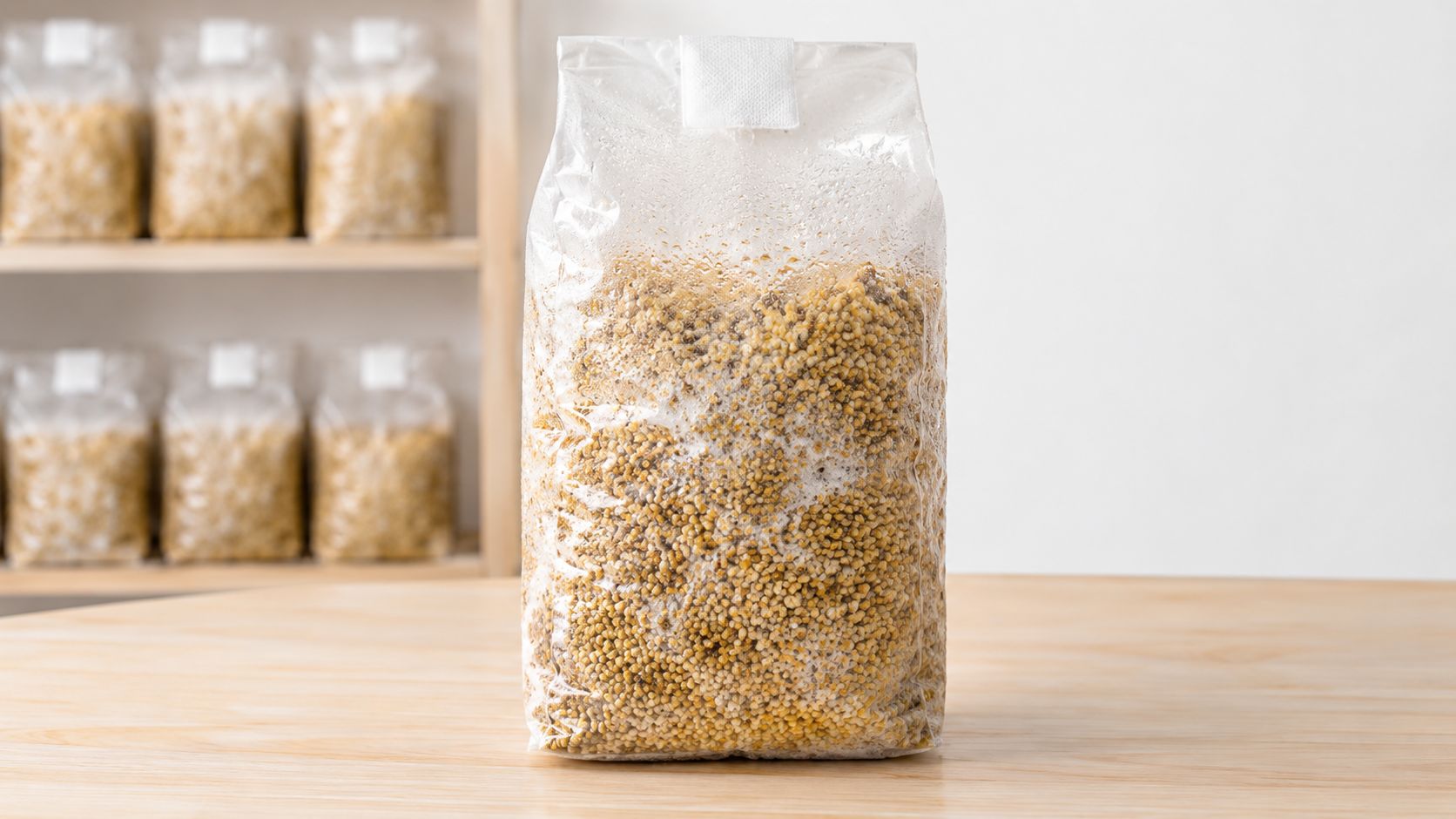
The moisture problem beginners miss
Grain needs water inside the kernels, with no free water pooling at the bottom of the bag. Excess moisture creates oxygen-poor pockets that support bacterial growth. Insufficient moisture leaves kernels hard and slows colonization. Growers commonly use field capacity as the practical target. A firm squeeze should release only a few drops, as described in this practical guide to sterilizing mushroom bags.
Colorado's indoor conditions make preparation errors harder to correct. Dry air and active heating can affect handling and storage, but they cannot remove excess water from sealed grain or restore moisture that was never absorbed. The target condition must be reached before the bag is sterilized. Check for pooled water, uneven hydration, and clumped grain before choosing a supplier or repeating a process.
Why the method remains commercially relevant
Grain spawn became central to commercial mushroom production after Dr. James Sinden developed a sterilized-grain method in 1930. By World War II, grain spawn had prevailed in the United States, and after 1950 it spread into Europe, according to Penn State Extension's history of grain spawn and substrate management.
The commercial logic still applies at hobby scale. Rye, millet, and similar cereals offer many surfaces for mycelium to occupy. Filtered plastic bags make gas exchange, inspection, and handling practical. Modern grain bags for sale reflect decades of refinement that began with commercial spawn production.
Market reporting also indicates continuing demand. One 2025 market report values the global mushroom grain spawn market at USD 285.3 million and projects USD 521.7 million by 2034, with a reported 7.2% CAGR, as detailed in this mushroom grain spawn market overview. For a hobbyist, the actionable question is simpler: does the bag match the intended workflow, moisture target, equipment, and Colorado growing conditions?
Raw Versus Pre-Sterilized Bag Options Explained
Raw bags and pre-sterilized bags serve different workflows. A raw bag is a heat-resistant container intended to be filled and prepared by the buyer. A pre-sterilized bag arrives with the grain already hydrated and processed by the supplier, so the buyer's job begins with inspection, inoculation, and incubation.
That difference affects more than convenience. It changes who controls the most failure-prone stages of preparation. With raw bags, you control the grain choice, hydration, fill level, filter orientation, and sterilization cycle. With pre-sterilized bags, you depend on the supplier's process, packaging, handling, and shipping conditions.
Raw bags suit controlled preparation
Raw bags make sense for growers who already have dependable equipment and a repeatable process. They can be economical when you prepare many bags, and they let you adjust grain type and hydration for a particular project. They also create more opportunities for error.
The critical threshold is true sterilization, not pasteurization. Cultivation guidance recommends processing grain spawn at 15 PSI, approximately 121°C or 250°F, for roughly 90 to 120 minutes, with larger loads often needing the longer end because steam moves more slowly through dense grain. Priorclave's grain sterilization guidance explains that insufficient heat and time can leave bacterial endospores and mold propagules alive in the grain.
A pressure cooker can be appropriate for a small home workflow when used according to its instructions. An autoclave offers a more controlled process for laboratory environments, but equipment alone doesn't guarantee a clean result. The load arrangement, bag size, steam penetration, cooling procedure, and handling after sterilization all matter.
Pre-sterilized bags reduce preparation variables
Pre-sterilized bags are useful when you lack sterilization equipment, have limited workspace, or want to focus on culture handling rather than substrate preparation. They're also practical for a first project because they remove several variables at once.
That convenience comes with a higher purchase price and less control over the recipe. You should inspect the bag on arrival for broken seals, excessive condensation, punctures, unusual odors, and signs that the filter patch was damaged. A supplier should be able to explain the grain used, the sterilization approach, the intended storage conditions, and how to report a damaged shipment.
For Colorado hobbyists, the sensible choice is usually based on workflow rather than ideology. Buy raw bags when you can consistently sterilize them and want process control. Choose pre-sterilized bags when reducing preparation risk and saving time is more valuable than making the substrate yourself. The Colorado guide to sterilizing grain bags can help you assess whether your current equipment and handling routine are suitable.
Choosing the Right Materials and Sizes for Your Project
Start with the project, then select the bag. Many buyers do the opposite. They see a large bag advertised at an attractive price and only later realize that it takes longer to process, is harder to mix, or produces more material than their available containers and workspace can handle.
Step 1 Match the material to the process
For pressure sterilization, look for bags made from a heat-tolerant polymer intended for that use. Polypropylene is widely used in mushroom cultivation because it tolerates high heat and remains sufficiently clear for visual inspection. Don't assume that any transparent plastic bag is suitable. Packaging designed for food storage, vacuum sealing, or ordinary shipping may not be built for a pressure cooker or autoclave cycle.
Check the listing for practical specifications:
Heat tolerance: The supplier should state that the bag is suitable for pressure sterilization if it's sold as a raw preparation bag.
Seal quality: Strong seams reduce the chance of splitting during handling and mixing.
Filter placement: The patch should remain exposed and shouldn't be positioned where grain can cover it.
Plastic clarity: Clear material lets you inspect colonization without opening the container.
Closure design: A reliable seal or fold system helps maintain separation between the prepared grain and the surrounding environment.
A thick bag isn't automatically better. Excessively stiff plastic can make mixing awkward, while thin plastic may tear when you break up colonized grain. The useful standard is compatibility with the intended sterilization and handling routine.
Step 2 Choose a manageable fill volume
Match the fill volume to your inoculation method, available equipment, and expected handling. A smaller bag is easier to inspect, move, mix, and isolate if something goes wrong. A larger bag can reduce packaging overhead, but it places more demand on sterilization, cooling, storage space, and gas exchange.
Leave sufficient headspace rather than filling the bag tightly. Mycelium needs room for air movement, and the filter patch must stay unobstructed. A bag pressed against a wall, stacked filter-to-filter, or folded over the patch may not exchange gases properly even if the plastic and filter are otherwise sound.
Practical rule: Choose the largest bag your equipment can sterilize evenly and your workspace can handle without blocking the filter patch.
Step 3 Inspect before you inoculate
Don't inoculate a bag just because it arrived sealed. Hold it under good light and look for pooled water, severely clumped grain, damaged seams, or a filter patch covered with substrate. If the supplier's storage instructions call for refrigeration or prompt use, follow them rather than leaving the bag in a warm vehicle or near a heater.
Smaller, more manageable bags are often the better learning tool because they let you isolate variables. Once your culture handling and sanitation routine are consistent, you can evaluate whether a larger format saves time. Bigger isn't a quality category. It's a workflow decision.
Selecting Bags for Spawn Versus Laboratory Research
A bag that performs well in a commercial production room may be a poor fit for a Colorado hobbyist's workspace. Spawn production rewards durable film, reliable seals, clear visibility, and a format that can be mixed without excessive handling. Laboratory research places more weight on traceability, repeatable preparation, controlled storage, and records that support comparison between batches.
Raw and pre-sterilized bags also serve different purposes. Raw bags give experienced operators control over substrate preparation and sterilization, while pre-sterilized bags reduce equipment demands and simplify a smaller legal cultivation setup. The trade-off is dependence on the supplier's process, packaging, shelf-life guidance, and batch documentation.
For spawn, expect the bag to be moved, inspected, and mixed during colonization. Seams should tolerate ordinary handling, and the film should make uneven growth, pooled liquid, or visible contamination easy to spot. A filter patch positioned away from common grip points is easier to keep clear during incubation.
Research-oriented work calls for a specification sheet that states the polymer type, filter material, bag dimensions, sterilization method, lot number, sterilization date, packaging method, and storage expectations. Those details let a researcher compare batches instead of treating every shipment as interchangeable. They also show whether the supplier understands the difference between a raw agricultural consumable and a prepared laboratory item.
Compare the operating priorities
Use case | Most important features | Common compromise |
|---|---|---|
Spawn production | Durable seams, clear film, practical handling, accessible filter patch | Documentation may be limited |
Small research projects | Consistent construction, traceable preparation, stable packaging | Higher cost and less flexibility in grain formulation |
Long observation periods | Predictable gas exchange, intact seals, clear labeling, controlled storage | Stricter handling reduces convenience |
Routine home cultivation | Easy inspection, manageable size, straightforward inoculation | Low-priced bags may provide little process information |
Moisture still affects both uses, but see the field capacity guidance above rather than treating bag selection as a substitute for proper substrate preparation.
Keep adjacent lab supplies consistent
A suitable bag can be compromised by careless handling. Use a stable work surface, clean tools, clear labels, and a defined sequence for opening, inoculating, sealing, and storing materials. If cultures or liquid materials are organized alongside grain bags, selecting quality vials from Herbilabs Labware can help with a separate, clearly labeled storage step.
Match the inoculation method to the bag's format. Avoid placing pressure on the filter or seal, and do not improvise around a design you have not tested. The Colorado guide to inoculating sterilized grain bags provides a practical reference for handling sequence and placement.
Set the buying standard by the work. A Colorado hobbyist growing culinary mushrooms may need a transparent, durable pre-sterilized bag with clear storage and inoculation instructions. A researcher recording repeatable observations needs lot-level documentation and consistent preparation. Commercial-style specifications are useful only when they support the actual workflow.
Certification Standards and Usage Guidelines in Colorado
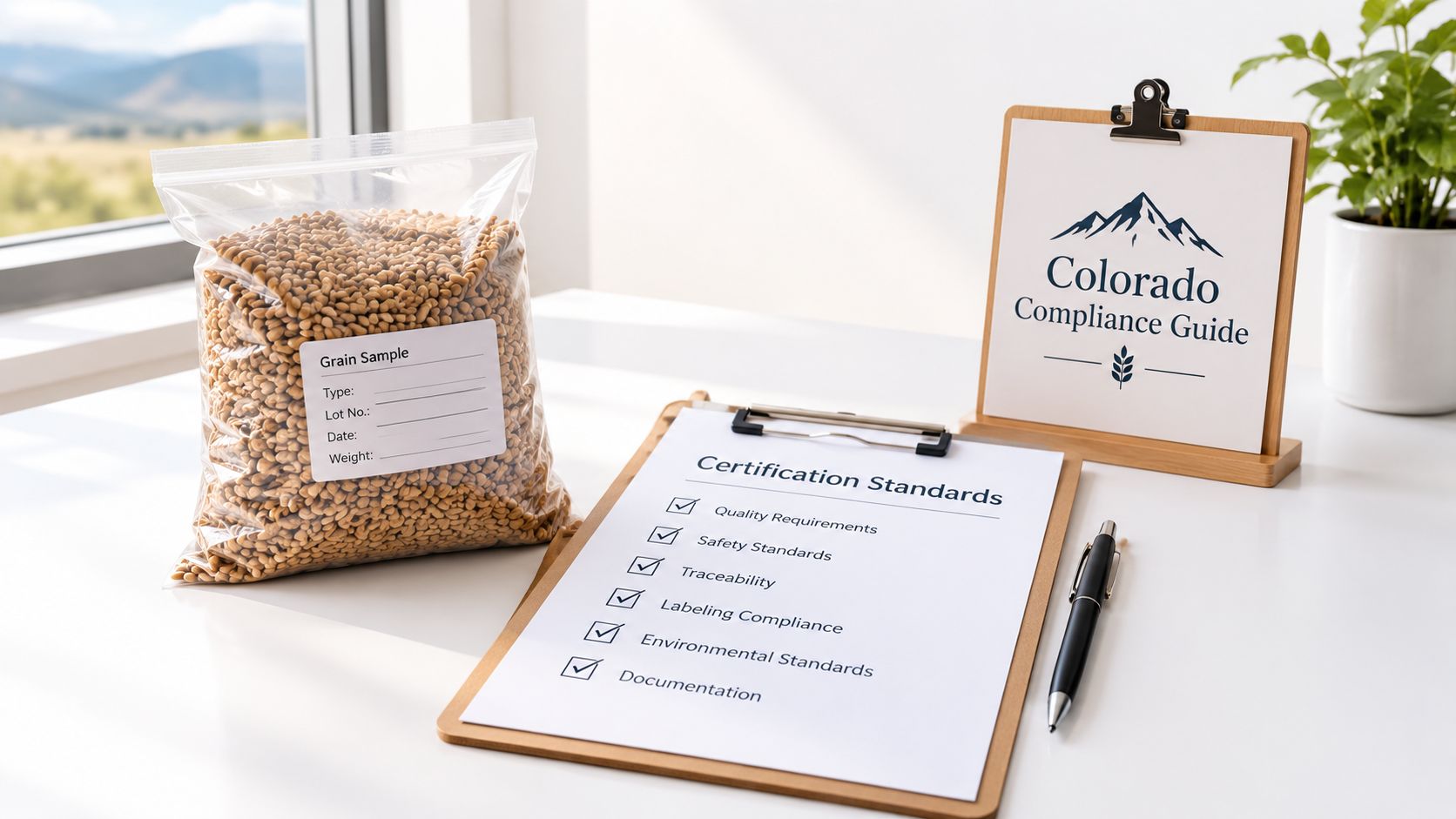
"Certified" can mean different things in different product categories. A label may refer to sterilization, material compatibility, manufacturing controls, laboratory documentation, or a supplier's internal quality claim. Before buying grain bags for sale, ask what the certification covers and whether the supplier can provide a process description or batch information.
Colorado residents should separate two questions. The first is whether the bag was prepared and packaged competently. The second is whether the intended culture, species, and activity are lawful in the buyer's location. Product compliance doesn't make an otherwise restricted activity lawful, and a supplier's marketing language shouldn't be treated as legal advice.
What to request from a supplier
A transparent vendor should be willing to explain the product without hiding behind broad phrases such as “lab quality.” Look for:
Sterilization information: Ask whether the bag is raw or pre-sterilized and what process the supplier uses.
Material details: Confirm that the film and filter are intended for the stated application.
Storage guidance: Follow the supplier's instructions for temperature, light, shipping, and use after arrival.
Damaged-shipment policy: Know what evidence is required if a seam, seal, or filter arrives compromised.
Responsible-use language: Choose products sold for clearly stated legal, educational, culinary, or research purposes.
Don't treat a printed certificate as a substitute for sound handling. Even a properly sterilized bag can be compromised after opening, puncturing, or storing it incorrectly. Keep the filter exposed, avoid unnecessary manipulation, and quarantine anything with an unusual odor, damaged packaging, or unexplained discoloration.
Colorado's rules can change, and local requirements may differ by activity and location. Check current state and local guidance before beginning a project, especially if you're working with organisms, selling products, hosting classes, or operating outside a private hobby setting. For a home grower, responsible practice means staying within the law, labeling materials accurately, keeping them away from children and pets, and disposing of failed cultures safely.
Practical Tips for Ordering and Managing Inventory
Treat grain bags as a controlled supply, not a commodity you can leave anywhere. Before ordering, write down the bag format, grain type, intended use, storage needs, and the date you expect to use it. This simple record prevents a common mistake, buying more bags than your equipment, workspace, or schedule can support.
Build a supplier checklist
Compare suppliers on process transparency rather than price alone. A lower-cost raw bag isn't economical if you lack reliable sterilization equipment. A pre-sterilized bag isn't convenient if it arrives with poor packaging, unclear storage instructions, or no practical response when a shipment is damaged.
Check these points before placing an order:
Lead time: Confirm when the product will ship and whether preparation happens before dispatch.
Packaging: Ask how the bags are protected from punctures and compression.
Shelf guidance: Follow the stated storage period and conditions instead of assuming the product is indefinitely stable.
Batch consistency: If you're repeating a project, record the supplier, grain format, lot details, and observations.
Order size: Buy enough to support your workflow, but don't create a storage problem.
Bulk ordering can make sense once you've tested a product and understand how quickly you'll use it. Small orders are safer while comparing bag designs, grain hydration, and supplier communication. For broader purchasing decisions, this guide to bulk and wholesale mycology items provides a useful starting point.
Store empty raw bags in a clean, dry area away from sharp tools, sunlight, and unnecessary compression. Store pre-sterilized bags according to the supplier's instructions, and inspect the packaging before placing them into your working area. If you manage several cultures or related materials, a basic inventory system can help. The principles in this resource on how to track lab reagents with Verbex also apply to labeling, stock rotation, and recording what was used.
A reliable record turns contamination into information. Note the supplier, bag format, grain condition, storage history, inoculation date, and visible changes. Over time, that record will show whether a problem follows a particular bag design, preparation batch, or handling step.
Colorado Cultures offers sterilized grain bags, substrates, all-in-one grow bags, grow kits, and related mycology supplies through its Lakewood and Englewood stores and online ordering. If you're comparing grain bags for sale or need practical guidance for a legal home or research project, visit Colorado Cultures to review available supplies and support resources.
Comments