
What Are Chanterelles? Identification and Safe Foraging
If a mushroom is orange, smells fruity, and grows in the woods, does that make it a chanterelle? No, and that gap between a familiar appearance and a reliable identification is where beginners need the most help.
Chanterelles are a group of wild mushrooms associated with living trees, not a single orange species. Understanding that definition makes their habitat, identification, and unusual cultivation requirements much easier to grasp.
What Chanterelles Are and Why Forests Matter
Say you notice a yellow mushroom pushing through leaves beside a forest trail. The part you can see is a fruiting body, the reproductive structure of a fungus whose threadlike network, called mycelium, extends underground.
Picking out that visible mushroom tells you only part of the story. To understand what chanterelles are, you also need to consider the tree roots beneath your feet.
The Cantharellus overview describes chanterelles as mycorrhizal fungi associated with trees; the broader common-name group includes mushrooms in Cantharellus and Craterellus, with representatives across Africa, Europe, Asia, North America, South America, and Australia.
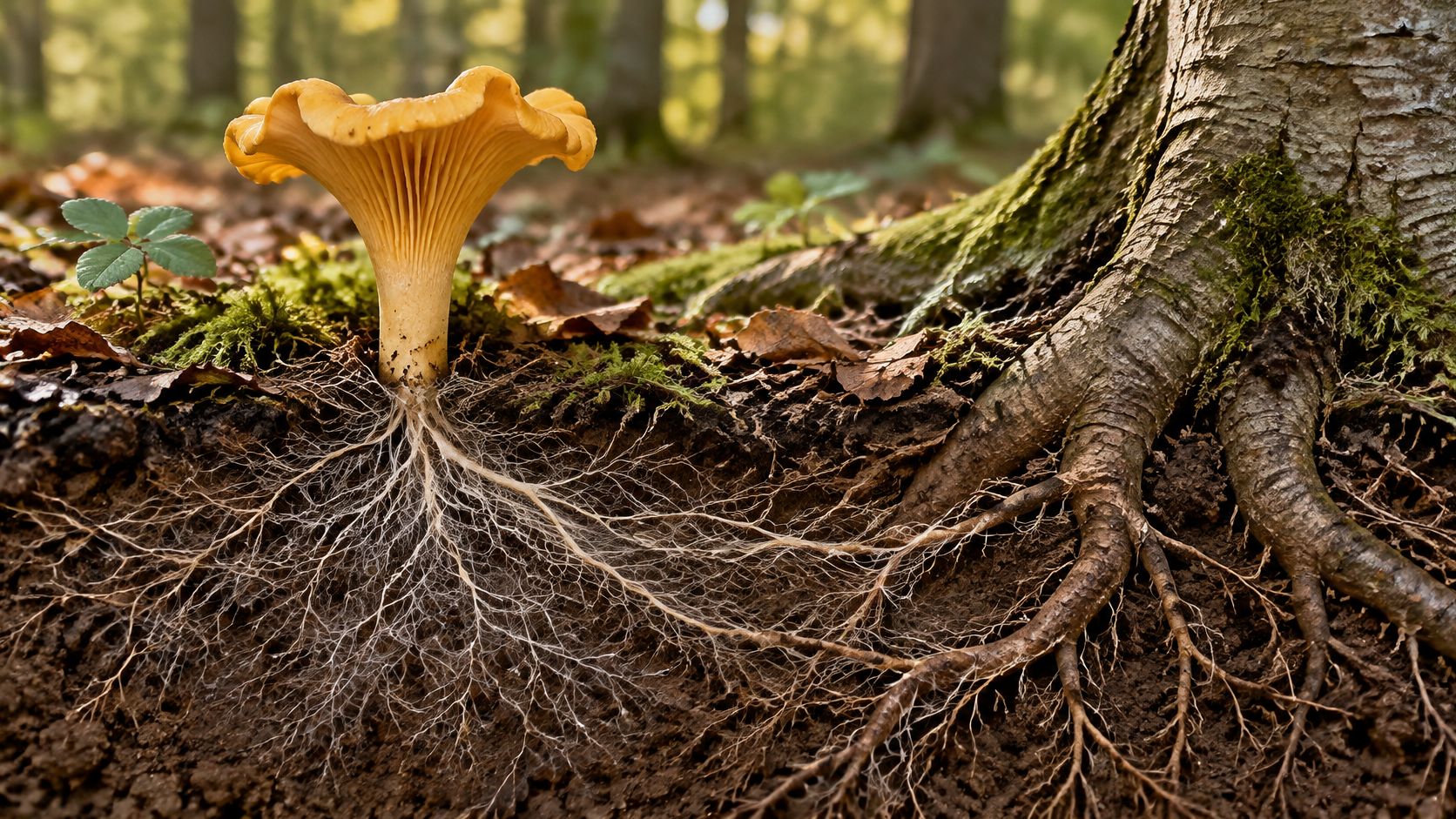
An underground trading partnership
Chanterelles are ectomycorrhizal. That technical word describes a relationship in which fungal threads surround the fine roots of a compatible tree and help it obtain water and mineral nutrients.
The tree supplies carbohydrates made through photosynthesis. Think of this as an underground trading partnership: the fungus gains a source of energy, while the tree gains access to resources through the fungal network.
That relationship distinguishes chanterelles from mushrooms that obtain food by breaking down dead material. A chanterelle isn't using a fallen branch as its meal, and a pile of rich organic matter doesn't automatically provide what it needs.
Habitat clue: Look beyond the mushroom. The living trees around it are part of its biology, not just scenery.
A group, not a universal species
The word chanterelle works more like a group name than a precise identification. Different members associate with conifers, hardwoods, or both, so a familiar-looking mushroom may have a different identity in another forest.
The golden chanterelle, Cantharellus cibarius, is the best-known European example. Its familiar shape shouldn't lead you to assume that every golden, funnel-shaped mushroom elsewhere belongs to that species.
The useful starting point is simple: chanterelles are forest partners. Their dependence on compatible trees helps explain why location and weather matter, why apparently suitable patches can remain empty, and why ordinary mushroom-growing methods don't translate neatly to them.
Field Checks and Look-Alikes to Rule Out
Color isn't a safe identification test. Toxic jack-o'-lantern mushrooms can also be orange and pleasantly scented, so a promising color and smell aren't enough to justify collecting one for dinner.
The chanterelle presentation hosted by Oregon State University Extension emphasizes useful differences in growth habit and underside structure, and describes long-term harvesting work that found no evidence that plucking suppressed chanterelle fruiting. That corrects a common distraction: cut versus pull isn't the main sustainability question, and neither method makes a misidentified mushroom safe.
Five checks before collecting
Start with the growth habit. Look for mushrooms growing singly or scattered on soil near living trees. Dense clusters attached to wood are a warning sign for jack-o'-lanterns; inspect the point of attachment rather than judging from above.
Examine the underside. Typical chanterelles have blunt, forked, vein-like ridges, often called false gills, that continue down the stem. Thin, distinct blades are true gills, not the expected chanterelle structure.
Follow the cap into the stem. Look for an irregular funnel shape and a continuous transition between these parts. Treat this as supporting evidence, not a pass that overrides contradictory features.
Use smell only as a supporting clue. A fruity or apricot-like scent may fit a chanterelle, but a pleasant odor doesn't exclude a toxic look-alike. Also, firmness describes texture, not smell.
Get regional confirmation. Photograph the cap, underside, complete stem, and surrounding habitat, then consult someone experienced with local mushrooms. A picture of the cap alone leaves too much unseen.
Use this visual checklist as a reminder, not as permission to eat a find.
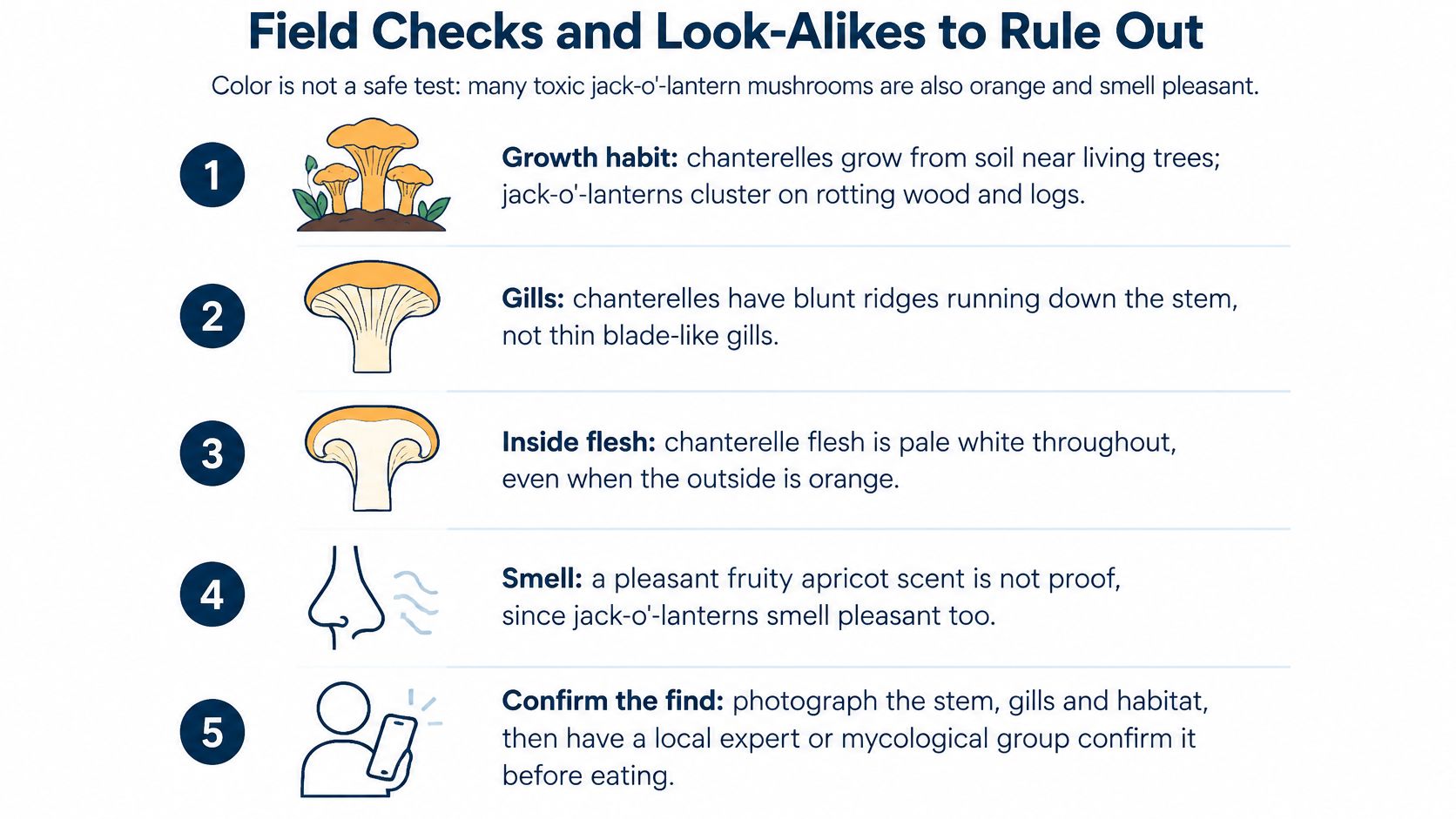
Chanterelle and jack-o'-lantern side by side
Feature | Chanterelle | Jack-o'-lantern |
|---|---|---|
Growth habit | Single or scattered on soil near living trees | Dense clusters on wood |
Gills | Blunt, forked, vein-like false gills merging into the cap | Thin, blade-like true gills |
Cap and stem | Irregular funnel shape with a continuous transition between cap and stem | Cap shape alone doesn't rule it out; check true gills and wood attachment |
Colour | Yellow to golden, orange in some species | Orange, often close to chanterelle colour |
Smell | Fruity, sometimes apricot-like; flesh often firm | Can also smell pleasant, so scent isn't a separating trait |
Where it fruits | Forest soil near host trees | Wood, including logs and stumps |
For another example of why common names require careful interpretation, our yellow-foot mushroom guide offers a related identification topic to study.
If any trait doesn't fit, or you can't obtain a confident identification, leave the mushroom in the forest and don't eat it.
Chanterelle Types by Region and Host
Chanterelle | Region | Typical host trees | Cap colour |
|---|---|---|---|
Golden chanterelle (Cantharellus cibarius) | Europe, Scandinavia to Mediterranean | Conifers and hardwoods | Yellow to golden |
Japanese golden chanterelle (Cantharellus anzutake) | Japan | Pine and oak in laboratory trials | Golden |
North American Cantharellus species | North America | Species-specific associations with conifers, hardwoods, or both | Yellow to orange |
Black trumpet (Craterellus cornucopioides) | Europe and North America | Hardwood and mixed forest | Dark grey to black |
Chanterelle types by region and host aren't interchangeable identification labels. The table gives you useful comparisons, but it isn't a substitute for a regional key.
The University of Florida extension review notes approximately 31 described North American Cantharellus species and explains that molecular evidence restricts C. cibarius to Europe, despite its historical use for North American collections. In other words, an older book may use a familiar European name for a mushroom that specialists now recognize as something else.
Why the names need context
The European golden chanterelle represents the familiar yellow mushroom many people first encounter in books. North American golden chanterelles can resemble it without sharing its exact species identity, so matching an illustration doesn't settle the name.
The Japanese golden chanterelle also has a distinct research history: a 2019 laboratory study published in Mycorrhiza produced small, spore-bearing Cantharellus anzutake fruit bodies with inoculated pine seedlings and transferred established mycorrhizae to oak seedlings. Those are experimental host associations, not instructions to plant either tree and expect a harvest.
Black trumpets provide a different lesson. A dark, funnel-shaped chanterelle relative doesn't match the beginner's assumption that every member of the group must be golden.
A common name helps you begin a search. A regional species identification tells you what you've actually found.
For a Colorado collection, record the region and nearby trees rather than importing a European name from a photograph. If you don't know the tree, photograph its bark, foliage, and cones or acorns when present.
Host information can strengthen an identification, but it doesn't prove which tree's roots support a mushroom. Give a local specialist the observations you can document, and keep uncertain details clearly marked as uncertain.
Where to Look, When to Go and How to Get a Find Confirmed
Begin with a forest, not a calendar. Search mossy or leafy ground near living trees, inspecting the soil rather than treating every mushroom on a fallen log as a potential chanterelle.
Forest age, stand structure, and disturbance can affect a patch. A place that looks green from a trail may still differ substantially from another site in tree composition, soil conditions, or recent disturbance.
Use the scene below as a reminder to study the surroundings as carefully as the mushroom.
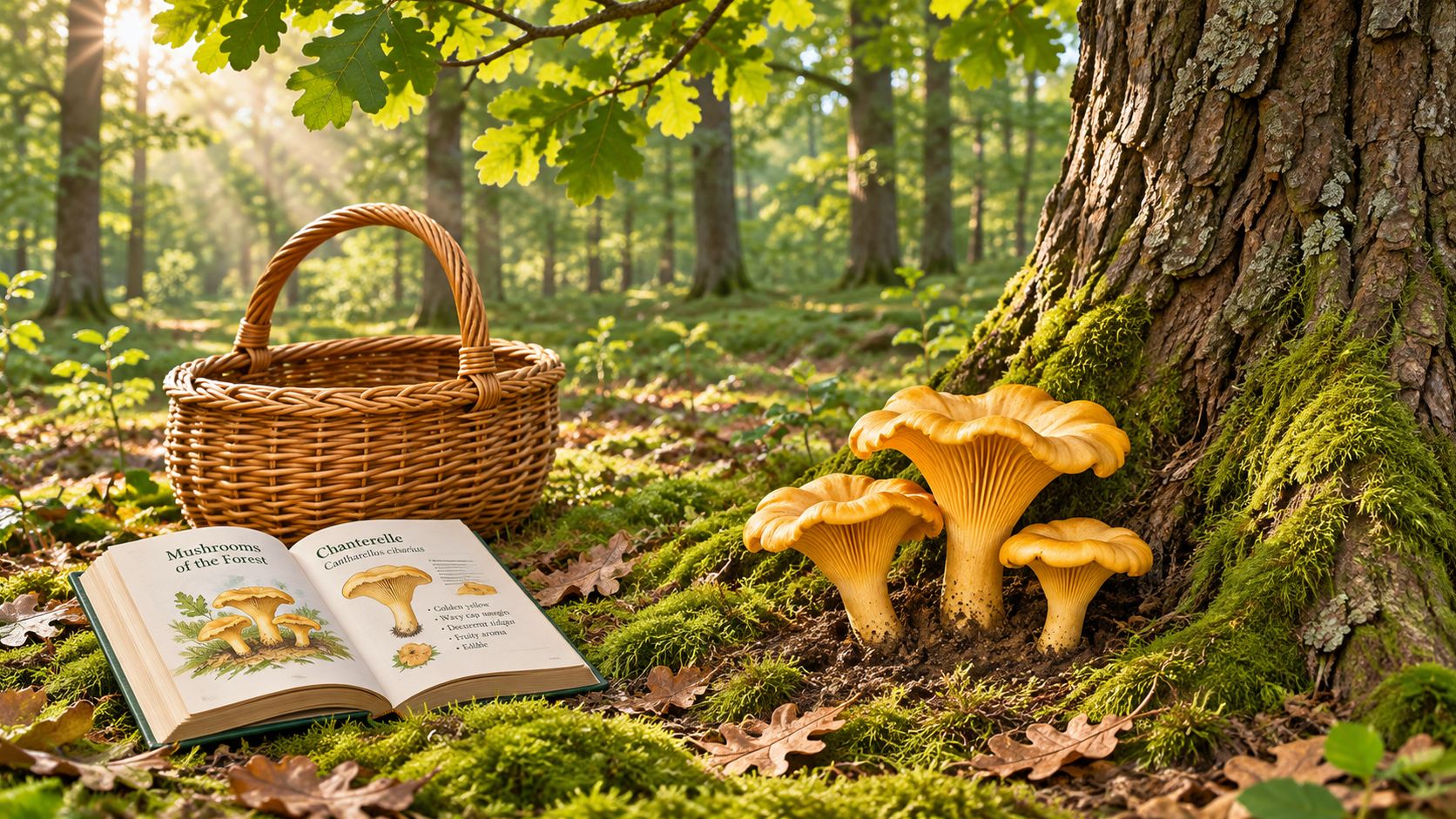
Choose conditions, then a route
Fruiting commonly occurs in late summer and autumn, with local timing shaped by rainfall, temperature, latitude, and tree associations; the Cantharellus cibarius species account provides seasonal context for the European golden chanterelle. Don't turn that broad pattern into a fixed Colorado appointment.
Recent rain can make a scouting trip more promising, but wet ground doesn't guarantee mushrooms. Check local observations and regional guidance before driving to a distant trailhead.
Choose a route you can follow safely and leave enough daylight to examine finds without rushing. If you're planning a California outing, HYDAWAY's hiking resource lets you find Sonoma trail maps and tips; route information helps with trip planning, but it doesn't establish permission to collect mushrooms.
Before heading out, learn the local look-alikes as deliberately as you learn your target. Knowing what would make you reject a specimen is more useful than memorizing only the appealing features of a chanterelle.
Make a useful field record
Carry a phone or camera, a notebook, a regional field guide, and a hand lens. Photograph the mushroom before moving it so the original growth habit remains visible.
Build a record that someone else can assess:
Location and date: Record the general area, elevation if available, and recent conditions. Keep precise patch locations private when sharing publicly.
Habitat: Note the forest type, nearby trees, ground cover, and whether the mushroom appears attached to soil or wood.
Whole mushroom: Capture the cap from above, the underside in focus, and the full stem and base.
Your uncertainty: Write down anything that doesn't fit, rather than omitting it to make the identification seem stronger.
Don't combine several similar-looking mushrooms into a single identification request. A mixed collection may contain more than one species.
A field demonstration can help you recognize which structures deserve a closer photograph.
Verify identity and collecting permission separately
Send clear images and habitat notes to a regional mycological society or university extension office, and ask whether they can assess the find. Some specimens require in-person examination or microscopic work, so an inconclusive photo response isn't a reason to guess.
For guided learning, explore our mushroom identification class information. Practice describing structures accurately before treating foraging as food collection.
Check the land manager's current collecting rules before removing anything, and obtain permission on private property. A public hiking trail doesn't automatically mean mushroom harvesting is allowed.
Before dinner: You need both a defensible identification and permission to collect. Neither substitutes for the other.
Know the species, resolve conflicting features, and eat only a collection whose identity has been confidently established.
Cooking With Chanterelles
Chanterelles are prized for their fruity aroma and firm texture. Once you have a verified edible collection, simple cooking lets those qualities stand out without burying them under strong seasoning.
Brush away soil and leaf fragments with a soft brush, then trim dirty or damaged stem ends. If grit remains, rinse briefly and dry promptly rather than leaving the mushrooms soaking.
From clean mushrooms to a browned pan
Leave small specimens whole and slice larger ones into pieces that cook evenly. Put them in a wide pan over medium-high heat, allowing released moisture to evaporate before adding butter.
Keep the pan spacious enough that you can move the pieces easily. Once the liquid has cooked away, add butter and finely chopped shallot or garlic, lowering the heat as needed to prevent scorching.
Finish: Add salt and thyme near the end, then taste before adding richer ingredients.
Pair with eggs: Fold cooked chanterelles into softly scrambled eggs.
Build a sauce: Add cream to the cooked mushrooms for pasta or a spoonable sauce.
Fill ravioli: Cool chopped, cooked mushrooms before combining them with ricotta and aged cheese.
Risotto is another practical pairing. For a pantry-based version, Saporia's 210g organic risotto pack provides a porcini risotto base to which you can add separately cooked, verified chanterelles.
Keep fresh and dried methods distinct
Dried mushrooms need a different preparation sequence from fresh ones. Our dried chanterelle mushroom guide addresses that option rather than treating dried pieces as a direct pan-for-pan replacement.
Cook wild mushrooms thoroughly, and never serve an unverified find. Heat isn't a remedy for mistaken identification.
Why Chanterelles Resist Home Cultivation
Chanterelles can't be treated like oyster mushrooms in a grow bag. Buying grain, adding a culture, and waiting for a flush doesn't reproduce the conditions needed for dependable chanterelle production.
The University of Kentucky guide to truffles and other edible mycorrhizal mushrooms describes the continuing difficulty of commercial production despite decades of work, alongside successful greenhouse fruiting with mycorrhizal seedlings and controlled laboratory fruiting of Cantharellus anzutake. The distinction is research-stage symbiotic cultivation versus practical home production, not a matter of possibility versus impossibility.
A successful experiment demonstrates that fruiting can happen under particular conditions. It doesn't establish a repeatable household method or a predictable commercial harvest.
Colonization isn't the finish line
For a hobbyist, the challenge isn't just getting fungal growth. Establishing a functioning association with a compatible seedling is a separate task from keeping a culture alive.
Even after that association forms, the fungus must produce fruiting bodies. Reliable, abundant fruiting remains the bottleneck, so an inoculated tree shouldn't be sold or understood as a guaranteed future patch.
Treat a chanterelle cultivation attempt as an experiment with an uncertain outcome, not as a delayed grow kit.
Before spending money, ask what a proposed method demonstrates:
Evidence of partnership: Does it verify mycorrhizae on living roots, or merely show fungal material near a seedling?
Evidence of fruiting: Does it document mushrooms, rather than only growth in a container?
Honest expectations: Does it acknowledge uncertainty instead of promising a harvest after planting?
For Colorado beginners who want to learn routine cultivation, an appropriate wood-decomposing gourmet species offers a more practical starting point. Chanterelles remain valuable subjects for patient ecological study, but adding more substrate or improving sterile technique alone won't solve their distinct biological requirements.
Colorado Cultures offers gourmet mushroom-growing supplies, practical education, and classes for people building their mycology skills. Visit Colorado Cultures to explore learning opportunities and choose a realistic cultivation project while you develop your field-identification knowledge.
Comments