
Yellow Foot Mushroom: How to Identify and Eat Safely
You're kneeling in damp moss under spruce, and a cluster of small brown funnels is right in front of your boot. The stems look yellow. A friend already called them edible. That single word is the mistake that gets beginners into trouble, because a yellow stem is only one clue, and a correct name still doesn't tell you whether this particular specimen is fit to cook.
A careful identification checks several features together, then a second decision about condition, then a third about whether you're even allowed to pick here. Sight alone can't confirm a species, a spore print, or a hidden larva. What it can do is give you a repeatable order so you don't harvest on colour.
Identifying Yellow Foot Mushrooms in the Field
The useful scene is a tight cluster in moss, needle duff, or a soft, crumbling log under conifers. Caps are small funnels, not buttons and not broad umbrellas. Work one feature at a time, and don't let the yellow stem talk you out of the rest.
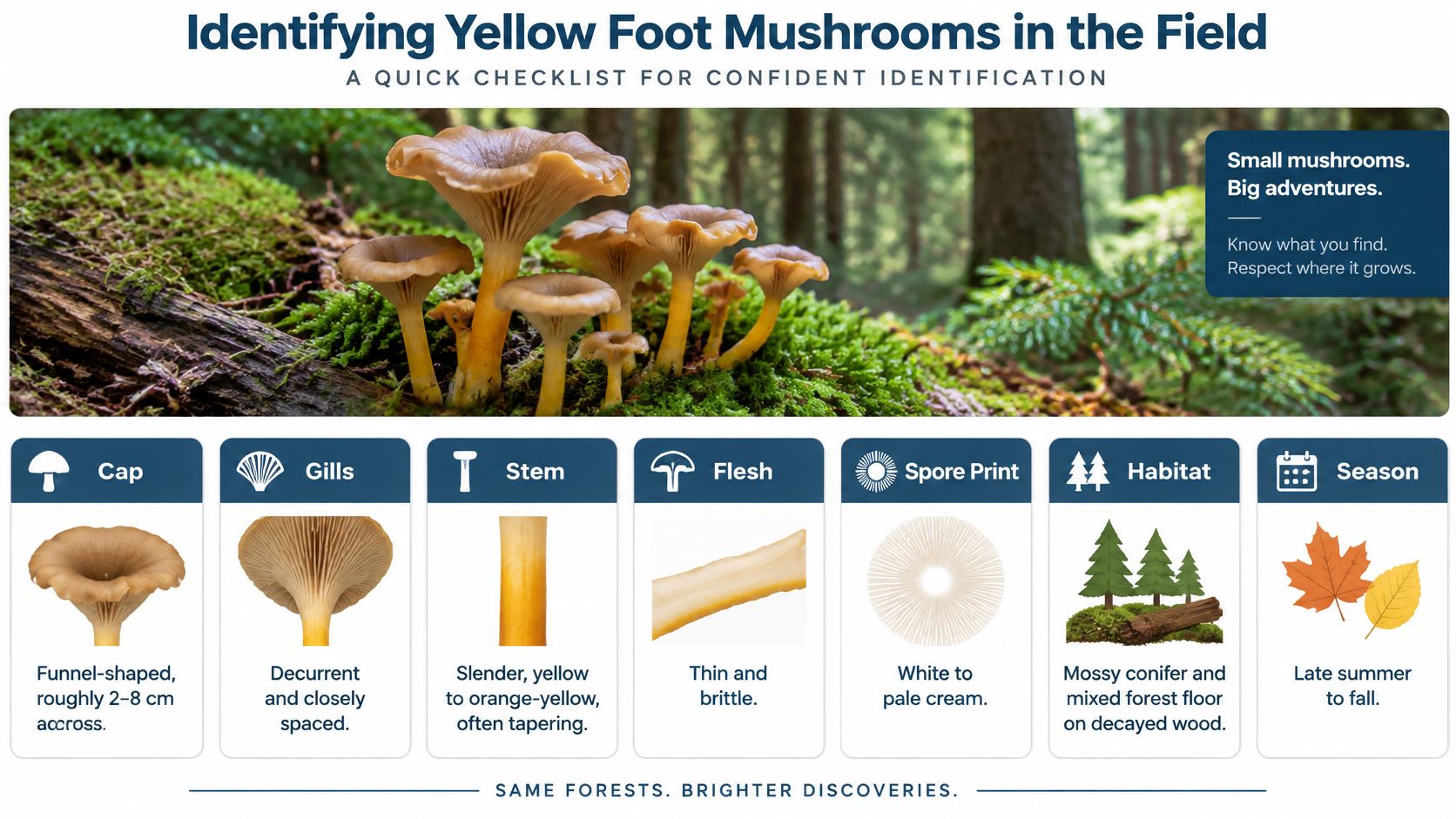
Feature | What to Look For | Why It Matters |
|---|---|---|
Cap | Brown to grey-brown funnel, darker toward the center, with a wavy margin that often splits as it matures | Narrows the search to funnel forms |
Underside | Blunt, forked, wrinkled false gills or folds, grey to pale yellow | True sharp gills point to a different species |
Stem | Hollow, fibrous, yellow to orange-yellow, often fused at base | Hollowness is checked by cutting the stem lengthwise |
Flesh | Thin, fragile, dries quickly | Thick, firm flesh suggests another species |
Growth | Groups in moss, duff or wood under conifers or beech | Open-grass solitary finds point elsewhere |
Season | Usually August to November | Off-season finds deserve extra scrutiny |
Why one feature is never enough
Colour shifts with rain, age, and camera white balance. Plenty of yellow and orange fungi photograph like a yellow foot mushroom and aren't one. The cap should be a brown to grey-brown funnel. The underside should show blunt false gills or folds that fork, wrinkle, and run a short way down the stem, grey to pale yellow, not the knife-edge plates of most gilled mushrooms. The stem should be fibrous, yellow to orange-yellow, and often fused with neighbors at the base. Flesh is thin and tears easily, and it fades as it dries.
Cut one stem lengthwise with a pocket knife. A hollow tube is what you're looking for. A stuffed or chambered core is a stop. Then turn a cap over and use a 10x hand lens on the folds. True gills are thin blades you can separate. False gills are ridges of the cap itself.
Practical rule: Confirm at least three features before any harvest decision, and photograph the cluster base and the underside for expert review.
A spore print on white paper or foil, left overnight under a cup, should come out white to pale cream. That test happens at home, not on the trail, so it never replaces the field checklist.
Names that send people to the wrong genus
Search both yellow foot mushroom and the older synonym Cantharellus tubaeformis. Field guides also say funnel chanterelle, trumpet chanterelle, winter chanterelle, or winter mushroom. Elias Fries described it in 1821 in Cantharellus, and the name in current use, Craterellus tubaeformis, dates to 1888, as recorded in the NCBI taxonomy record. The common name sounds like a true chanterelle. The genus doesn't. A name on a label is not an identity test.
Yellow Foot Look-Alikes and How to Tell Them Apart
Most mix-ups start on the underside and on how the cluster is attached, not on how orange the photo looks. The mushroom you least want to confuse with a yellow stem is jack-o'-lantern (Omphalotus), which is orange, has true gills, and grows in dense clusters on wood. It causes severe gastrointestinal distress. Sort every candidate in the same order: underside first, stem second, substrate third.
Look-Alike | Key Difference | Safety Note |
|---|---|---|
Golden chanterelle (Cantharellus species) | True forked ridges, not false gills; more uniform orange-yellow | Edible, but a gill-type mistake is easy to make |
False chanterelle (Hygrophoropsis aurantiaca) | Orange cap, true thin gills, grows on wood | Not deadly; can cause stomach upset |
Jack-o'-lantern (Omphalotus species) | Orange, true gills, clustered on wood | Toxic; causes severe gastrointestinal distress |
Black trumpet (Craterellus cornucopioides) | Dark grey to black, no yellow stem | Edible; not a colour match |
Any unidentified yellow-stemmed fungus | Fails one or more checklist features | Do not eat without expert verification |
Sort underside, then stem, then wood
Golden chanterelle (Cantharellus) is the flattering mistake. The whole fruiting body tends toward a more uniform orange-yellow, and the underside is a set of true forked ridges rather than the duller, wrinkled folds of a yellow foot. Both can be edible, which is exactly why a gill-type error feels harmless until the next species in the basket isn't.
False chanterelle (Hygrophoropsis aurantiaca) has an orange cap and true, thin, crowded gills, and it grows on wood. It isn't regarded as deadly. It can still upset a stomach, so "not poisonous" is not the same as "fine in the pan."
Jack-o'-lantern fails the yellow-foot checklist on purpose if you look. True gills, orange flesh through the cluster, and a woody substrate. Leave any wood-clustered orange mushroom you can't separate from it.
Black trumpet (Craterellus cornucopioides) shares the genus and the funnel habit, and it's edible, but the fruiting body is dark grey to black and there's no yellow stem. A colour match fails immediately. People still bag them together because both lack ordinary gills. That's a labelling problem, not a safety pass.
Other funnel fungi, including some Clitocybe, can glance-match a brown cap and then show true gills under the lens. If you want a sense of how different a toothed wood fungus looks from a ridged funnel, the bear's tooth mushroom is a useful contrast, not a substitute.
Any yellow-stemmed fungus that misses even one checklist feature stays in the woods until someone who handles local collections has seen the specimen or clear photos of cap, underside, cut stem, and substrate.
Edibility and When to Discard a Find
People treat "edible" as a verdict. It isn't. Identifying the species and judging whether this fruiting body is safe food are two different questions, and a correct name doesn't rescue a spoiled mushroom.
A 2025 peer-reviewed review describes Craterellus tubaeformis as growing mainly in mossy, moist, acidic conifer and beech forests and fruiting primarily from August through November, sometimes beginning in July or extending later, according to that peer-reviewed review. The same discussion is blunt about method. A hollow yellow stem plus forked ridges is not a protocol. You still have to match the brown-to-gray funnel cap, the blunt false gills or folds, and the hollow yellow-to-orange stem, and you still have to weigh habitat, maturity, and specimen condition.
Condition decides the basket
Specimen Condition | Decision | Reason |
|---|---|---|
Firm, dry, correctly identified, young | Harvest and cook thoroughly | Lowest spoilage risk |
Waterlogged, slimy or fermenting | Discard | Spoilage makes safety unknowable |
Insect-filled or larvae present | Discard | Damage hides features and degrades quality |
Old, shrivelled or decomposing | Discard | Maturity changes the features |
Any uncertain identification | Do not eat | Resemblance alone is not a guarantee |
Firm, dry, young, and fully matched is the only row that moves toward the kitchen, and even then the mushrooms get cooked through, not nibbled raw. Waterlogged, slimy, or sour-smelling specimens go back to the duff or into the trash. Once tissue is fermenting, you can't see whether you're tasting the mushroom or the breakdown. Insect tunnels and larvae are a discard, not a trimming project. Chewed flesh hides the folds and the hollow stem you were using as evidence. Old, shrivelled, or collapsing fruiting bodies change colour and shape, so the checklist you trusted on a fresh cap no longer applies. Any uncertainty means you don't eat it.
"No commonly reported toxic lookalike" does not mean every yellow-stemmed mushroom is safe. Mixed baskets are the quiet failure mode. One odd cap in a pile of good ones is enough to retire the whole pile.
A small first meal, then a pause
For a species you've personally confirmed for the first time, cook a small portion and wait a full day before eating more. Individual tolerance isn't something a field guide can promise. If you're unsure, take the photos and, if the land rules allow, a specimen to a county extension office or a regional mycological society. A grower or a supply shop can't validate a wild find. That check belongs with someone who can look at the actual mushroom and the local flora.
Rocky Mountain conditions add their own noise. Dry spells bleach caps, and a sudden soak makes healthy tissue look waterlogged. Use the condition table anyway. A Colorado checklist is still the same features, read against montane conifer moss and decayed wood, not against a Scandinavian spruce plantation or an eastern hardwood guide copied word for word.
Where and When to Search for Yellow Foot
Look on moist, mossy, slightly acidic forest floors under conifers, and also under beech where that tree is part of the stand. Fruiting bodies show in moss, in needle duff, and on well-decayed coarse woody debris. Yellow foot is a mycorrhizal partner of living trees, so a pretty forest can produce nothing in a dry year. No amount of walking invents a crop the mycelium didn't fruit.
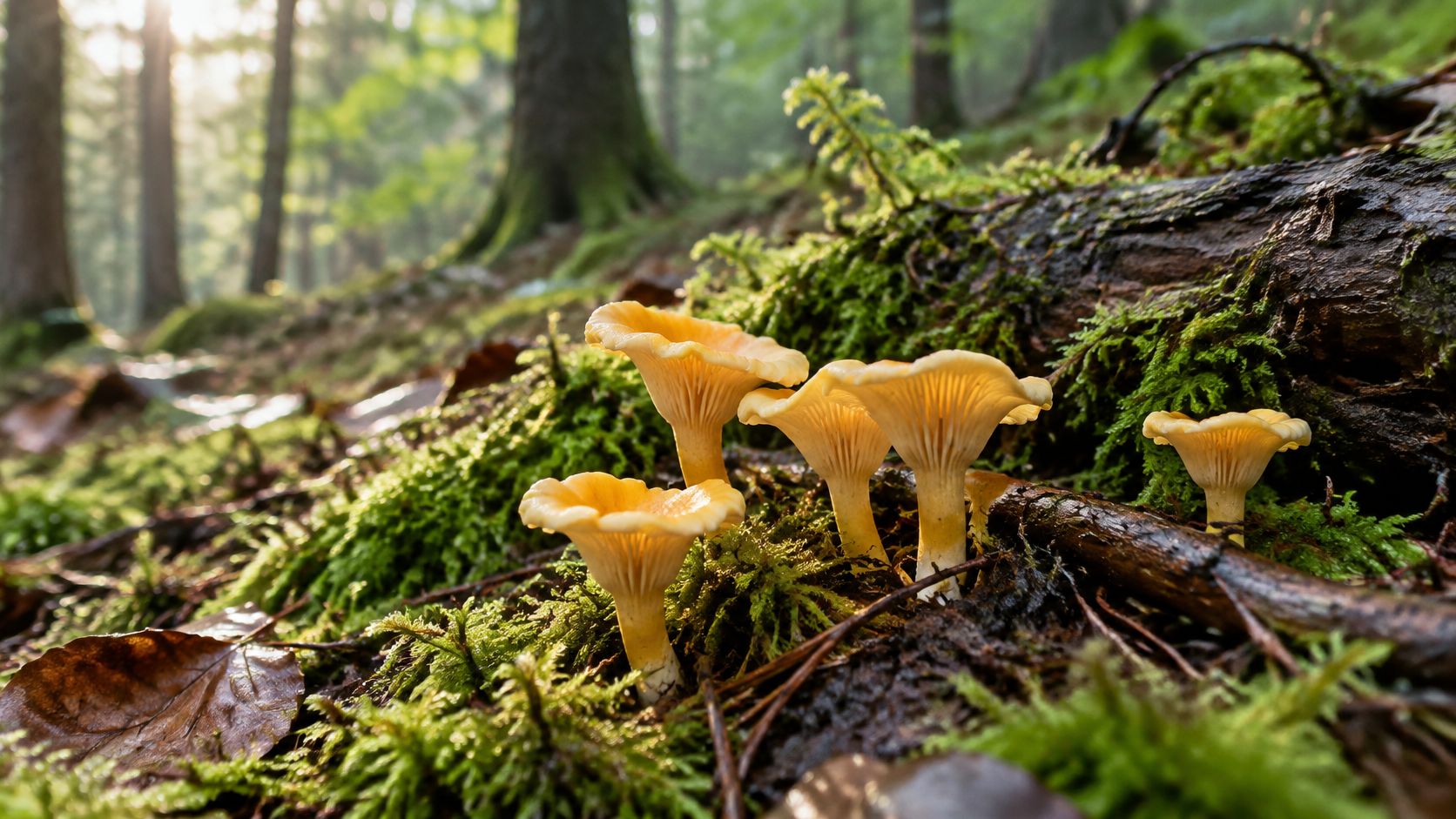
Along the Front Range and similar Colorado ranges, the plausible ground is montane and higher-elevation conifer forest. Lawns, cottonwood bottoms, and open grass slopes can be skipped. Local presence still has to be confirmed, so treat a range map as a starting hint rather than a promise that your trail has them this week. Monsoon rain and the first hard frosts move the window. Read the local mycological society's recent reports and the land manager's notices before you drive.
A scouting routine for one drainage
Choose ground that stays moist: Shaded forest with real conifer cover and an intact moss layer is the starting filter. Aspect is a weaker clue than dampness, so a mossy east- or west-facing bench can be worth the same walk as a north-facing one.
Search the wood as much as the moss: In a habitat study of 64 plots in Oregon's Coast and Cascade Ranges, 88% of Craterellus tubaeformis fruiting bodies grew directly on well-decayed coarse woody debris, even though that material covered only 3% to 26% of the ground. Check log edges and the duff piled against them.
Time it to rain: Return after a soaking rain, then revisit the same short loop on later days instead of declaring the drainage empty.
Photograph before you pick: Get the cluster base, the cut stem, and the underside in separate frames, with a coin or knife for scale.
Log the observation: Date, elevation, habitat, and photos belong in a citizen-science record whether you harvest or not.
Western hemlock was the strong associate in that Oregon work, with Douglas-fir and Sitka spruce also noted, and the mushroom was rare where western hemlock was missing. Colorado forests don't copy that tree list. Use the study for its substrate lesson, the decayed wood, and treat host trees as a local question. The same study found slope, elevation, and aspect weren't significant there, which fits the advice above: moisture and rotten wood narrow your search more reliably than a compass bearing.
A barren visit is not evidence of absence. Fruiting is seasonal and patchy. Mark the spot, note the weather, and come back after the next wet spell rather than widening the search into habitats that don't match.
Foraging Ethics, Legal Limits and Cultivation Options
Global conservation assessments do not treat Craterellus tubaeformis as threatened. Read that line carefully, because it is easy to misread. It describes extinction risk across the species' entire range, and it says nothing about the cluster at your feet in one Colorado drainage. A yellow foot works like an apple on a tree. The part you pick is the fruit. The organism is the mycelium threaded through the soil and the rotting wood beneath it. Picking fruit does not kill the tree. Compacting the ground, raking moss, and tearing up decayed logs damages the orchard. Responsible harvest protects that hidden life, patch by patch, not the species' standing on a global list.
A harvest you can defend
Take a meal, not a haul. Pick only what you will cook or dry in the next few days. Clusters left standing keep releasing spores.
Leave the forest floor intact. Cut the stem or twist it gently until you feel a small break, leaving the base and substrate in place. Raking moss or tearing duff to "check for more" removes the habitat the next flush needs.
Carry a breathable basket or mesh bag. Spores shed as you walk, seeding the ground along your route. A sealed plastic sack does the opposite of helping: it sweeps the mushrooms toward slime before you reach the car.
Skip the damaged ones. The condition rules already decided those are not food. Pulling them anyway does nothing for the patch.
Rules change with the map square you are standing on. National forest, state land, county open space, private land, and designated wilderness or research areas do not share one picking policy, and those boundaries can cross a single ridge. Commercial quantity almost always requires permission or a permit even where small personal amounts are tolerated. Confirm the managing agency's current order for the exact unit you plan to visit before the trailhead. A forum post from another state is not a permit, and last year's order is not this year's.
Legality and ethics are settled before the first stem comes up, not in the parking lot afterward.
Yellow foot is not a common home-grow species, and the reason sits in its biology. It partners with living trees and fruits from wild, well-decayed wood, a pairing no countertop kit reproduces. If you want to grow mushrooms, start with a species whose needs are already worked out, such as oyster or lion's mane genetics with published methods for grain, substrate, and fruiting conditions. Treating a wild mycorrhizal funnel as if it were an oyster mushroom wastes spawn and teaches the wrong technique.
Decide Whether to Forage, Study or Grow Yellow Foot
Three paths, in order of how much can go wrong. Eating is the strict one. Studying is the one most first visits should use. Growing means a different species.
Path 1. Eat only after every gate
Confirm at least three checklist features on the specimen in your hand, including a lengthwise cut that shows a hollow stem.
Rule out every look-alike, starting with true gills and anything clustered on wood.
Apply the condition rules. Waterlogged, buggy, old, or mixed batches don't get a pass because the nicest cap in the group looked right.
Confirm land rules and any permit with the managing agency for that exact unit.
If any feature was soft or the photos are unclear, a local expert verifies the find before it becomes food.
Then cook a small portion and wait a day. A good lunch is not a reason to finish the bag that night.
Path 2. Learn without eating
Join a local mycological society walk so someone else is naming mushrooms beside you. Photograph the cluster base and the underside, and file the observation with date and habitat. You leave with a record and an intact patch. That's a complete day.
A mushroom identification class is the right room for practicing cuts, prints, and the habit of saying "I'm not sure" out loud. Classroom species and wild Rocky Mountain finds still aren't the same specimen.
Path 3. Grow something with a published method
Yellow foot stays a wild-harvest question. For home culture, choose a species with tested instructions. We supply mycology and lab materials for that bench work, and the genetics catalog includes mushroom genetics such as Blue Oyster, Lion's Mane, Golden Teacher, Reishi, and Turkey Tail. None of those labels turns a trailside funnel into a kit.
The single next step for any wild find is mechanical. Photograph cap, underside, cut stem, and substrate. Set aside anything that fails a checklist feature. Send the photos to a local mycologist or a county extension office. No supplier and no webpage can validate a wild specimen. Verification comes from a person who can examine it.
If the woods can wait and the bench can't, Colorado Cultures is a Denver-area mycology shop for people who want reliable supplies and practical classes instead of guessing at a wild patch. We carry lab and grow materials for species that have home methods, and we teach the handling habits that keep cultivation clean. Visit Colorado Cultures when you're ready to study fungi with the right tools.
Comments