
Laminar Flow Hood Horizontal
You've prepared a clean jar, watched healthy mycelium spread, and finally set up an agar transfer. Then, as soon as the lid comes off, an invisible contaminant enters the work area. A few days later, the plate turns cloudy or a green patch appears, and weeks of careful cultivation are lost.
A horizontal laminar flow hood can greatly reduce that risk by creating a continuously swept clean-air zone around exposed sterile materials. It's not a magic shield, and it won't correct poor technique or a drafty room. Used correctly, however, it gives mushroom cultivators a more reliable sterile workspace for nonhazardous transfers, media preparation, and culture work.
The most important lesson comes before airflow settings or filter ratings: a horizontal hood protects the work, not the person using it. Once that boundary is clear, the equipment becomes much easier to choose, install, and operate.
The Hidden Key to Sterile Mushroom Culture
A contaminated agar plate often looks innocent at first. You may see healthy mycelium at the edge, then a faint haze, an unexpected color, or a texture that spreads faster than the culture you intended to grow. The contamination might have entered during a single exposed transfer, when ordinary room air crossed the plate before the lid returned.
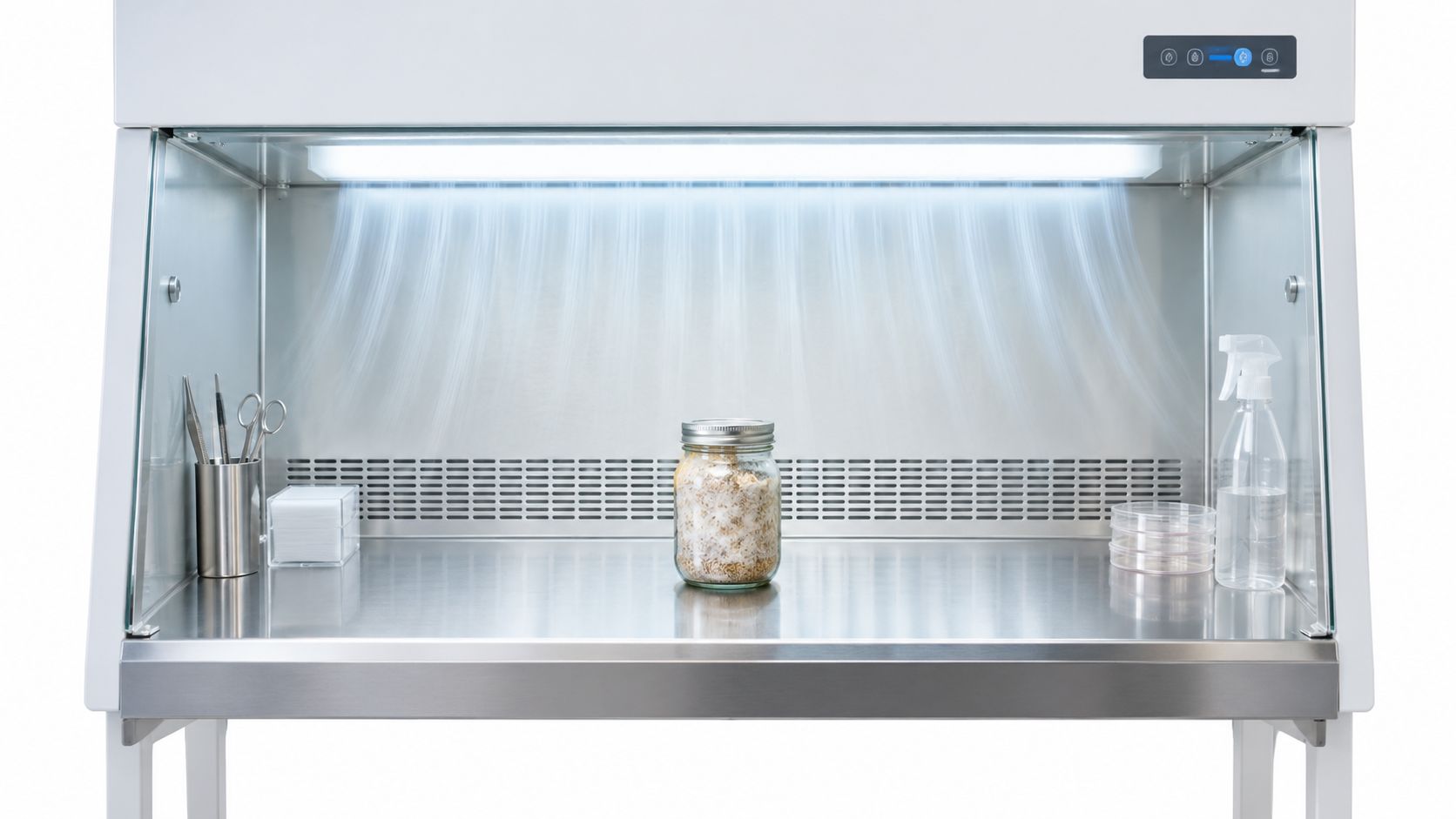
A still-air box can help by reducing movement, but it depends heavily on careful technique and relatively calm air. A horizontal clean bench takes a more active approach. It draws room air through filtration and sends a steady stream from the rear filter toward the front opening, continuously moving airborne particles away from the exposed work zone. The design is intended to protect materials, not provide containment for hazardous organisms, as explained in this guide to contamination control.
What changes during a transfer
Without directed airflow, dust, skin particles, fabric fibers, and other airborne material can settle unpredictably. The hood creates a cleaner corridor in which the filter, airflow path, tool arrangement, and operator technique work together.
That corridor only protects an open jar or plate when the air can reach it without being blocked. A tall bag, bottle, or cluster of tools can disturb the stream and create a sheltered region behind the obstruction. The hood therefore improves the conditions around a transfer, but the cultivator still has to preserve those conditions.
Practical rule: Treat the hood as a controlled workspace, not as permission to work casually.
For a beginner, the difference is meaningful. You're not trying to make the entire room sterile. You're creating a cleaner local environment at the exact moment when sterile material is exposed. That makes the hood especially useful for nonhazardous mushroom culture transfers, sterile media preparation, and similar aseptic tasks.
How Horizontal Airflow Protects Your Work
The operating principle is straightforward. A blower moves room air through a pre-filter and then through a high-efficiency filter positioned at the rear of the enclosure. Cleaned air travels in one direction across the work surface and exits toward the operator.
This stream acts less like a sealed wall and more like a moving conveyor belt for air. Particles that might otherwise drift down onto an open plate are carried away from the work zone. The air must remain uniform, though. If the velocity is too low, room particles can enter the clean area. If it's too high, turbulence can form around hands, containers, and tools.
A horizontal bench commonly operates at approximately 0.35 to 0.50 m/s, or about 70 to 100 feet per minute, measured downstream from the filter, according to Air Science's laminar-flow guidance. A typical operating point is approximately 0.45 m/s, equivalent to about 90 feet per minute, as described in VWR's clean-bench reference.
The specifications that matter
Filter performance and air velocity answer different questions. The filter determines how effectively particles are removed from the incoming air. The velocity and uniformity determine whether that cleaned air reaches your work without breaking into turbulent pockets.
Specification | Typical standard |
|---|---|
Air direction | Rear filter toward the front opening |
Air velocity | Approximately 0.35 to 0.50 m/s, or 70 to 100 feet per minute (Air Science) |
HEPA efficiency | Approximately 99.97% for particles measuring 0.3 micrometers (VWR) |
ULPA efficiency | Can exceed 99.999% for particles in the roughly 0.1 to 0.3 micrometer range (VWR) |
Common cleanliness classification | ISO Class 5 or cleaner, with some models claiming ISO Class 3 inside the work zone (VWR) |
A specification sheet can tell you what a hood is designed to deliver, but it can't confirm how your installed unit behaves. Dust loading, filter condition, fan performance, and obstructions all affect the result. For mushroom work, a calibrated anemometer is more useful than relying only on a fan dial.
Measure across multiple points rather than checking one location. A single reading can miss low-flow areas where contamination settles. Uniformity matters because the culture responds to the air reaching its immediate surroundings, not to the number printed on the product label.
Horizontal Laminar Flow Hood vs Vertical Designs
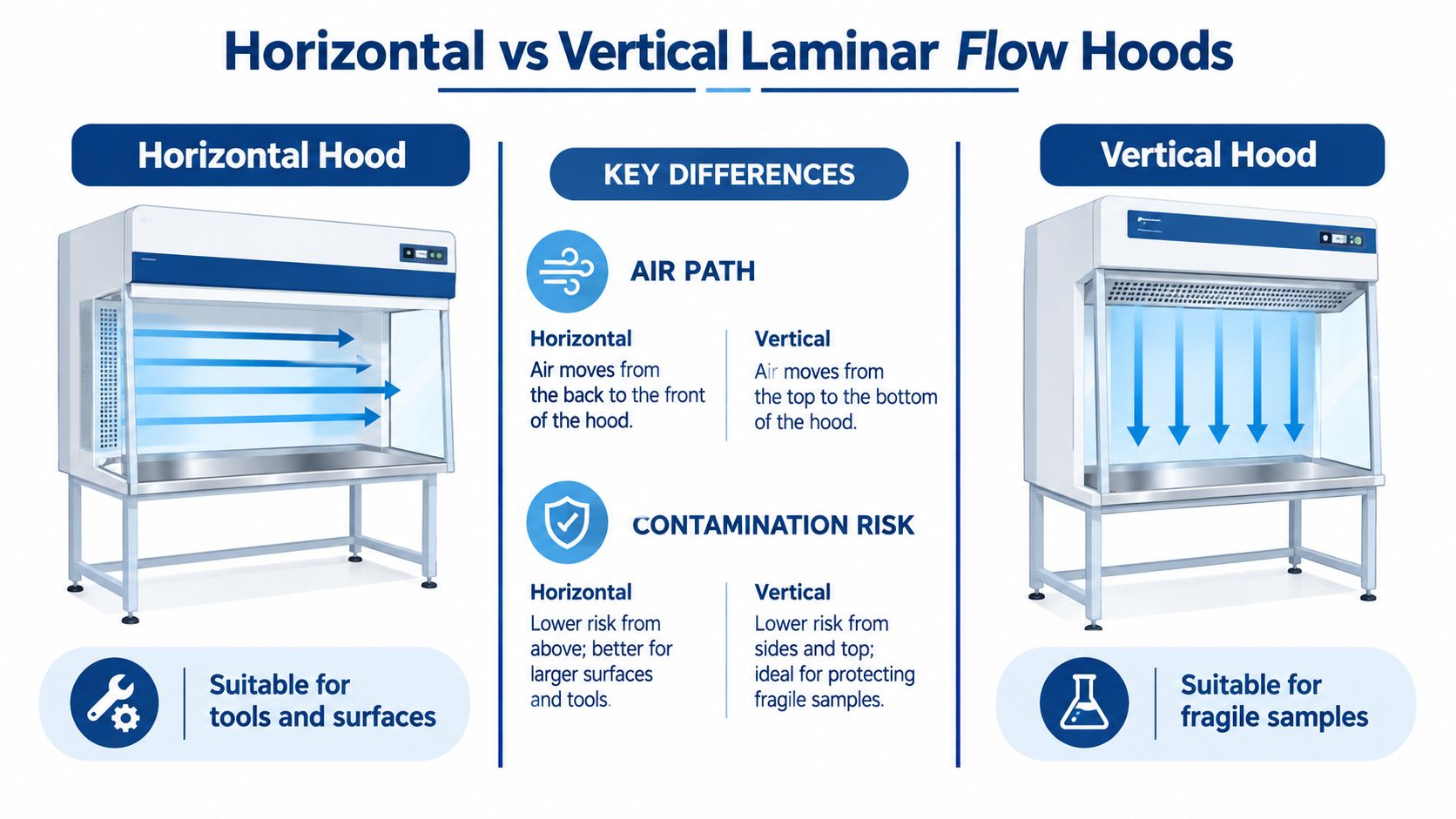
Horizontal and vertical clean benches both use filtered air, but their airflow paths create different working conditions. A horizontal unit sends air from the rear toward you. A vertical unit sends air downward from the top toward the work surface.
For open agar plates and transfers, horizontal airflow gives the exposed material a direct stream from the rear filter. Your hands enter from the front, so you need to work without placing them between the filter and the sterile opening. Vertical airflow can feel more natural for some tasks because the stream descends over the work, but containers and hands can still disturb the air as it moves around the surface.
The right choice depends on your material, movement pattern, and safety requirement. Neither configuration should be confused with a biological safety cabinet. For a broader equipment comparison, Labs USA's laboratory equipment resource provides useful context on clean-air hood designs.
Feature | Horizontal flow | Vertical flow |
|---|---|---|
Air path | Rear filter toward operator | Top filter toward work surface |
Main strength | Direct sweeping flow across exposed materials | Downward clean-air delivery over the work |
Primary use | Nonhazardous product protection | Nonhazardous product protection |
Main workflow concern | Hands and objects can block the rear-to-front path | Tall objects can disturb downward flow |
User protection | Not provided | Not equivalent to biological containment |
Which design suits mushroom culture
A horizontal bench can fit well when your work involves deliberate transfers across a clear surface. You can place tools and vessels in a linear arrangement and keep sterile openings downstream of anything that might shed particles.
A vertical design may suit a cultivator who prefers top-down access or regularly works with delicate items that benefit from air descending over them. That preference doesn't change the safety boundary. If the material could expose you or the surrounding room to a biological hazard, choose equipment designed for containment and follow appropriate safety guidance instead of selecting a clean bench based on airflow direction alone.
A practical explanation of the terminology appears in this overview of flow hoods, which can help separate airflow style from the broader question of protection.
Critical Safety Boundaries for Your Hood
The horizontal design creates its most important limitation. Air flows from the rear filter toward the operator, so material inside the work zone can send particles or aerosols in your direction. A horizontal laminar flow hood is a clean bench, not a biological safety cabinet.
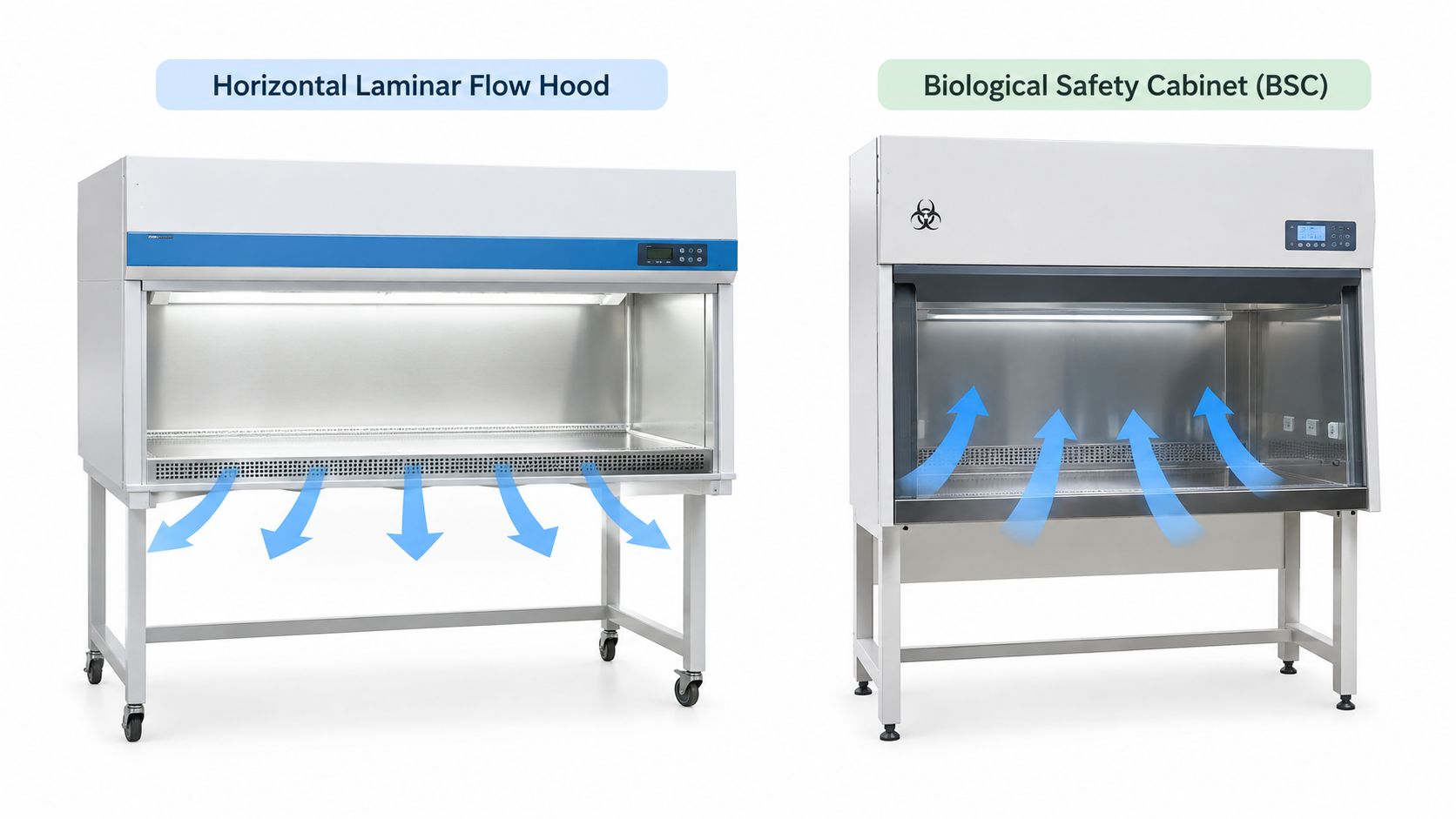
The bench protects exposed sterile materials from room contamination. It does not provide personnel protection or environmental containment. University guidance limits horizontal flow benches to low-risk work and excludes materials that require protection for the operator or surrounding environment, as outlined in this biosafety guidance from the University of Montana.
A simple decision boundary
Use a clean bench only when the material and task are understood to be nonhazardous and the purpose is product protection. Examples can include sterile media preparation, transfers involving known nonhazardous cultures, and handling clean materials that need protection from airborne contamination.
Do not use it for pathogens, toxins, hazardous chemicals, unknown environmental samples, or visibly suspect material that may release contaminants. A contaminated plate that you're trying to diagnose deserves particular caution. The fact that it sits inside a HEPA-filtered enclosure doesn't make the work safe for the person in front of the hood.
More filtered airflow toward the work does not mean more protection for the grower.
If your work requires personnel or environmental containment, stop and select a properly designed and certified biological safety cabinet or another suitable control. Legal status and biological safety are separate questions, so knowing that a cultivation activity is permitted doesn't remove the need for a risk assessment.
This short video can help reinforce the distinction between clean-air equipment and containment equipment:
Keep the hood's purpose visible in your workspace. Labeling it as product protection only can prevent a hurried decision later, especially when several kinds of cultures, substrates, or samples share the same home laboratory.
Strategic Siting and Installation in Your Home Lab
A transfer can fail before your hands reach the hood. Someone opens the door, the HVAC starts, or a ceiling fan pushes air across the bench. These disturbances can carry room air into the clean working corridor, affecting an exposed plate or jar.
Choose a low-traffic location with predictable airflow. Keep the unit away from doors, supply vents, fans, and routes used by people passing behind or in front of the operator. The goal is practical control: remove avoidable crosscurrents without trying to isolate the entire room.
Build the room around the workflow
Set the hood on a stable bench that will not wobble when you open a jar or move a tool. Leave the clearance required for the intake, exhaust, and service areas, following the manufacturer's installation instructions. Avoid a cramped corner, where cleaning becomes awkward and supplies gradually accumulate inside the work zone.
Map the surrounding activity before an important transfer. Check whether the door opens toward the unit, whether a heating or cooling cycle begins nearby, and whether another person regularly crosses the space. Plan exposure work during a quiet period, then keep movement around the hood to a minimum.
The clean bench protects your materials. It does not protect the grower from hazardous contamination, so keep that boundary clear while arranging the room. A hood's settings cannot correct every draft, blocked clearance, or sudden change in nearby airflow.
Leave enough space to clean around the unit and reach its service points. Keep cords, storage boxes, and spare containers from narrowing the operator's access or obstructing ventilation. A simple layout makes correct technique easier to repeat.
Verify actual performance
Use a calibrated anemometer to check airflow across multiple points rather than relying on a single convenient reading. The test should reveal uneven velocity and localized low-flow areas. Record the results after installation and whenever the hood is moved, serviced, or begins producing inconsistent outcomes.
Professional testing can assess airflow and HEPA filter integrity. If visible turbulence, unusual fan behavior, or repeated failures persist despite sound technique, investigate the hood and room conditions instead of assuming the culture is at fault.
Optimizing Workflow to Prevent Shadowing
A tall bottle between the rear filter and an open plate can disrupt the clean stream before it reaches the plate. The resulting turbulent area, often called a shadow, may carry contamination into the sterile work zone. Research on obstructed horizontal airflow found that perforating an obstruction reduced bacteriophage contamination by approximately 86.79% to 98.92% across test locations, with reductions observed in 48 of 51 trials (experimental study). Keep the workspace open rather than relying on a modified obstruction to control airflow.
Arrange the bench so filtered air reaches sterile openings before passing over your hands or less-clean objects. The filter-to-opening route should resemble a clear lane. Keep large items low and to one side, and avoid forming a wall of bags, bottles, or equipment across that route.
A practical layout
Place clean items in the airflow path. Set unopened sterile vessels and the receiving container where filtered air reaches them without crossing a contaminated object first.
Keep tools accessible without crowding the bench. Lay out scalpels, forceps, lids, and transfer materials in a clear sequence. Each tool should be reachable without sweeping your arm across an exposed opening.
Shift tall objects aside. Substrate bags and bottles may remain inside the hood when they do not block the stream. Keep them low and outside the direct line between the filter and sterile work.
Reserve the front for your hands. Your body already occupies the operator side. Extra containers can force awkward reaches over open cultures, so store them elsewhere or place them along the side.
Control movement. Slow hand movements create less local disturbance than quick reaches. Bring your hands in deliberately, keep sleeves controlled, and avoid coughing, sneezing, or talking toward exposed cultures.
Close vessels promptly. Filtered air limits airborne exposure while an item is open. It does not make extended exposure harmless, so close plates, jars, and bags before organizing the next step.
For hand position, tool handling, and transfer order, follow this aseptic technique lab guide. The working rule is simple: keep the path from filter to sterile opening open, short, and predictable. In a home lab, that also means placing supplies so you can work without reaching across the stream or repeatedly turning toward nearby airflow.
Maintenance and Long-Term Best Practices
A reliable hood depends on more than a clean filter. Dust, residue, changing airflow, or a poorly maintained room can compromise the work area. Before and after each session, clean the interior with a compatible disinfectant, following the manufacturer's instructions for the surface and filter assembly. Use controlled wiping motions, and keep spray away from electrical components and the filter face.
Inspect the pre-filter and visible seals regularly. Look for dust, damage, gaps, or poor seating. If you use a separate HEPA-rated vacuum for surrounding cleanup, find Fein dust extractors designed for HEPA and fine-particle collection rather than assuming a household vacuum provides equivalent filtration.
A concise service rhythm
Before each session: Remove unnecessary items, inspect the work surface, and confirm that the airflow path is open.
After each session: Remove materials, disinfect the surface, and leave the interior prepared for the next transfer.
During routine checks: Watch for dust buildup, damaged seals, unusual fan noise, or visible turbulence.
When performance changes: Measure airflow with a calibrated anemometer and arrange qualified testing instead of adjusting the fan blindly.
After service or filter work: Verify airflow and filter integrity before using the hood for sterile transfers.
The hood and the room function as one system. A clean filter cannot correct a blocked path, while an organized bench cannot compensate for a damaged filter. Keep surrounding airflow controlled, maintain the equipment, and treat clean-work practices as separate from the safety requirements of a cabinet designed to protect the operator.
Colorado Cultures provides sterilized grain bags, substrates, all-in-one grow bags, grow kits, cultures, and practical mycology education for home cultivators and researchers. Visit Colorado Cultures to explore supplies and guidance for a cleaner, more organized mushroom-culture workflow.
Comments