
Best Oyster Mushroom Substrate: How to Choose the Right One
Composted sawdust produced 183.12 g from 1 kg of wet substrate with 61.04% biological efficiency, while rice straw produced 151.8 g and 50.64%, so there is no universal winner. Composted straw and supplemented sawdust are the most reliable top performers, but the right choice depends on your space, species, preparation time, and whether you want speed or maximum yield.
You're probably standing in a Denver kitchen, basement, or spare room with a grow bag on one shelf and a bag of grain spawn on another, wondering what should fill the next container. Straw looks simple. Sawdust looks professional. Coconut coir is easy to find. Grain spawn seems important, but it isn't the main fruiting substrate at all.
The practical answer is to match the material to your growing conditions. Oyster mushrooms are aggressive decomposers, but they still need the right moisture, air structure, nutrition, and level of cleanliness. A cheap material can work well after proper processing, while a richer material can fail if it's too wet or poorly sterilized.
Choosing Your Oyster Mushroom Substrate
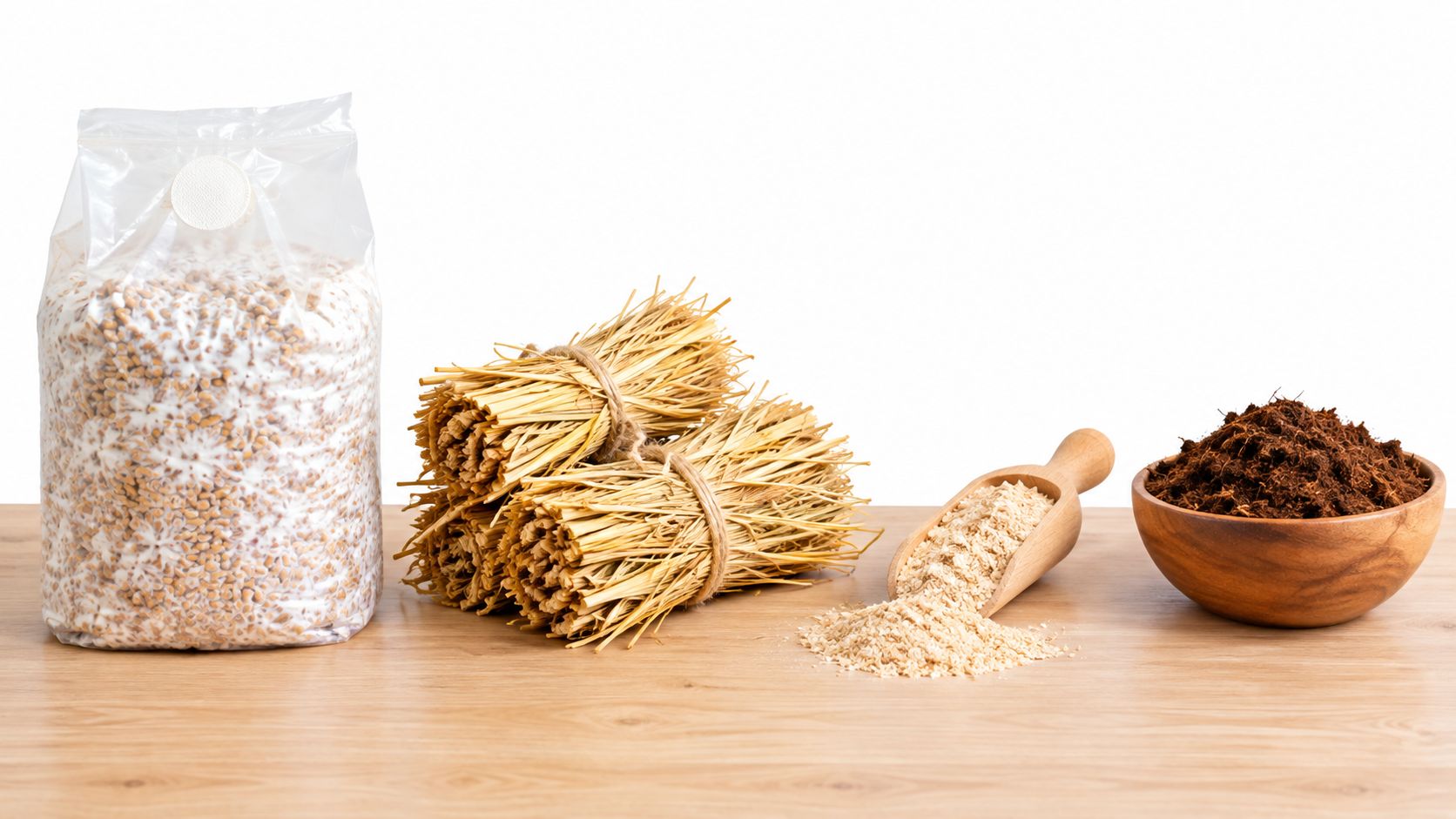
A substrate is the food and physical environment where mushroom mycelium grows before it fruits. For oyster mushrooms, that usually means a lignocellulosic material such as straw, hardwood sawdust, or a blend of agricultural by-products. Grain spawn is different. It carries the culture into the substrate, but it usually isn't the bulk material you'll fruit from.
For Colorado home growers, the first decision is less about finding a magic recipe and more about managing preparation. A small apartment grow may favor a ready-to-fruit bag or pasteurized straw. A cultivator with a pressure cooker, clean workspace, and patience may prefer supplemented hardwood sawdust. An outdoor bed may benefit from a locally available straw mix rather than a nutrient-dense indoor block.
The yield gap can be dramatic. In a comparative study of Pleurotus ostreatus substrates, composted sawdust produced 183.12 g from 1 kg of wet substrate over 8 weeks, while fresh sawdust produced only 13.0 g and elephant grass produced 0.0 g. That difference is more than an order of magnitude, which means raw material choice and processing state deserve attention before you inoculate anything.
Start with the outcome you want
Ask three questions before choosing:
Do you want the simplest first grow? Choose a prepared substrate or pasteurized straw.
Do you want a dense, productive block? Consider supplemented hardwood sawdust, provided you can sterilize it properly.
Do you want to use a local waste stream? Straw, coffee by-products, or suitable agricultural residues may be practical, but they require consistent moisture and cleanliness.
Practical rule: The best oyster mushroom substrate is the one you can prepare consistently, not the one with the most impressive recipe.
Species also matters. Pearl and blue oysters generally suit cooler indoor conditions, while pink oysters prefer warmer fruiting environments. If you're growing a less forgiving species, a stable prepared block can be a better starting point than an improvised mixture.
Common Substrates Compared for Home Cultivation
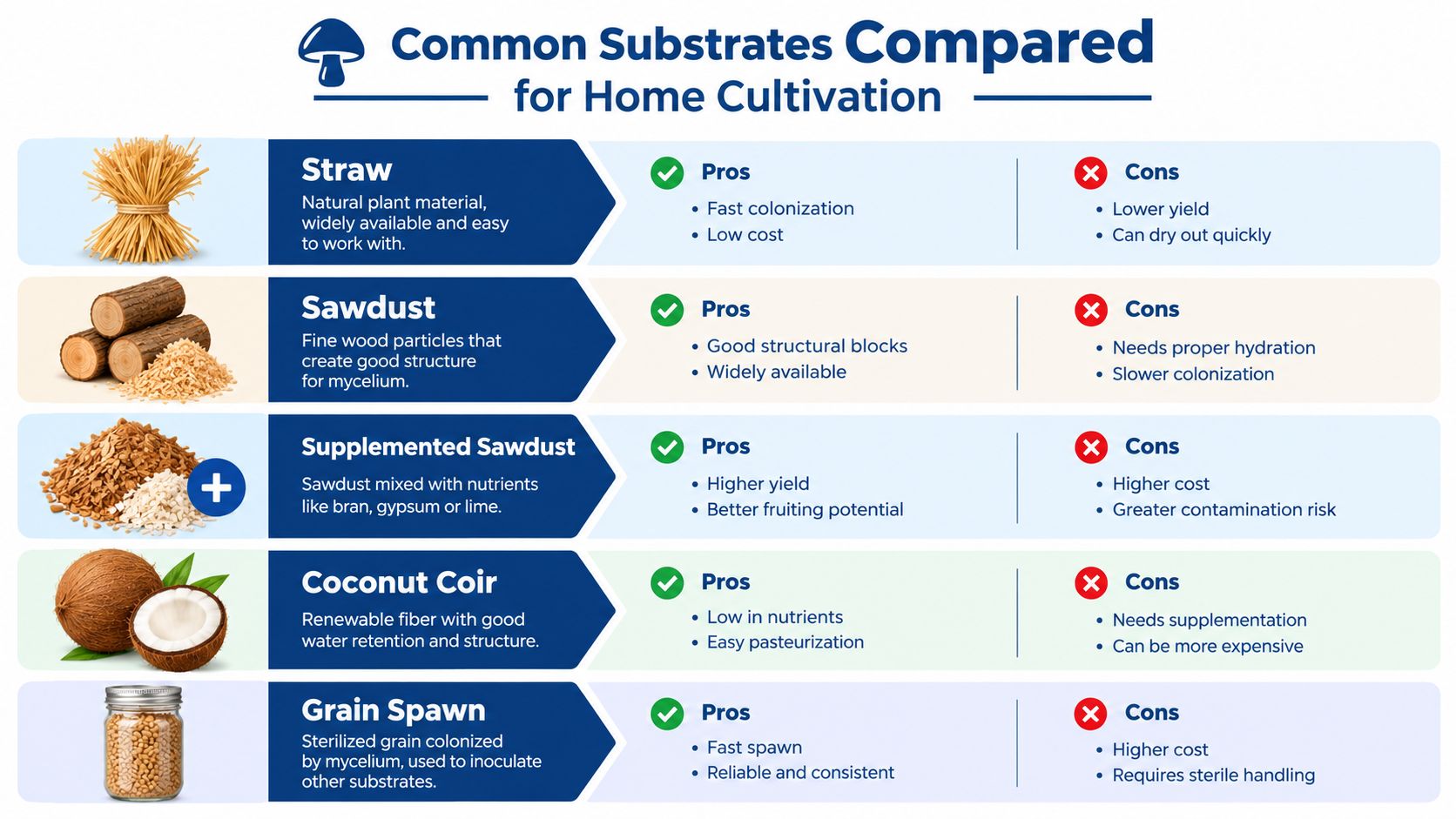
The main options differ in three ways: colonization speed, yield potential, and preparation burden. Straw is usually accessible and forgiving. Sawdust provides a stable structure but needs careful hydration. Supplemented sawdust can support stronger production, yet its extra nutrients increase the consequences of sloppy sterilization.
Substrate | Colonization Speed | Yield Potential | Prep Complexity |
|---|---|---|---|
Straw | Fast when evenly hydrated | High with proper supplementation | Low to moderate |
Sawdust | Moderate | Moderate to high after processing | Moderate |
Supplemented sawdust | Fast in clean conditions | High | High |
Coconut coir | Moderate | Low to moderate without added nutrition | Low |
Grain spawn | Fast inoculation tool | Not usually used alone for fruiting | Moderate |
Straw
Chopped wheat or rice straw is often the most approachable base for a first bucket or bag. It has useful air space, absorbs water well, and can be pasteurized with hot water rather than sterilized under pressure. The main failure is overhydration. Wet straw collapses into a dense, oxygen-poor mass, while dry straw leaves the mycelium without enough available moisture.
Rice straw has performed especially well in published trials. One comparison placed rice straw second to composted sawdust, at 151.8 g and 50.64% biological efficiency, while the study identified rice straw as the strongest alternate substrate when yield and biological efficiency were considered. You can review the study's comparison of processed lignocellulosic by-products.
Sawdust
Hardwood sawdust creates a compact, durable block and works well for species that prefer wood-based nutrition. Fresh sawdust is a poor shortcut, however. The same study recorded only 13.0 g from fresh sawdust, compared with 183.1 g from composted sawdust. Processing changes how accessible the food is to the mushroom.
Supplemented sawdust
Adding bran or another suitable nutrient source can raise yield potential, but it also gives contaminants more to consume. This is a better fit for a pressure cooker, filter-patch bag, and disciplined inoculation technique than for an improvised open-air setup.
Coconut coir and grain spawn
Coir is easy to hydrate and pasteurize, but it's relatively low in nutrition. It can improve texture in a blend, though it's rarely the strongest standalone choice for oyster production. Grain spawn, meanwhile, is the inoculation engine. Use it to distribute vigorous mycelium through straw or sawdust, not as a substitute for the main fruiting medium.
For a warmer-loving variety, compare the environmental needs of a pink oyster cultivation project before choosing a substrate solely on convenience.
Why Composted and Supplemented Substrates Perform Better
Raw plant material contains carbon, but oysters need more than a pile of dry fiber. They need a substrate with accessible nutrients, usable moisture, and enough structure for oxygen to move through the block. Composting, conditioning, or supplementing changes the food value of the material, which helps explain why processed substrates can outperform raw ones.
The strongest evidence comes from comparing mixes rather than brands. A 2025 study of agri-food waste substrates found that wheat straw combined with brewer's spent grain reached 54.33% biological efficiency, while wheat straw combined with wheat bran reached 45.30%. The paper associated the stronger mix with a lower carbon-to-nitrogen ratio, 24.73 versus 41.98, as reported in the study of agri-food waste substrates for oyster cultivation.
Substrate Mix | Biological Efficiency (%) | C/N Ratio |
|---|---|---|
Wheat straw plus brewer's spent grain | 54.33 | 24.73 |
Wheat straw plus wheat bran | 45.30 | 41.98 |
Nutrition must stay balanced
A high-carbon material such as straw or sawdust can support mycelium, but the mushroom may produce more effectively when the nutrition is balanced. Supplementation adds nitrogen and other nutrients. The trade-off is that bacteria and molds benefit from the same enrichment if the bag wasn't sterilized thoroughly.
That's why a simple pasteurized straw bag can be safer for a beginner than an enriched sawdust block. The simpler material may have less yield potential, but it also gives contamination fewer advantages. A sterile supplemented block can be excellent, while a poorly sterilized one can fail quickly.
Processing matters as much as the ingredient
Composted sawdust and fresh sawdust aren't interchangeable. Composted material has already gone through biological and physical changes that can make its nutrients more usable. Fresh material may be too resistant, too dry, too fine, or chemically unsuitable for dependable colonization.
For a Denver grower, this creates a useful decision boundary: use raw or lightly processed material only when the species and method support it. If you're making a nutrient-rich block, treat sterilization as part of the recipe, not an optional finishing step.
How to Prepare and Use Each Substrate Correctly
Preparation determines whether a sound recipe colonizes evenly. Stalled growth, sour odors, wet pockets, and green contamination often trace back to uneven hydration, excess supplementation, or inoculation before the substrate has cooled.
Straw needs even moisture
Chop straw into pieces that pack together without forming a dense mat. Pasteurize it with hot water, then drain and cool it fully before adding spawn. The correct texture is damp rather than glossy or dripping. Squeeze a handful. No water should run from it. If it does, drain longer.
Distribute spawn throughout the straw instead of placing it in one central pocket. Multiple inoculation points shorten the distance the oyster mycelium must colonize and help reveal poorly mixed areas sooner. For a small Denver grow, this simple step is often easier to control than correcting a wet, compact bag later.
Sawdust needs controlled processing
Use suitable hardwood sawdust and hydrate it evenly. Unenriched sawdust can work after proper conditioning, while supplemented sawdust belongs in a filter bag and requires pressure sterilization. Bran increases available nutrition, but it also gives contaminants more to consume if sterilization is incomplete.
Pack the material firmly enough to hold its shape, without compressing it into an airless block. If colonization stalls in the bag's center, check for excessive density or hydration above field capacity. Loosen the pack and drain longer before re-inoculating. Let the bag cool completely, then inoculate with clean tools and confirm that the filter remains unobstructed.
Coir is a texture component
Hydrate coir to field capacity and break apart compressed clumps before mixing. Coir helps retain moisture, but it does not automatically supply the nutritional balance oysters need for strong production. Use it as a structural ingredient unless you are following a tested blend.
Spawn must be handled cleanly
Choose grain spawn that is fully colonized, fresh, and free from unusual colors or odors. Break it apart gently and distribute it through the cooled substrate. Keep the bag closed while preparing other materials to limit exposure.
If you use a prepared Microppose Mark 1 grow kit, follow its instructions rather than adding water or supplements by guesswork. For straw, pasteurize at the method's target temperature, drain to field capacity, and inoculate only after cooling. For supplemented sawdust, use pressure sterilization because enrichment raises contamination risk beyond what straw-style pasteurization can reliably control. These preparation choices matter more than just selecting a named substrate.
When to Choose Straw, Sawdust, Coir, or Grain Spawn
The right choice becomes clearer when you start with the growing situation rather than the ingredient list.
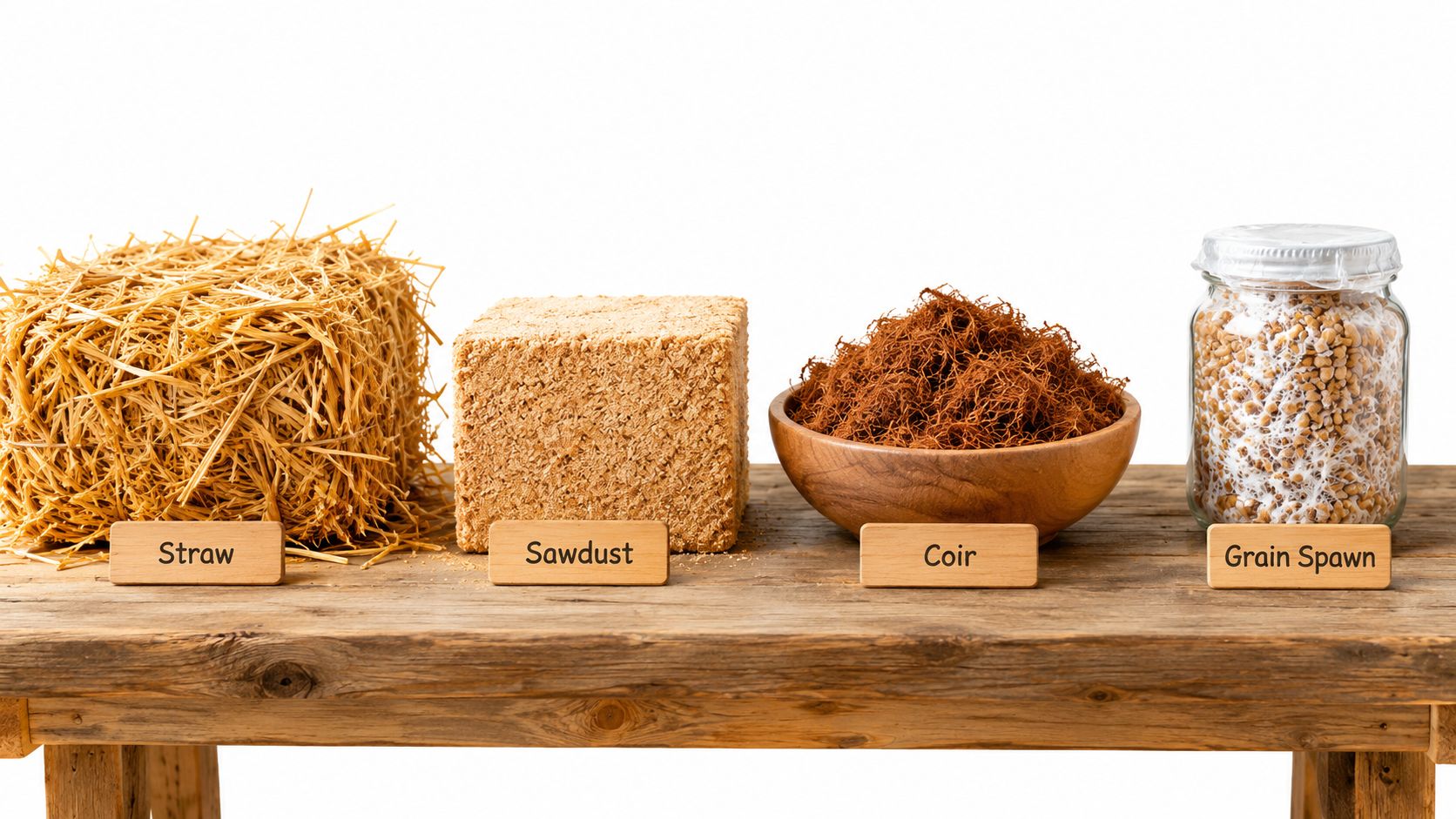
Choose straw for a low-equipment start
If you're growing in a bucket, tote, or simple bag and don't own a pressure cooker, pasteurized chopped straw is a sensible starting point. It's easier to inspect, drains clearly, and doesn't demand the same sterile workflow as a nutrient-rich block.
Rice straw has a strong record in the available trials, but local availability matters. In Colorado, clean wheat straw may be easier to source than rice straw. That practical advantage can outweigh a theoretical performance difference if the material is fresh, dry, and free of chemical treatments.
Choose supplemented sawdust for controlled production
Use supplemented hardwood sawdust when you want a dense block and have the equipment to sterilize it reliably. This approach suits a dedicated indoor shelf, consistent temperature, and someone willing to track hydration and inoculation carefully.
One cultivation trial reported rice straw supplemented with 10% rice bran at 381.85 g fresh yield and 95.46% biological efficiency, compared with sawdust at 247.87 g and 61.96%, as shown in the rice straw supplementation trial%202013/2%20JNBR%202(1)2.pdf). That doesn't make every straw bag superior. It shows why supplementation and substrate choice should be evaluated together.
You can also compare a pearl oyster cultivation option when you're selecting a species and deciding how much environmental control your space can provide.
If you're weighing the four options at the shelf, this video offers a visual reference for the basic growing workflow.
Choose coir for moisture management
Coir makes sense when you need a clean, easy-to-hydrate texture in a blend. It's less compelling as the only food source for oysters. Use it to solve a moisture or structure problem, not because it automatically improves yield.
Choose grain spawn for reliable inoculation
Grain spawn is the right purchase when you already have a prepared substrate and want vigorous, even colonization. It's also a useful bridge between a culture and a fruiting block. It doesn't replace the bulk substrate, so plan for both pieces.
Recommended Substrate Setup for Colorado Home Growers
For a first serious indoor grow, I'd keep the setup straightforward: a ready-to-fruit supplemented sawdust bag or a clean grain spawn bag paired with pasteurized straw. This gives you one low-prep path and one hands-on path without asking you to troubleshoot every variable at once.
Colorado's dry air can pull moisture from exposed blocks quickly, especially in heated homes during winter. A filter-patch bag or enclosed fruiting setup helps stabilize the substrate, while a simple humidity routine protects developing pins. Don't compensate for dry air by soaking the block. Keep the substrate intact and manage moisture at the fruiting surface.
A practical starting setup
Choose based on your available equipment:
No pressure cooker: Buy a prepared block or use pasteurized straw with clean spawn.
Basic sterile equipment: Use sterilized supplemented sawdust and a filter-patch bag.
Outdoor or garage experiment: Use straw in a protected container, but expect more environmental variation.
Warm room: Select a species that tolerates the temperature instead of forcing a cool-loving oyster to fruit in heat.
A prepared bag from a local supplier can reduce the number of variables in your first attempt. Colorado Cultures offers sterilized grain bags, all-in-one grow bags, substrates, grow kits, tools, instructions, and classes through its Denver-area storefronts and online store. Those supplies are one option for growers who want a prepared starting point rather than building every component from scratch.
Use products for legal gourmet, educational, or research purposes, and follow applicable rules for cultivation. Responsible growing also means labeling cultures, keeping food-production areas clean, and separating experimental material from household food preparation.
The most useful setup is the one you can repeat. Once you've completed one clean grow, change one variable at a time, such as the base substrate, spawn distribution, or fruiting location. That approach gives you meaningful feedback instead of a pile of competing guesses.
Frequently Asked Questions About Oyster Substrates
How can I recognize contamination?
Unusual green, black, or strongly colored growth, sour odors, and slimy wet areas are warning signs. Isolate the bag and don't open questionable material indoors. White oyster mycelium should spread in a clean, consistent way, although the exact appearance varies by culture.
Can I reuse spent substrate?
You can move spent substrate to a compost system or garden area rather than trying to force another indoor production cycle. Once the accessible nutrition has been used, later flushes usually become less productive, and handling the old block introduces more contamination risk.
Does grain spawn replace bulk substrate?
No. Grain spawn carries the culture, while straw, sawdust, or another bulk material supplies most of the fruiting structure and nutrition. Mix the spawn through cooled, properly prepared substrate.
What should I do if colonization stalls?
Check temperature, moisture, and air exchange first. A dry edge, compacted center, or contaminated pocket can stop growth. Don't keep opening the bag to inspect it, because repeated handling makes diagnosis harder and increases exposure.
How should I store dry substrate materials?
Keep straw, sawdust, and coir dry, sealed, and away from pests or chemical contamination. Label materials clearly, and hydrate only what you can inoculate under clean conditions.
For a dependable Denver-area start, browse Colorado Cultures for sterilized grain bags, all-in-one grow bags, prepared substrates, grow kits, and practical cultivation guidance. Choose a substrate that matches your equipment, then start with one manageable grow and build from the results.
Comments