
Sawdust Mushroom Spawn: What It Is and How to Use It
Is a fully white bag the same thing as a harvest? Most sawdust spawn guides imply it is, and that's where beginners get hurt. A block can colonize completely and still fruit poorly, because colonization only proves the mycelium could move through the wood. Whether it turns that wood into mushrooms depends on choices made well before the bag was opened.
Sawdust mushroom spawn is simple in concept and fussy in practice. You're buying living mycelium already established in a wood-based carrier, and everything that follows depends on species, wood source, moisture and how clean you can keep the transfer.
Colonization is not the same as a crop, and the gap between those two things is where most first-time disappointment lives.
What Sawdust Spawn Is and How It Works
Sawdust mushroom spawn is a carrier: sterilized sawdust that has been colonized by a chosen mushroom culture, sold so you can seed something larger, whether that's a log, a supplemented block or a fruiting bag.
Think of a starter cutting from a friend's garden. The cutting isn't the bed, and it doesn't do much on its own at first. It carries living tissue into new ground so the ground fills with the plant you wanted. Spawn does the same job, carrying living mycelium into a much bigger mass of wood or sawdust so that the mass, not the bag, becomes the crop.
Two setups dominate, and they demand different habits from you:
Outdoor logs: wood-based spawn gets packed into drilled holes, and the log fruits on a seasonal rhythm set by weather rather than by your thermostat.
Indoor blocks and bags: filtered bags of supplemented sawdust run in a room you control, with steady temperatures and a measurable spawn run.
The commercial history explains why the method comes with such detailed protocols. Shiitake drove the transition. Modern synthetic sawdust-log cultivation was established in Japan in 1930 by Hikosaburo Morimoto, who received U.S. Patent No. 1,833,089 for replacing naturally inoculated hardwood logs with a controlled sawdust substrate, and air conditioning advances from the 1980s made year-round production practical, as a 2022 population-genetics study in Mycoscience recounts. The same study reports that about 99% of Japanese nameko production (Pholiota microspora) used sawdust-based cultivation, with Forestry Agency data cited there placing the share at 99.7% by 2019.
That scale is the lesson. Sawdust spawn isn't a shortcut around good practice. It's the input that industrial systems built strain selection, sterilization, moisture control and climate management around, which is exactly why choosing, checking, storing and using it well matters more than whatever the bag's label promises.
Matching Spawn to Your Mushroom Species and Wood
Spawn catalogs assume hardwood sawdust is a generic input, as if one bag serves shiitake, oyster, lion's mane and reishi equally well. That assumption works like assuming every flour bakes the same loaf. The recipe changes the result, and so does the wood under the mycelium.
Start with a species that colonizes beautifully and fruits reluctantly. Research on wild Ganoderma sinense found the fungus would fruit on sawdust, but the best reported formulation, roughly 98% sawdust with 1% wheat bran and 1% calcium carbonate, reached only about 3.0% biological efficiency, according to the published optimization study. White mycelium filled the substrate. A crop worth the shelf space never followed.
That gap between colonizing and cropping is the most misunderstood point in spawn selection. A bag that turns fully white tells you the fungus survived. It tells you nothing about whether you'll harvest enough mushrooms to justify the shelf space, the supplements or the weeks of climate control.
The wood itself matters just as much. Oak is the default most guides recommend, but softer hardwoods and agricultural fibers can beat oak for faster-growing species such as oyster and lion's mane, so treat the oak default as a starting point rather than a law.
Mushroom | Substrate tested | Result |
|---|---|---|
Shiitake | Supplemented oak sawdust | 59.7% maximum biological efficiency (2025 PeerJ study) |
Wild Ganoderma sinense | About 98% sawdust, 1% wheat bran, 1% calcium carbonate | About 3.0% biological efficiency, so fruiting didn't equal a usable crop |
Pelletized vs raw sawdust | Same wood, different processing | Compression and kiln drying make pellets pack tighter and absorb water more slowly than loose sawdust, which changes gas exchange through the block |
Wood source shifts yield even when the mushroom stays the same. Mixing oak acorns with vineyard pruning waste lifted biological yield by 144.6 grams per kilogram at the first flush and 212.3 grams per kilogram at the second flush compared with vineyard pruning waste alone, per a 2024 study in Plants. Same fungus, different wood, measurably different harvest.
Three questions settle your formulation before you buy anything:
Which wood species suit this mushroom? Oak and other dense hardwoods favor shiitake. Softer wood and agricultural fibers can outperform oak for oyster and lion's mane.
Does pelletized sawdust behave like raw sawdust? No. Pellets need slower, more even rehydration, and they compress into a denser block than the same wood in loose form.
Do lion's mane, oyster and medicinal species need different supplements or moisture targets? Yes. The shiitake and Ganoderma results above show how wide the spread between species can run, so no single recipe covers all three.
Identify the mushroom species and the wood source first, then pick the spawn formulation. "Hardwood sawdust spawn" is a category, not a product. If you're still deciding what the spawn will go into, our guide to hardwood mushroom substrate walks through the wood choices in more detail.
Expected Yields and When Supplements Help
A colonized bag is a milestone, not a harvest. The gap between those two things is what this section is about, and a substrate trial on Pleurotus ostreatus shows it better than any single headline figure: five substrates, one species, one method, eight weeks of cropping.
Here's how they stacked up:
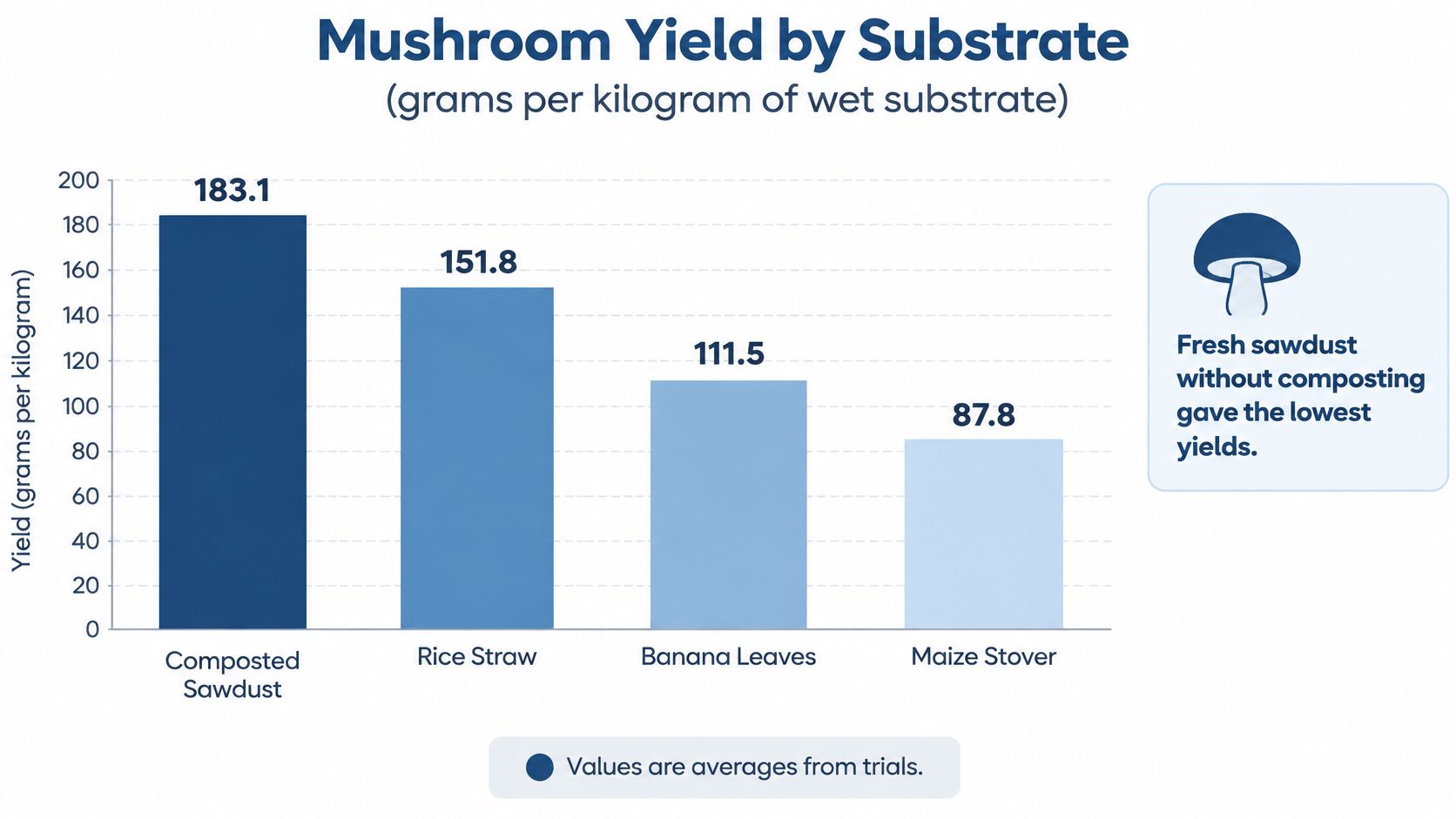
Substrate | Mushrooms per kg wet substrate (g) | Notes |
|---|---|---|
Composted sawdust from Triplochiton scleroxylon | 183.1 | Highest result in the comparison |
Rice straw | 151.8 | Same 8-week study |
Banana leaves | 111.5 | Same 8-week study |
Maize stover | 87.8 | Same 8-week study |
Fresh, untreated sawdust | 13.0 | Raw sawdust is not equivalent to prepared spawn |
Those figures come from a published comparison of lignocellulosic substrates, and a later trial in the same body of work compared experimental block spawns with conventional sawdust spawn: colonization took 34.38 to 36.12 days, yields ran 180.22 to 186.21 grams per bag, biological efficiency landed between 68.65% and 70.94%, and none of the differences were significant at p > 0.05. Read the last row of the table first. Raw sawdust produced only about 13 grams per kilogram, a small fraction of what the composted material yielded.
That last row is the trap beginners fall into. Fresh sawdust will often colonize, because mycelium can run through almost anything woody, and a fully white bag looks like success. Colonization only means the fungus survived the substrate. The table shows what it could fruit from it, and preparation is what separates a carrier from a crop.
What biological efficiency actually tells you
Biological efficiency expresses fresh mushroom mass as a percentage of dry substrate mass. A value near 70% means roughly 700 grams of fresh mushrooms per kilogram of dry substrate under those study conditions. Treat it as a planning number, since it moves with species, wood, moisture, packing density and how clean your run stays.
The supplement trade-off
Supplements are where beginners overreach. Wheat bran and soybean hulls raise yield because they add nutrition, and they raise contamination risk for exactly the same reason, so supplementation and sterile technique have to rise together. A cultivation study reported in Cornell Small Farms' guide to commercial mushroom cultivation put unsupplemented sawdust at 285.44 grams per bag and the best wheat-straw and yeast-extract treatment at 461.96 grams per bag.
Practical rule: at home, pick the formulation you can keep clean over the one with the biggest theoretical yield. A forgiving low-supplement bag that finishes beats a rich bag that turns green.
What you're really comparing is contamination-adjusted yield rather than peak yield. A first-time grower with a still-air box and a kitchen pot may rationally choose plain sawdust and accept less per bag, because the failure rate matters more than the ceiling. Once your setup runs clean and consistently, the guide to how to increase mushroom yield covers the remaining levers in order of impact.
For the full picture of what a colonized bag went through to get there, this walkthrough covers the flow from hydrated sawdust to finished spawn:
How Sawdust Spawn Is Made and Inoculated
A bag can turn completely white and still make poor spawn. White mycelium shows that the sawdust has colonized, but useful spawn also has to be clean, evenly hydrated and matched to the mushroom species and wood it will feed. The Ohio State University fact sheet on shiitake log inoculation describes the resulting product as a carrier of actively growing mycelium. Commercial spawn commonly arrives in autoclaved plastic bags fitted with filters, which work like screened windows by allowing gas exchange while limiting airborne contamination.
The production sequence below includes the reason behind each step:
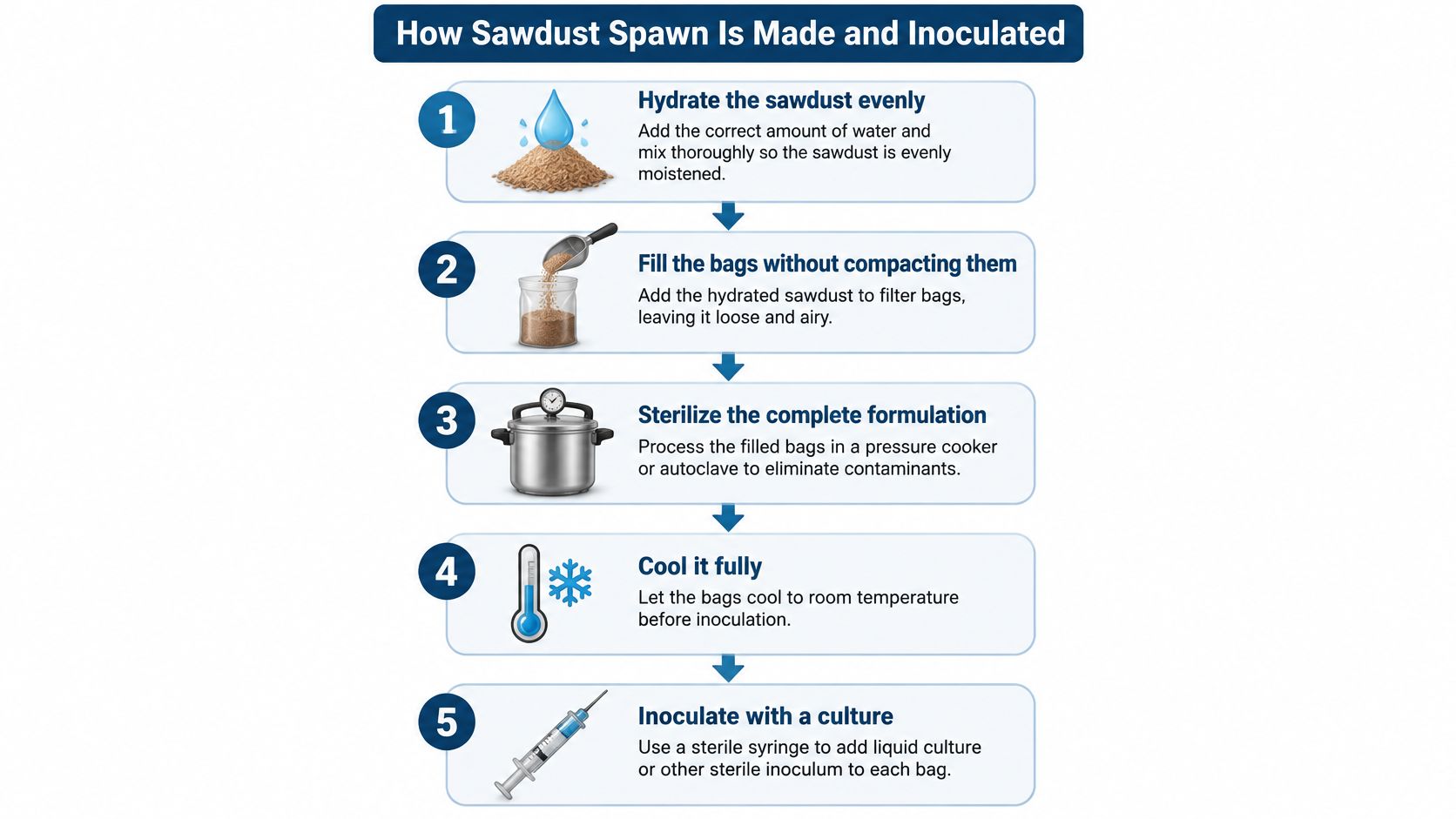
Hydrate the sawdust evenly. Dry patches give mycelium nothing to work through, while soggy patches restrict airflow. Mix water in gradually and squeeze a handful to check that the moisture is distributed throughout.
Fill the bags without compacting them. Pressed sawdust loses the air spaces mycelium needs. Dense areas colonize slowly and can give bacteria time to establish before the culture reaches them.
Sterilize the complete formulation. Add bran, hulls or other ingredients before sterilization, because supplements feed contaminants as readily as they feed the selected culture.
Cool it fully. Bagging warm substrate creates condensation. Water then collects in low spots instead of remaining evenly distributed through the sawdust.
Inoculate under clean conditions. Work quickly with a vigorous culture and expose the sterilized substrate to open air for as little time as practical.
Incubate with filtered gas exchange. Keep the bag sealed and let the filter supply air exchange. Repeatedly opening the bag to inspect progress adds exposure without helping colonization.
At transfer time, keep the bag sealed until the moment you inoculate. Minimize how long it sits open, then distribute the spawn so mycelium contacts fresh surfaces, whether those surfaces are drilled log holes or a prepared wood-based block.
For outdoor logs, wood-based spawn is technically preferable to grain spawn for wood-inhabiting species such as shiitake. It places mycelium directly against the target material and presents less loose grain to competing organisms. Even so, colonizing sawdust in a bag does not prove the formulation will produce well in every wood source; the species still determines the appropriate pairing.
Timing matters as much as technique. Cut logs lose moisture as they sit, and exposed wood gives competing fungi time to establish. Inoculate promptly, then keep the wood damp enough that it does not dry out before colonization finishes, without letting standing water collect around the holes or beneath the logs. A fast, clean transfer and steady moisture generally matter more than adding more spawn.
Inspecting, Storing and Handling Spawn
Check the bag before you open it
Viable spawn is visibly moist and predominantly white, with a dense or fuzzy mycelial look. Anything else is information, and the right response is to act on it before the bag touches your workspace.
Observation | What it means | What to do |
|---|---|---|
Moist, predominantly white spawn with dense or fuzzy mycelium | Viable spawn | Use promptly in a clean inoculation step |
Excessively wet bag or standing water | Elevated bacterial risk | Do not use; isolate the batch |
Sour odor | Likely contamination | Discard; do not mix into more substrate |
Green, black, gray or pink colored mold | Contaminating fungi | Discard and clean the work area |
Uncolonized pockets | Incomplete colonization and contamination risk | Do not use; isolate the batch |
The moisture warnings aren't fussiness. Water fills pore space, restricts oxygen transfer and favors bacteria, while too little water reduces enzyme activity and desiccates the substrate mid-run. For indoor blocks, that balance is the whole game.
The moisture balance behind the warnings
A published sawdust-substrate study set initial substrate moisture at 70% and found a supplemented sawdust mix at 75% moisture, incubated at 28°C, hit the highest reported mycelial growth rate in that experiment at 9.3 mm per day. Treat that as a benchmark, not a recipe. Wood species, particle size, supplement type, pH, packing density and strain all move the optimum.
The practical workflow follows from that: hydrate uniformly, avoid compacting the bag, sterilize the full supplemented mix, cool it completely, then inoculate aseptically with vigorous spawn. During incubation, hold steady moisture and let filtered gas exchange do its job.
Any sour smell, persistent wet spot or nonwhite growth means isolating that batch. Never stir it into fresh substrate hoping to salvage the volume.
Storing spawn between sessions
Keep spawn sealed in its filtered bag until you're ready to use it. Store it somewhere cool, dry and shaded, away from heat sources and direct sun, and reseal partly used bags immediately. Use spawn soon after arrival, since both logs and prepared substrates depend on prompt inoculation.
Don't open several bags at once in a dusty or busy room. Every opening is a contamination event, and batching your openings multiplies the risk across the whole session.
Run one habit that pays for itself: label each bag with its arrival date, note what it went into, and set aside any failed bag so a single bad batch doesn't spread through your stock. When you're restocking, compare listings by species and substrate rather than by price alone, and check the mushroom spawn we offer online against the formulations above before ordering.
Using Sawdust Spawn Responsibly and Your Next Step
Check the cultivation rules that apply to the species you plan to grow. They differ by country, state and province, and they can differ between a bag on a shelf and a log in a yard. Keep projects to lawful gourmet or research purposes, and confirm what's allowed before you buy.
Then work through this in order:
Choose the species and the wood source first. Everything downstream, from supplement level to moisture target, follows those two decisions.
Pick a formulation that matches your contamination risk. Use the setup table above to see what's been tested for your mushroom.
Run a small test batch. One or two bags tell you whether your sterile technique holds before you commit to a season's worth of logs.
Measure it against the yield table. Compare your grams per kilogram with the published figures, and note where you fell short.
Log every batch. Dates, formulation, species, wood, outcome. Without records you're guessing, and with them you're running your own trials.
The small batch is the part people skip. It's also the cheapest education you'll get, because a clean small run proves your process before a contaminated large run proves it wasn't ready. Our shop carries spawn, substrates, and liquid culture recipes, so matching a culture to the wood you have on hand is straightforward.
Start with one controlled batch. Record what you did and what came back. That single habit turns sawdust spawn from a gamble into a method you can repeat.
Ready to put a controlled batch together? Colorado Cultures supplies sterilized grain bags, all-in-one grow bags, substrates, spawn and the tools that keep a transfer clean, all prepared under rigorous sterilization standards, with printable instructions and video tutorials for first-time growers. Compare our spawn and substrate listings against the species and wood pairings above, then start with one small batch and log the result. Visit Colorado Cultures to see current listings and weekly Tuesday Deals.
Comments