
Brown Jelly Fungus: Species, Look-Alikes and Edibility
Most beginner advice tells you to identify a brown jelly fungus by its color and wobble, then check whether it's edible. That order is backwards, and it can lead you to a confident answer about the wrong organism.
Brown jelly fungus isn't one species. It's a loose label people apply to several fungi that look gelatinous when wet, shrink when dry, and happen to be brown, amber, or black-brown in the light they found them in. Some eat dead wood. Some parasitize other fungi living in that wood. Some are eaten widely, others have almost no substance to eat.
So start with a candidate, not a conclusion. Match what you've found to a group, check the current name, record the wood and any neighboring fungi, and only then decide whether to leave it, photograph it, or collect it for expert help.
The Common Brown Jelly Fungi at a Glance
Use this table as a first sort, not a final name. A match gives you a likely genus or group to investigate further.
Species or group | Substrate and role | Size and look | Edibility status |
|---|---|---|---|
Tremella mesenterica (yellow brain, witches' butter) | Dead deciduous wood; often parasitizes other fungi | Lobed, gelatinous, golden to orange-brown when wet | Edibility unconfirmed; little food value |
Exidia glandulosa (black jelly roll) | Dead hardwood | Brown to black; single bodies 1-2 cm, fused masses 3-10 cm | Dubious edibility |
Exidia nigricans | Dead hardwood | Brown to black, thin and insubstantial | Dubious; too insubstantial for culinary value |
Phaeotremella frondosa (formerly Tremella foliacea) | Parasite of other wood-decay fungi | Brown, leafy, gelatinous | No confirmed culinary use; don't eat |
Brown Auricularia species (wood ears) | Dead attached or fallen wood | Brown, ear-shaped, rubbery | Edible; widely eaten when correctly identified |
A table match is a candidate name only. It isn't a confirmed identification, and it isn't enough reason to eat or culture a specimen.
The reason for caution is simple. The December 2025 issue of Inoculum from the Mycological Society of America frames brown jelly fungus as a label that can cover brown Exidia species, Phaeotremella frondosa, and brown Auricularia species, which differ in host relationship, microscopic features, texture, and culinary value. In other words, the feature you notice first, brown gelatinous tissue, is one of the least diagnostic features you have.
How to read each row
Tremella mesenterica is the name many older guides reach for first. It's known as yellow brain, golden jelly fungus, and witches' butter, and it forms lobed, gelatinous bodies on dead deciduous wood. Don't let a yellow-leaning common name rule it out if your specimen looks amber or orange-brown after rain, and don't let a brown tint rule it in.
Exidia glandulosa, the black jelly roll, grows directly on dead hardwood. The First Nature species page for Exidia glandulosa, updated in 2026, gives individual fruit bodies at 1-2 cm across, with fused masses typically 3-10 cm across. Size helps here only if you record whether you're measuring one button or a merged patch.
Exidia nigricans is also brown to black and thin. Even a correct name doesn't make it a useful find, because there's very little tissue to collect.
Phaeotremella frondosa creates a naming trap. Older sources often call it Tremella foliacea, so two pages can describe similar brown, leafy lobes under different names. Its role matters as much as its shape, because it depends on another wood-decay fungus rather than feeding only on wood.
Brown Auricularia species are the wood ears. They're rubbery and ear-shaped, and they grow on dead attached or fallen wood. If you're comparing a specimen with that group, our guide to cloud ear fungus and its close relatives is a useful next check, but ear shape alone still doesn't confirm the species.
Work down the table by substrate and role first, then size and form. Write down the best candidate and what doesn't fit. That short note will save you from forcing a photo into the first row that looks close.
Check the Name Before You Compare Sources
You'll often find three sources that seem to disagree about the same brown jelly fungus. Sometimes they do disagree. More often, they're using different names, different species concepts, or a mix of old and current terminology.
That's not a small detail. Edibility notes, habitat notes, and cultivation advice travel with a name. If the name has shifted, the advice may now belong to a different organism.
Why Tremella causes so much confusion
Tremella mesenterica carries a long naming history. The Wikipedia history of Tremella mesenterica records that Swedish botanist Anders Jahan Retzius first described it from Sweden in 1769, and Elias Magnus Fries formally sanctioned the name in 1822 in the second volume of Systema Mycologicum. The same history notes that Linnaeus created Tremella in 1753 for a mixed group of gelatinous organisms, before Christiaan Hendrik Persoon revised the genus in 1794 and 1801 and moved it into the fungi.
That's why T. mesenterica matters beyond one branch in the woods. It's the type species of Tremella, the reference point for the genus. Early mycologists grouped organisms by visible texture, so jelly-like algae, cyanobacteria, and slime molds once sat near true fungi. Microscopy and molecular work later separated them.
Modern classification places it in Basidiomycota, class Tremellomycetes, order Tremellales, and family Tremellaceae. You don't need to memorize that chain. You do need to recognize that an old text using Tremella broadly may not mean what a current database means.
A four-step name check
Build this habit before you compare any two guides.
Copy the name exactly. Record the scientific name, common name, author, and publication date if the source gives them.
Check the accepted name. Look it up in a current database such as Index Fungorum or MycoBank, and note any synonym the source used.
Check the description, not just the photo. Look for host wood, texture, growth pattern, and microscopic features. Those details separate Exidia from Tremella relatives when color doesn't.
Compare like with like. Only combine edibility or habitat claims from sources that agree on the accepted name and species concept.
Say you find a brown, leafy jelly listed as Tremella foliacea in an older book and as Phaeotremella frondosa online. Don't average the two accounts. Note both names, confirm which one the current database accepts, then check whether each description mentions the same host relationship and form.
Do the same with Exidia glandulosa and Exidia nigricans. They belong to a separate genus from Tremella, even if a search result groups all of them under witches' butter. A shared nickname isn't evidence of a shared identity.
Practical rule: If you can't state the accepted name your source is using, you aren't ready to use its edibility advice.
Field Checks Before You Name a Specimen
Color narrows the field. It doesn't close the case. These checks give you evidence that still makes sense after the specimen dries, changes tone, or gets photographed under different light.
Work in order, while the fungus is still in place.
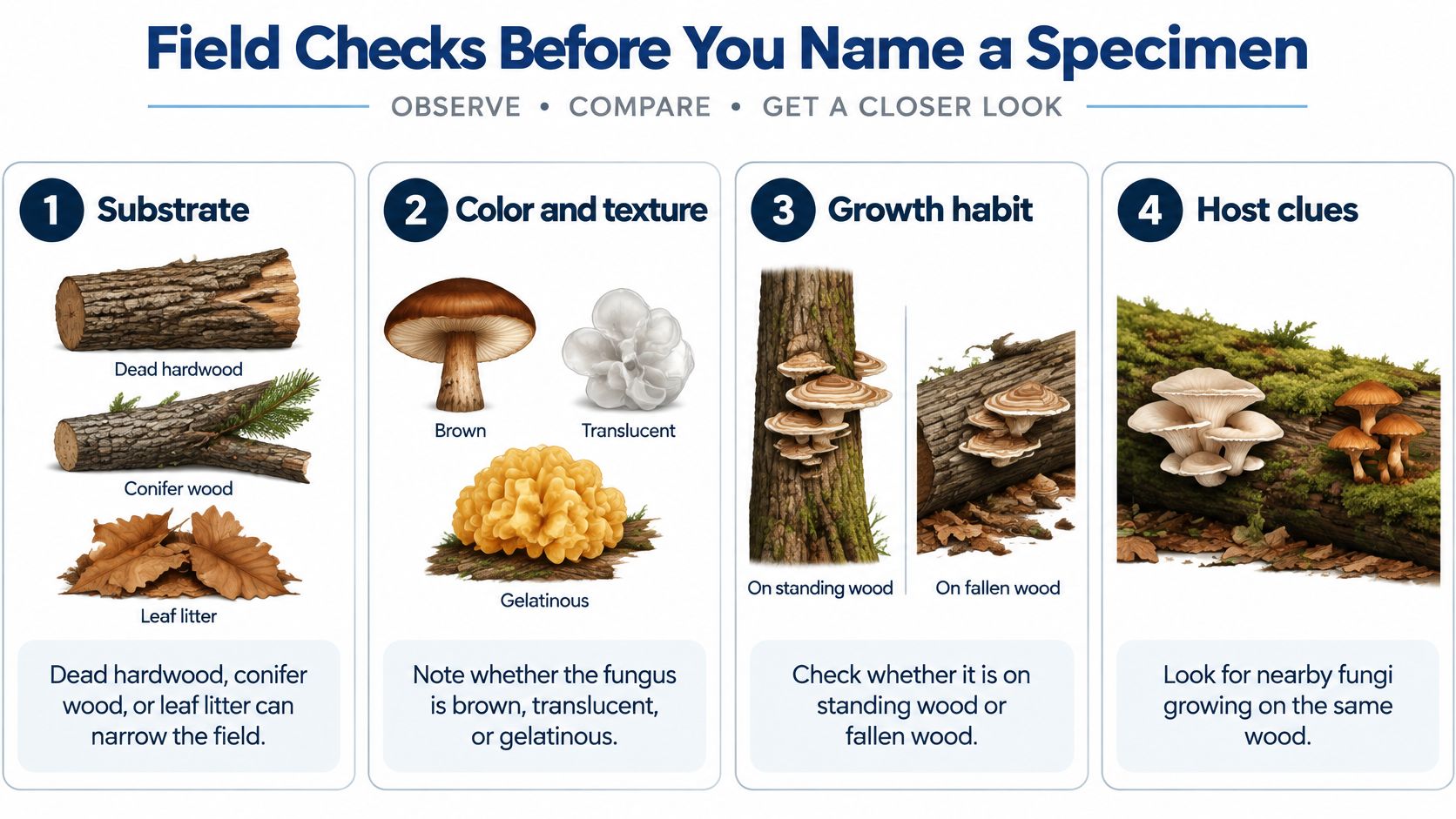
The five checks
Note the substrate first. Is it growing on dead hardwood, conifer wood, or through the surface of another fungus? A jelly on bare wood points one way. A jelly emerging where a crust fungus is living points another way, because some candidates feed on wood and others feed on a fungal host.
Record the moisture state. Write "fully hydrated," "partly dried," or "dry" next to every photo. Jelly fungi shrink into thin, crust-like films as water leaves the gelatinous tissue, then swell again after rain. Without that note, you may compare a dry film with a guide photo of a swollen lobe and reject the right group.
Measure the growth pattern. Use a ruler or coin and record the size in centimeters. Note whether you're looking at separate lobes, small buttons, or a fused mass. That distinction matters because a merged patch can look like a different, larger species.
Check odor and surface detail. Sniff gently and note any smell, or state that there's none you can detect. Photograph the edge of a lobe, the upper surface, and the point where it meets the wood. If you have access to microscopy, spores and other microscopic features can separate genera that look alike to the naked eye. If you're learning basic documentation, our explanation of what a spore print is and what it can tell you will help you understand one part of that evidence, though jelly fungi often need more than a print.
Escalate when confidence is low. Send your photos, substrate note, host tree if you know it, location, and date to a regional mycological society or microscopy lab. Don't ask only, "What is this?" Ask which features support the suggested genus and which features would rule it out.
What moisture does to the evidence
Moisture state | Typical appearance | Identification risk | What to record |
|---|---|---|---|
Hydrated after rain | Swollen, lobed, glossy and gelatinous | Lowest; shape is most visible | Substrate, host wood, size in cm |
Partly dried | Shrunken lobes with uneven color | Color shifts; color alone is unreliable | Photos at two moisture states |
Dry or warm weather | Thin, crust-like film on wood | High; resembles unrelated crusts | Note it was dry; photograph again after rain if possible |
Read that table as a warning about timing. The best field photo is usually the hydrated one, because lobes, folds, and translucency are visible. A dry photo still has value if you label it clearly. It shows persistence on the wood and gives an expert a second state to compare.
Don't name a dry, crust-like jelly from color. Wait for rain, revisit the same log, and photograph the rehydrated form.
A common beginner mistake is collecting first and trying to reconstruct the habitat later. By then, you've lost the host wood, neighboring fungi, and moisture context. Leave the specimen attached until you've finished the checks. If you still can't separate field identification, likely genus, and confirmed species, record it at the level you can defend, for example "Exidia species, unconfirmed," rather than choosing a precise name to fill a blank.
Where They Grow and What They Do in the Wood
A fallen limb after wet weather is a good place to see the difference. The photo below shows the sort of damp, dead wood where a brown jelly fungus becomes visible once it has absorbed water.
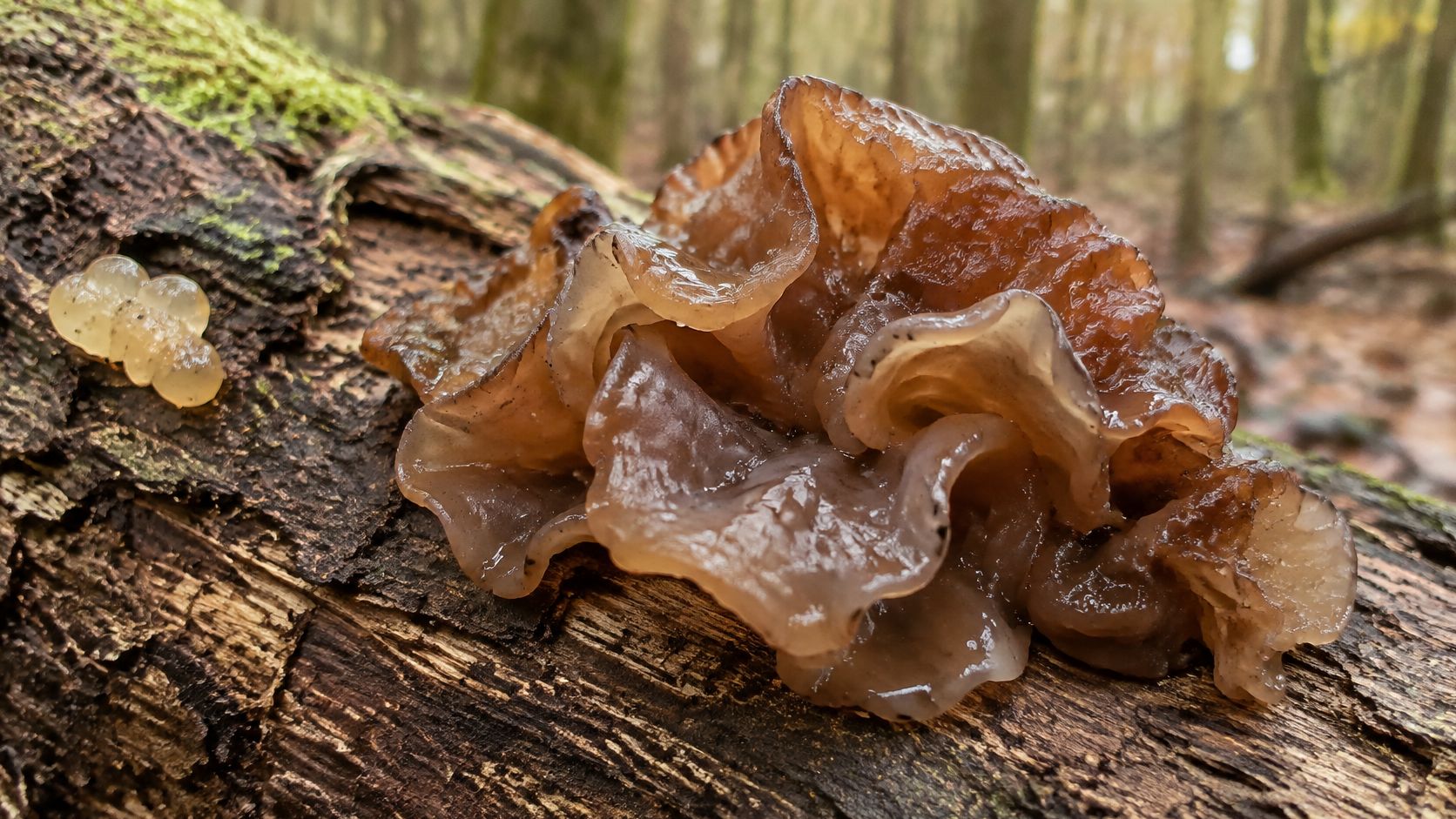
Some fungi rent the building. Others rent a room inside another tenant's space.
Wood-rotting jelly fungi break down dead attached or fallen hardwood over months. Parasitic Tremella relatives live one level up. They draw nutrition from another fungus that's already living in or on the wood, so the wood is their address, not necessarily their food.
The Ensembl Fungi genome page for Tremella mesenterica DSM 1558 summarizes evidence that Peniophora laeta is an in-vivo host, with specialized haustorial filaments forming micropore connections between parasite and host cytoplasm. You can't see that connection in the field, but you can look for its context, a crust-like host fungus on the same piece of wood.
Two field pictures to compare
Golden lobes on a fallen oak limb, with a pale crust spreading beneath them. That pairing suggests a parasite and its host. Photograph both organisms, not just the colorful lobes.
Dark jelly buttons directly on bare, dead hardwood, with no obvious crust beneath. That pattern fits a wood-rotter better, though it still doesn't prove the species.
This is also where habitat notes stop being background trivia. If you want the broader picture of how fungi feed and break material down, read our overview of how mushrooms decompose and grow differently from other organisms. In the field, the practical point is narrow. Record the host wood, whether the wood is attached or fallen, and every fungus sharing the surface.
The short video below is useful for watching how a naturalist handles that context on site, moving from the visible jelly to the wood around it.
In temperate woodland, you'll most often notice these fungi on dead deciduous branches and fallen logs after wet weather in cool seasons. Dry periods don't necessarily mean they've vanished. The visible body may have collapsed while the underlying tissues remain on the wood, ready to swell again.
Is Brown Jelly Fungus Edible and Worth Picking
The name “brown jelly fungus” does not identify one edible species. It covers fungi with different traits, so decide what you hope to do before considering a specimen for the table.
Three outcomes, three evidence thresholds
Observation. A photo and clear notes may be all you need. You can record an uncertain find at genus level without picking it.
Culinary use. First confirm the species, then check that it is documented as edible. A photo that looks similar is not enough to identify a mushroom for eating.
Cultivation. Identify both the fungus and how it gets food. A wood-rotting fungus and a parasite of another fungus need different growing conditions.
Thin brown jellies such as Exidia nigricans offer little culinary value. They have so little substance that picking them adds little to a meal. For these fungi, leaving the specimen in place is often the more useful choice.
Brown Auricularia wood ears are different: they are edible and widely eaten. Their rubbery texture and ear-like form can help distinguish them from shapeless brown lobes, but color and resemblance alone do not confirm an identification. Check the form, substrate, and texture, and seek expert help when needed.
Phaeotremella frondosa does not meet the culinary threshold on the evidence presented here. Older sources may call it Tremella foliacea, so check which species a name refers to before applying advice about use.
For cultivation, wild material needs contamination controls before it goes into an indoor culture. If the fungus is parasitic, label the culture with the proposed host fungus as well as the jelly fungus. Without knowing whether a host is needed, you cannot choose an appropriate growing setup.
If you can't identify the genus with confidence, don't eat it. Observation is still a successful find.
Photograph and Record Before You Decide to Pick
A sharp photo is the cheapest identification tool you own. It preserves color, scale, substrate, and neighbors after the specimen dries or disappears back into the wood.
Use your phone, a coin or ruler, and a notes app. Work before you touch the fungus.
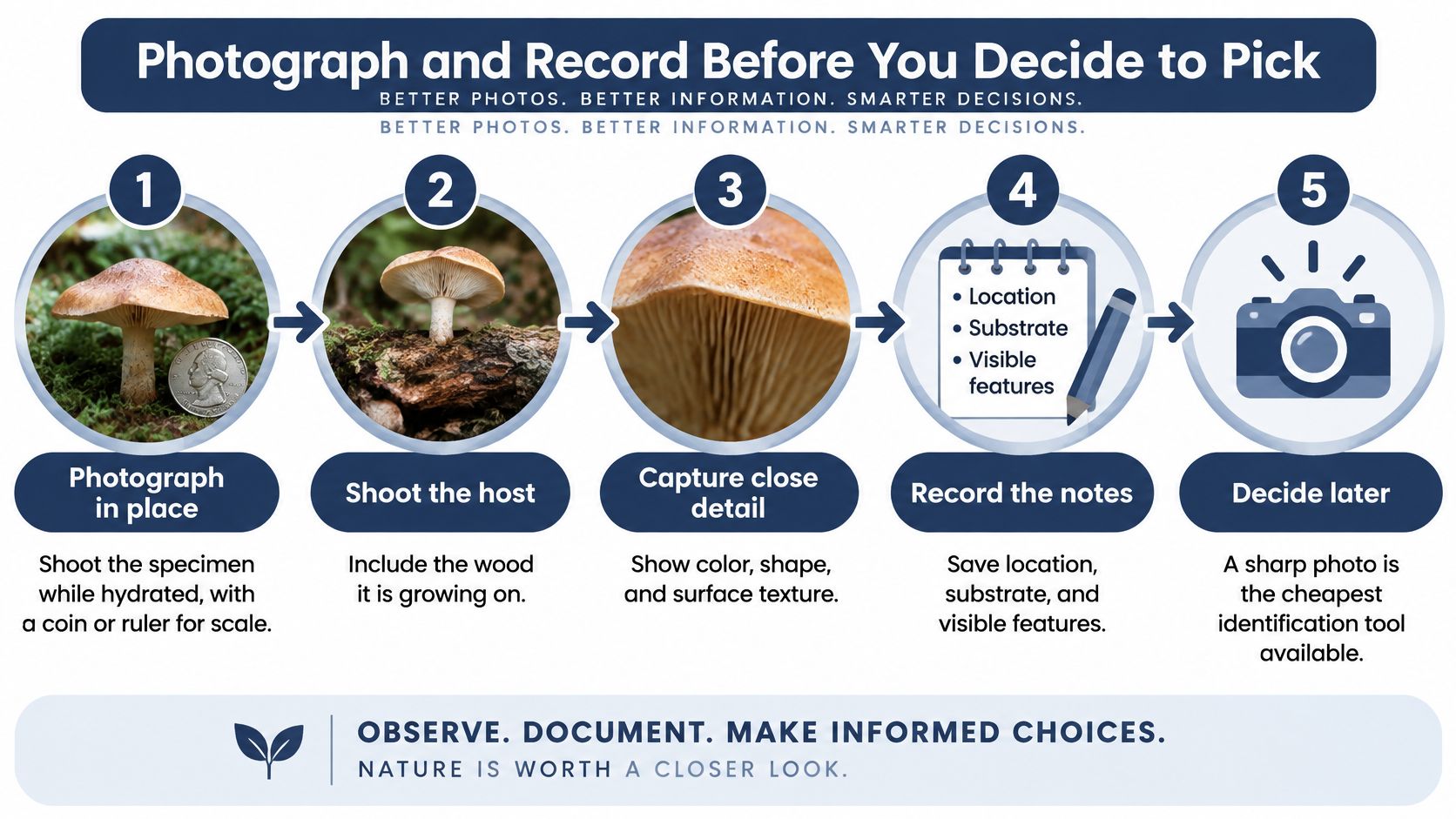
The capture sequence
Photograph it in place while hydrated. Include a coin or ruler for scale, but don't cover the edge of the lobes.
Shoot the host. Step back and show the branch or log, whether it's attached or fallen, and any bark that's still present.
Capture close detail. Photograph the surface, a lobe edge, and the underside or attachment point if you can do so without tearing it away.
Photograph neighboring fungi. Include any crust, bracket, or mold-like growth on the same wood. That neighbor may be the host that explains the jelly's presence.
Record the notes immediately. Write the date, location, substrate, host tree if known, moisture state, odor, and whether the bodies grew singly or in fused masses.
Decide on a reason. Observe only, seek an identification, or collect a small piece for expert or microscopic examination. "It might be edible" isn't a sufficient reason.
Collect cleanly if you collect at all. Cut a piece rather than pulling wood away. Carry it in a paper bag, not sealed plastic, and keep it separate from food mushrooms.
If you can revisit the site, photograph the same patch after it dries and again after rain. Two moisture states often help an expert more than ten nearly identical close-ups taken on one day.
At home, name your files with the date and a provisional label, such as "brown jelly, oak limb, genus unconfirmed." That wording protects you later. A file called "wood ear" can turn a guess into a memory, and memories have a way of becoming false certainty by the next season.
Don't transfer wild material into indoor cultures without contamination controls. Wild wood carries bacteria, molds, insects, and other fungi, including the possible host. Bringing that mixture inside doesn't create a clean culture, and it can compromise unrelated projects.
Your decision rule is simple. If the genus is uncertain, leave the specimen, keep the photos and notes, and contact a regional mycological society or microscopy lab. If you later get a confident species name, apply the correct threshold for observation, food, or cultivation before you pick anything.
When you're ready to move from identifying wild fungi to growing known gourmet species with clean, labeled material, Colorado Cultures offers sterilized grain, substrates, grow kits, classes, and in-person guidance in Lakewood and Englewood. Visit Colorado Cultures to browse supplies, check the CC Classroom calendar, and get help choosing a beginner setup that matches the species you want to grow.
Comments