
Trees That Look Like Mushrooms: 7 Cap-Like Canopies
Ever squinted at a distant tree and mistaken it for a giant mushroom? The more interesting question is why unrelated trees can develop the same cap-and-stem outline. A broad crown above an exposed trunk can result from spreading branches, the loss of shaded lower limbs, browsing animals, or roots that eventually become supporting columns.
Trees that look like mushrooms aren't a botanical group, and their shape doesn't mean fungi caused it. A young tree may look pointed or bushy before developing its familiar umbrella crown. Trees growing close together may also look very different from open-grown specimens of the same species.
For a mushroom-curious naturalist, there's another layer to notice: fungi can partner with living roots, break down fallen branches, or decay damaged wood. Those relationships aren't interchangeable. As you examine these cap-shaped trees, look beyond the silhouette to the leaves, bark, branching pattern, and the precise place where any actual mushrooms appear.
1. Italian Stone Pine (Pinus pinea)
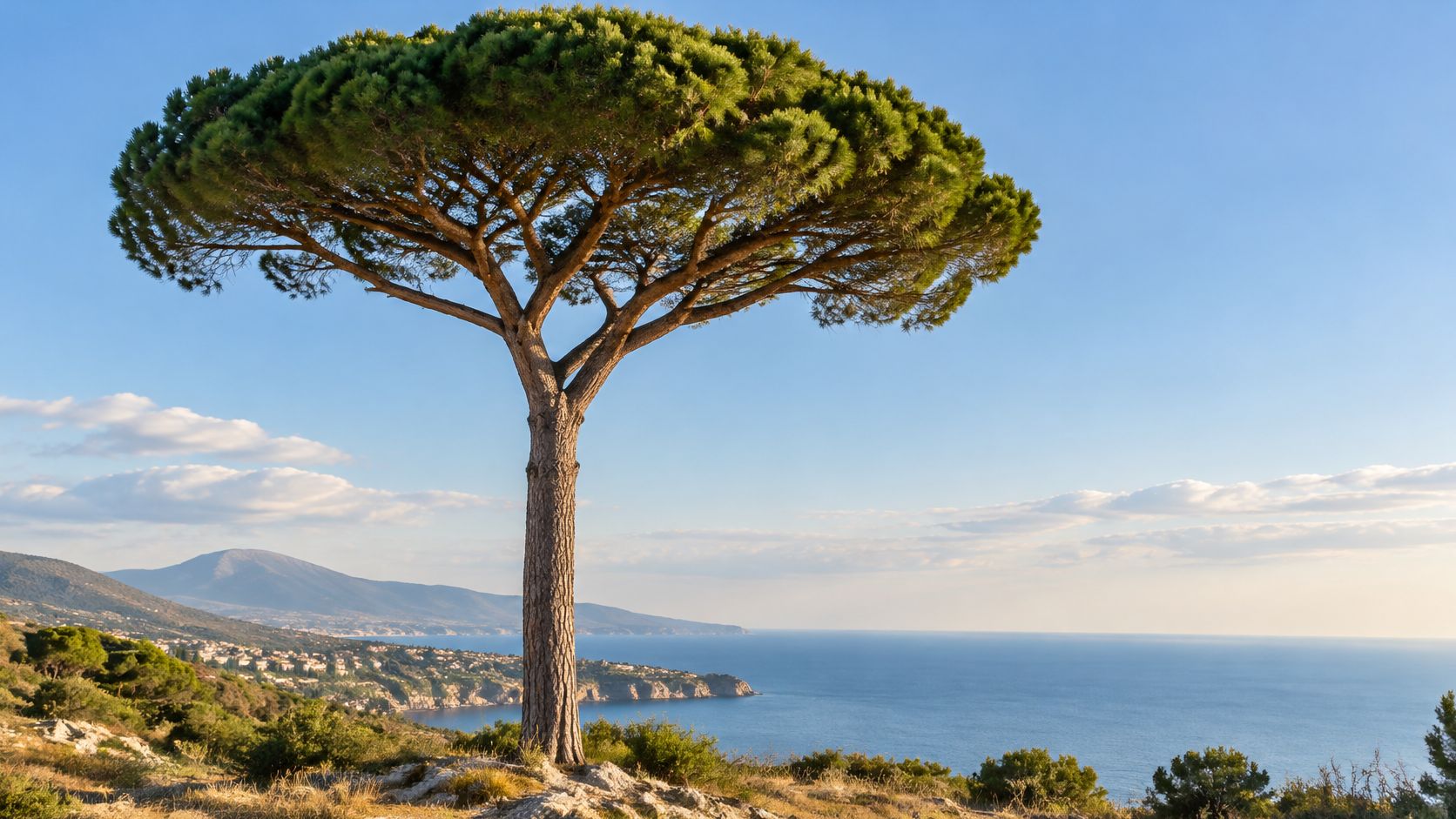
The Italian stone pine is the classic mushroom-shaped tree: a tall, exposed trunk holding a broad, rounded crown. Young trees look more conical, but mature specimens lose lower branches while their upper limbs spread outward. Think of an umbrella opening above a lengthening handle.
The Missouri Botanical Garden's stone pine profile describes mature trees commonly reaching 40–60 feet. Their edible seeds are the pine nuts, or pignoli, associated with Mediterranean cooking.
Look above and below ground
For identification, combine the crown shape with long needles held in bundles, substantial cones, and textured bark. A Mediterranean-style park planting is a useful setting for observing the umbrella outline because open-grown trees have room to spread.
Pines form ectomycorrhizal partnerships: fungi surround fine roots and exchange soil nutrients for sugars from the tree. Some partners produce visible mushrooms, but an absent mushroom crop doesn't mean the underground partnership is missing.
Growing conditions: Choose full sun and freely draining soil, and avoid keeping established roots continually wet.
Colorado expectations: This isn't a dependable outdoor pine for Denver. A bright, protected container setting is more realistic, although indoor light and eventual size remain challenges.
Our guide to mushrooms in Colorado's ecosystem offers a local starting point for understanding fungal roles beyond the mushroom cap.
2. Umbrella Thorn Acacia (Vachellia tortilis)
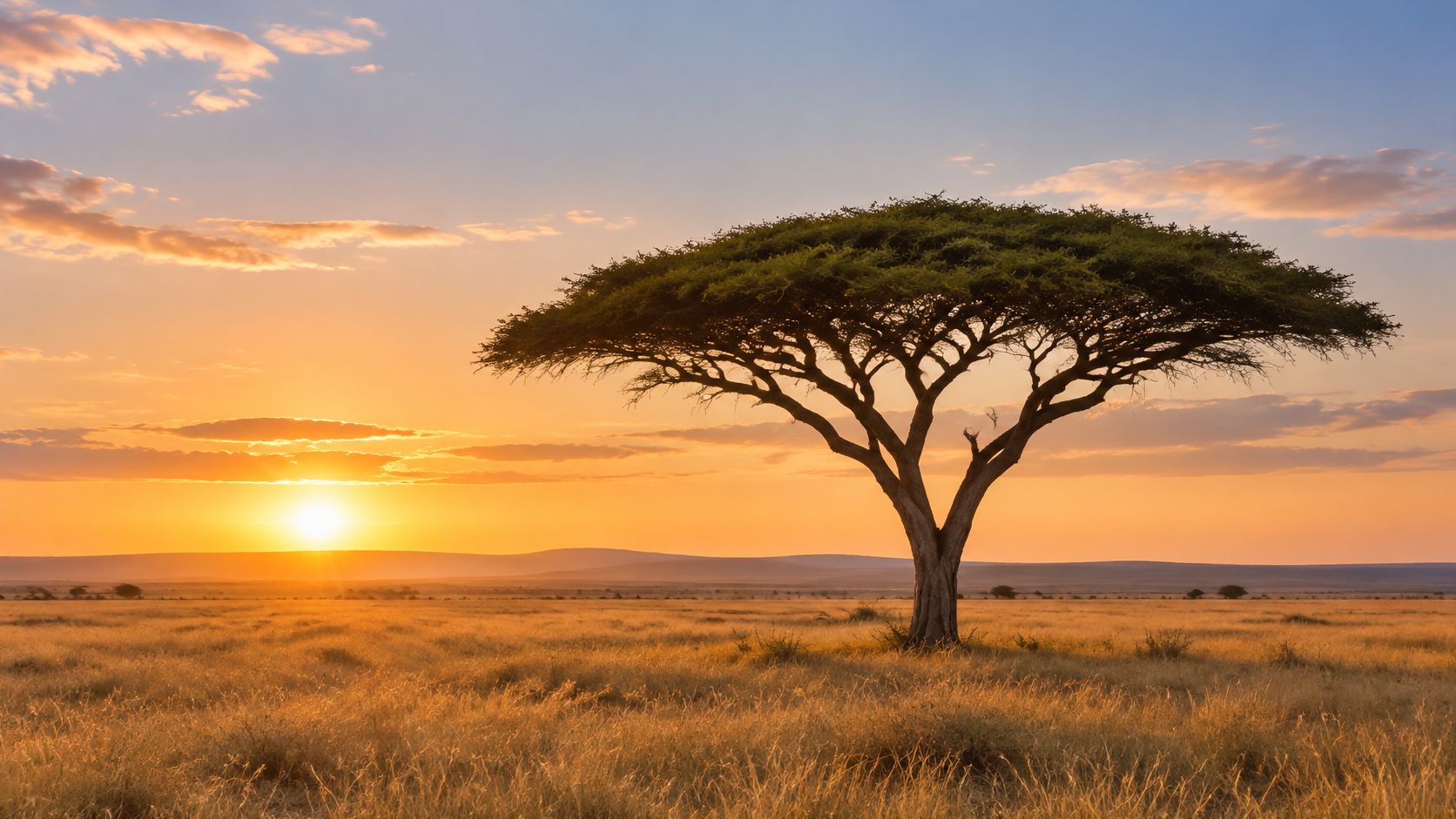
On an African savanna, an umbrella thorn can resemble a shallow mushroom cap balanced above the grass. Its spreading upper branches create the basic outline; browsing animals can accentuate the exposed space beneath by removing reachable foliage. Browsing helps explain some silhouettes, but it isn't the sole cause of the crown.
Look closely before calling every flat-topped savanna tree an umbrella thorn. Fine, divided leaves, conspicuous thorns, and twisted pods are more useful clues than the distant outline alone.
A browse line explains where animals can reach. It doesn't, by itself, identify the tree.
A fungal partnership without obvious caps
Umbrella thorn can associate with arbuscular mycorrhizal fungi inside its roots. Unlike familiar cap-producing woodland fungi, these partners don't advertise their presence with recognizable toadstools beneath the canopy. Root-nodule bacteria are another relationship entirely, not a kind of fungus.
For an educator, this makes the tree a useful comparison with stone pine: similar crowns can stand above quite different belowground partnerships.
In a warm, arid garden, allow room for natural branching and keep thorny limbs away from paths. Use well-drained soil, protect young plants from browsing, and avoid heavy pruning to force a flat top. In Colorado, treat it as a protected botanical specimen rather than an outdoor shade-tree recommendation.
3. Monkey Pod (Samanea saman)
Stand beneath an open-grown monkey pod, also called a rain tree, and the mushroom comparison becomes easy to understand. Long, spreading limbs hold a broad dome of foliage, often creating a stronger impression of width than height.
Unlike the stone pine's parasol, this crown can look like a low, generous cap. Leaflets fold during darkness and can respond to changing weather, altering how much light filters through the branches.
Identify the whole tree
Leaves: Look for feathery, compound foliage made up of small leaflets.
Flowers: Pinkish, brushlike flower clusters help distinguish it from other tropical shade trees.
Setting: A spacious tropical park is a more plausible home than a narrow pavement planting.
A park lawn in Hawaii provides a useful viewing scenario: step back to see the dome, then move beneath it to follow the major branches outward. Don't assume a dense crown is just a ball of foliage; its supporting framework explains the shape.
The mycology connection is partly beneath your feet. Root-associated fungi can help the tree obtain nutrients, while decomposers work through fallen leaves, pods, and dead twigs. A mushroom growing from buried wood is performing a different job from a fungus associated with living roots.
For planting, leave generous clearance from buildings and paving. Water young trees during dry spells, and have a qualified arborist develop sound branch structure rather than repeatedly cutting back the crown.
4. Queensland Umbrella Tree (Schefflera actinophylla)
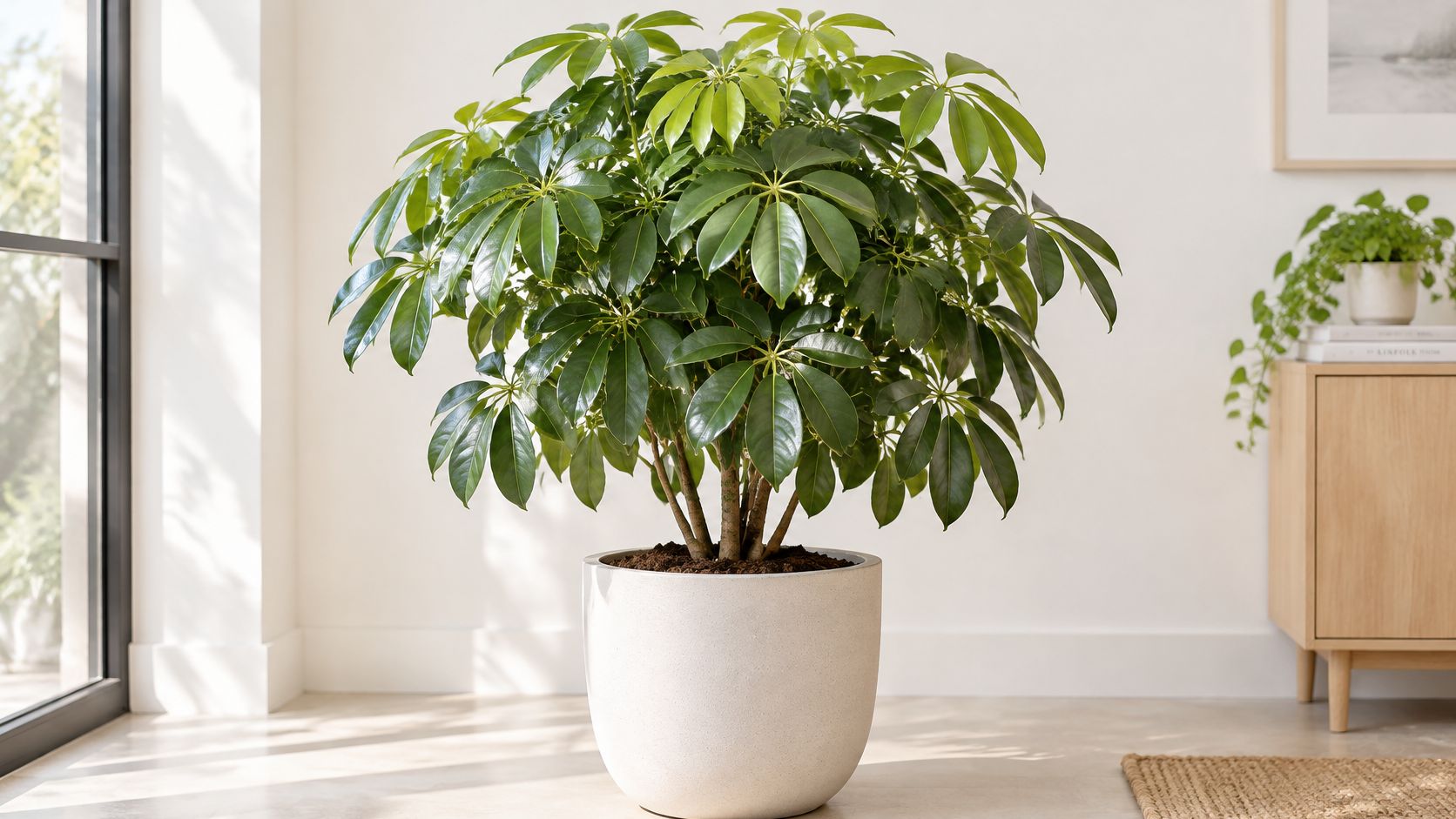
The Queensland umbrella tree offers a different kind of mushroom resemblance. Its leaflets radiate from a shared point like umbrella spokes, and clusters of those leaves can form a rounded crown above exposed stems.
That makes it useful for studying shape indoors, although a nursery plant won't necessarily develop the silhouette of a mature outdoor tree. Don't confuse it with every smaller houseplant sold under the umbrella-plant name.
A practical indoor comparison
In a Denver classroom, place a specimen where students can compare an individual umbrella-like leaf with the outline of the whole plant. Look for glossy, elongated leaflets arranged like fingers around the end of a stalk.
Give it bright, indirect light and a pot with drainage holes. Water thoroughly when the surface layer has dried, then empty the saucer instead of leaving the roots standing in water.
Container insight: Mushrooms in potting mix may be decomposing bark or other organic ingredients. Their presence alone doesn't establish that the living plant is diseased.
Don't eat unidentified pot mushrooms, and keep them away from children and pets. Persistent sogginess, wilting, or deteriorating roots deserves attention regardless of whether mushrooms appear.
For an outdoor subtropical planting, check local invasive-plant guidance first. Use landscape software for homeowners to visualize canopy placement, but confirm suitability and mature spread independently.
5. Chinese Parasol Tree (Firmiana simplex)
Smooth green bark is a better starting clue for Chinese parasol tree than its silhouette. Add large, palmately lobed leaves and an upright trunk supporting a rounded crown, and the identification becomes more convincing.
An open-grown specimen can resemble a mushroom because its large leaves overlap above visible supporting branches. The effect changes with the seasons: once this deciduous tree sheds its leaves, the leafy cap becomes an exposed branching framework.
Read the crown without diagnosing disease
In an East Asian-style courtyard garden, compare a leafy summer view with a winter photograph from the same position. That simple exercise separates foliage shape from permanent branch architecture.
Crown form responds to growing conditions as well as species identity. The tree-architecture publication collection at SelvaLab provides context for understanding crowns through light interception and competition rather than treating each outline as a fixed template.
The fungal connection is easiest to observe on fallen material. Decomposer fungi can colonize shed twigs and dead wood, but a fungus on a detached branch doesn't automatically diagnose disease in the standing tree.
Planting choice: Use a sheltered position with well-drained soil and adequate establishment watering.
Identification habit: Photograph the bark and a complete leaf, not just the crown.
Local caution: Check regional hardiness and invasive status before planting. An attractive specimen elsewhere isn't proof of suitability for a Front Range garden.
6. Banyan Tree (Ficus benghalensis)
A banyan turns the mushroom analogy into something closer to a cap supported by extra stems. Branches send aerial roots downward; roots that reach suitable ground can thicken into supporting columns.
The infographic below highlights the banyan's appeal and the space considerations behind that unusual architecture.
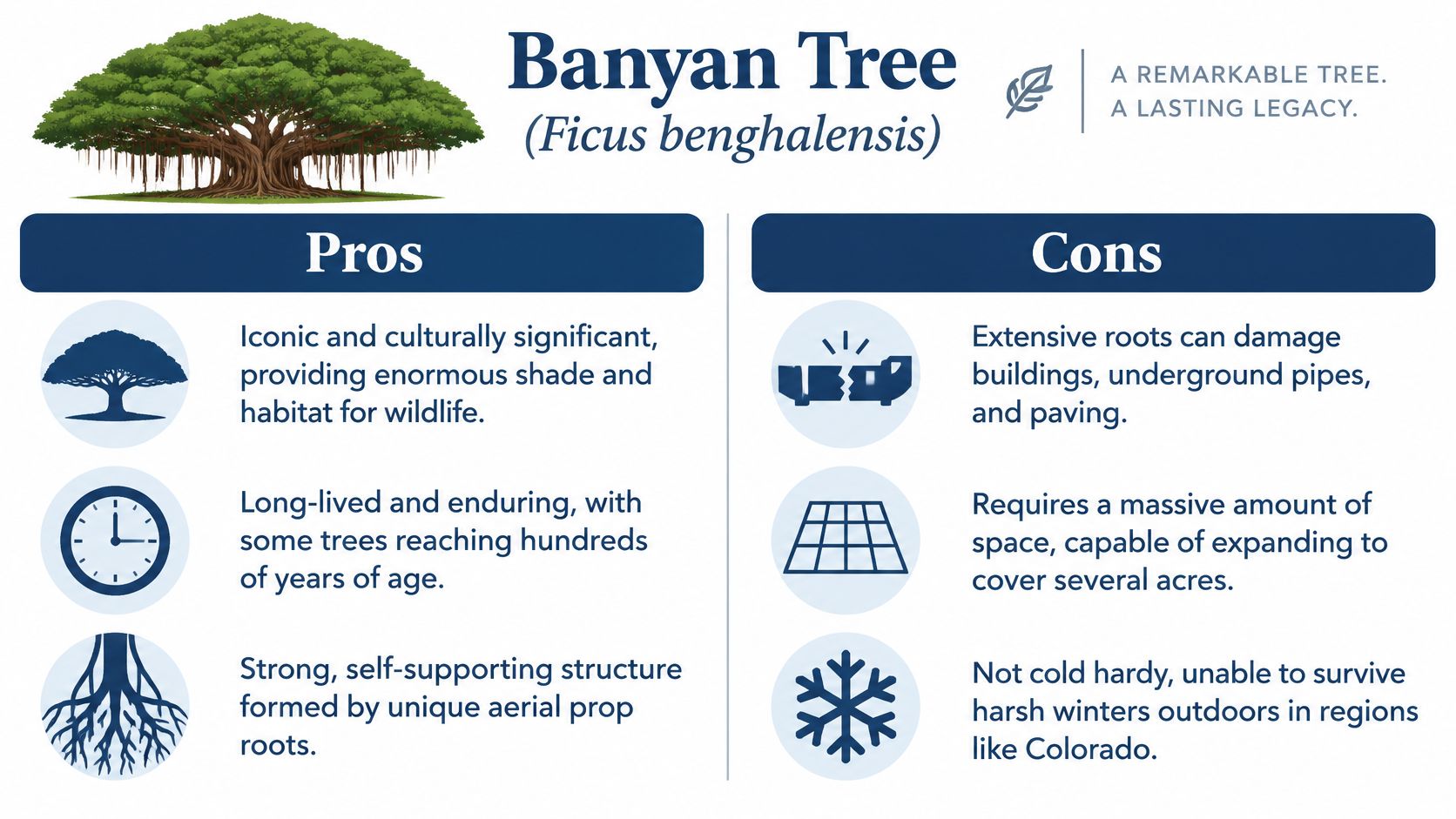
Its crown is not just perched on a single bare trunk. Over time, the tree can support spreading branches with a network of rooted props, making the boundary between trunk and root surprisingly difficult to trace.
Follow a root from branch to soil
At a tropical botanical garden, look for hanging root strands, thicker columns, leathery oval leaves, and small fig fruits. Not every banyan-like fig is Ficus benghalensis, so use the garden label and foliage details to confirm your observation.
This video provides another view of the tree's distinctive form.
For the mushroom observer, distinguish living support roots from dead woody material within or beneath the crown. Fungi decomposing dead wood aren't necessarily attacking every adjacent living column. Our guide to mushrooms growing on a log explains the dead-wood side of that relationship.
Plant banyans outdoors only where climate and space permit their expansive growth. Keep them away from structures and utilities; in Colorado, a greenhouse or bright indoor container is the practical approach, without expecting the sprawling architecture of a tropical landmark.
7. Live Oak (Quercus virginiana)
A Southern live oak often looks less like a tall parasol and more like a broad mushroom cap settling toward the ground. Long, low limbs spread horizontally, then branch into a dense, rounded canopy.
An open-grown park specimen makes the pattern easy to see. Trees crowded by neighbors may grow more upright, so the iconic dome isn't guaranteed.
Confirm the oak, then inspect the fungi
Look for small, leathery leaves, acorns, and rough bark. Spanish moss may hang from branches in humid southern settings, but it isn't a fungus and isn't part of the oak itself.
Oaks form ectomycorrhizal partnerships with root-associated fungi. Other fungi decompose their dead wood, and some decay living trees internally. The crown architecture and light-capture chapter by Valladares and Niinemets helps distinguish natural crown architecture from the separate concern of fungal growth on wood.
Safety first: A leafy mushroom-shaped crown isn't a disease symptom. A shelf-like fungus attached to a major limb or trunk deserves closer assessment, especially near people or buildings.
Photograph attached fungal growth and consult a qualified arborist rather than removing it and assuming the problem is solved. For cultivation, mushroom log kits are a separate subject from mushrooms appearing on a living tree.
Regional advice such as oak care for Newcastle gardens needs local interpretation. Denver gardeners should choose locally suitable, cold-hardy oaks rather than expecting Southern live oak to thrive.
7 Trees With Mushroom-Cap Canopies at a Glance
Tree | Native Range | Canopy Shape | Climate Tolerance | Best Known For |
|---|---|---|---|---|
Italian Stone Pine (Pinus pinea) | Mediterranean Basin | Flat, broad umbrella crown | Drought-tolerant; not reliably cold-hardy | Edible pine nuts and iconic umbrella form |
Umbrella Thorn Acacia (Vachellia tortilis) | Drier parts of Africa and the Middle East | Flat-topped, umbrella-shaped crown | Highly drought-tolerant; frost-sensitive | Defining tree of African savannas |
Monkey Pod (Samanea saman) | Tropical Central and South America | Broad, dome-shaped spreading crown | Fast-growing in tropical climates; frost-sensitive | Extensive shade and leaves that fold at night |
Queensland Umbrella Tree (Schefflera actinophylla) | Australia and New Guinea | Dense, rounded umbrella-like canopy | Suited to warm climates; not frost-hardy | Ornamental evergreen and popular houseplant |
Chinese Parasol Tree (Firmiana simplex) | China, Korea, and Japan | Broad, open, dome-shaped crown | Tolerates urban conditions; can struggle in extreme cold or dryness | Green bark and wood traditionally used for instruments |
Banyan Tree (Ficus benghalensis) | Indian subcontinent | Vast spreading canopy supported by aerial roots | Tropical; not cold-hardy | Aerial roots, enormous shade, and cultural significance |
Live Oak (Quercus virginiana) | Southeastern United States and Gulf Coast | Wide, domed crown with spreading limbs | Tolerates coastal conditions and some salt spray; not suited to harsh winters | Historic Southern shade tree and exceptional longevity |
From Cap-Shaped Canopies to Real Caps Key Takeaways
The mushroom silhouette appears in unrelated trees because branches can spread above an exposed trunk in several ways. Mature pines lose lower branches, browsing can emphasize a savanna tree's clear underside, and banyans add supporting roots beneath an expanding crown. Similar outlines don't mean identical growth processes.
Nor does every broad crown represent a special adaptation to make a mushroom shape. Age, available light, neighboring trees, pruning, and growing conditions all influence what you see. A sapling in a nursery may offer little hint of its eventual outline.
Observe shape, identity, and fungal role separately
Start at a distance: Notice whether the crown is domed, flattened, or supported by low spreading limbs.
Move closer: Examine leaves, needles, bark, fruits, and branching patterns before naming the tree.
Locate the fungus: Distinguish mushrooms emerging from soil, dead wood, potting mix, or living woody tissue.
Respect uncertainty: Neither the host tree nor a mushroom's appearance alone establishes edibility.
The most useful distinction for beginning mycologists is between partnership and decomposition. Root-associated fungi exchange resources with living trees; decomposers obtain food from dead organic material. Decay fungi on living trees raise another set of questions, especially when damaged wood supports a heavy branch.
For Colorado gardeners, enjoy tropical crowns without assuming they're suitable for outdoor planting. Some can be maintained as protected container specimens, but indoor plants may never develop their outdoor form. Locally adapted trees offer a more dependable way to create lasting shade.
You don't need to grow a tropical tree to explore fungi. Careful observation, photographs, and controlled mushroom cultivation let you investigate the fungus half of the relationship while leaving unfamiliar wild mushrooms undisturbed. The canopy may catch your attention first, but the hidden biology is just as rewarding.
At Colorado Cultures, we offer mushroom grow kits, sterilized grain, substrates, and mycology tools for exploring real caps at home. Visit our online store or our Lakewood and Englewood storefronts, and use our product instructions, classes, and personal guidance to turn curiosity about trees and fungi into a hands-on growing project.
Comments