
Skull Shaped Puffball: How to Identify and Avoid Mistakes
You're walking past the edge of a lawn when a pale, wrinkled ball catches your eye. It looks oddly like a skull, or perhaps a brain, and you wonder whether you've found a skull shaped puffball.
The mushroom generally meant by that name is Calvatia craniiformis, also called the brain puffball. But the resemblance is a starting point, not an identification. Before you think about collecting it for food, you need to check where it grows, how its skin behaves, and what's inside.
Spotting the Skull Shaped Puffball by Its Outside
A skull shaped puffball produces its spores inside the fruiting body rather than on exposed gills. As it matures, that interior becomes a powdery spore mass. The MushroomExpert species account identifies Calvatia craniiformis by a combination of its form, surface, and internal features, not by a skull-like outline alone.
Start by looking without squeezing or breaking the specimen. Notice whether the rounded upper portion narrows into a substantial base, and whether the surface looks smooth, folded, or already broken apart. Photograph it where it stands before moving surrounding grass or leaves.
Exterior features of the skull shaped puffball
Feature | What to look for | Confirms the species | Rules it out |
|---|---|---|---|
Shape | Inverted-pear form, becoming lobed and brain-like with age | A folded upper body above a pear-like base supports identification, but doesn't confirm it alone | A smooth round ball isn't decisive; it may be young or a different puffball |
Surface | Whitish to pale brown, smooth initially | Cracking and peeling skin on an aging specimen supports identification | Hard, thick, scaly skin suggests an earthball |
Size | A medium-to-large fruiting body; published descriptions give different ranges | Size consistent with the other features supports identification | A tiny specimen calls for comparison with smaller puffball groups, not an automatic verdict |
Spore release | Spores develop internally and eventually become powdery | The absence of gills is consistent with a puffball | Visible gills indicate a different kind of mushroom |
Supporting clues aren't confirmation
Read the confirmation column as a collection of supporting clues. None is exclusive to this species. A pear-shaped base occurs in other puffballs, while a young brain puffball may not yet have the folds that make photographs memorable.
Likewise, “no gills under the cap” needs care: a puffball doesn't have a conventional cap to turn over. If your specimen clearly has a cap and stalk, you're already considering another form of mushroom.
Field rule: A convincing outline earns a closer inspection, not permission to eat.
Leave the specimen intact until you've recorded its setting. The outside helps narrow the possibilities; a full-length cut provides essential evidence that the surface can't.
Where and When Skull Shaped Puffballs Grow
Follow the lawn edge toward a ditch or an open patch beside woodland. Those transition zones deserve a slow look because Calvatia craniiformis fruits from soil and among organic debris, and it doesn't grow directly from living trees.
That habit reflects its ecology. The fungus is saprobic, meaning it obtains nutrients by breaking down dead organic material. A specimen may appear alone or with others nearby, including in lawns, meadows, drainage ditches, roadside edges, leaf litter, and disturbed grassy ground.
Read the ground before the map
Suppose you find a pear-shaped cluster beside an old stump. Before calling it a skull shaped puffball, check whether the fruiting bodies attach to decaying wood or buried roots. A wood-based cluster points toward stump puffballs, while loose specimens sitting on open soil fit a Calvatia.
Substrate works like an address check: a convincing silhouette in the wrong place is a wrong answer. The Journal of Threatened Taxa account describes fruiting bodies approximately 6–20 centimeters tall and commonly 8–20 centimeters across, and records a broad fruiting period from March through November. That calendar describes reported occurrence across the range, and it can't promise fresh specimens in your neighborhood at any point in that window.
Old fruiting bodies may persist after active growth has ended. A dry remnant tells you that the fungus fruited there, but it doesn't establish when it was fresh. That persistence matters for identification, because the skull-like folds deepen as a specimen ages. A weathered remnant can look more convincingly "skull" than a young fresh one ever will.
Put a local find in geographic context
A broad distribution doesn't make every local identification plausible. Regional field guides and verified observations are more useful than a photograph taken in a distant climate.
For Colorado finders, lawns, pasture margins, and open grassy woodland edges are reasonable habitats to inspect during warm conditions. Cold mountain sites offer a narrower fruiting window than sheltered lower-elevation ground. Check local records rather than assuming a widespread species must appear wherever a similar puffball does.
Why the Skull Shape Forms and What It Tells You
Think of the skull shape as a maturity clock, not a species badge. It offers clues about development, but it can't give an exact age or establish identity by itself.
Look at the folds as evidence to investigate, rather than as a finished identification.
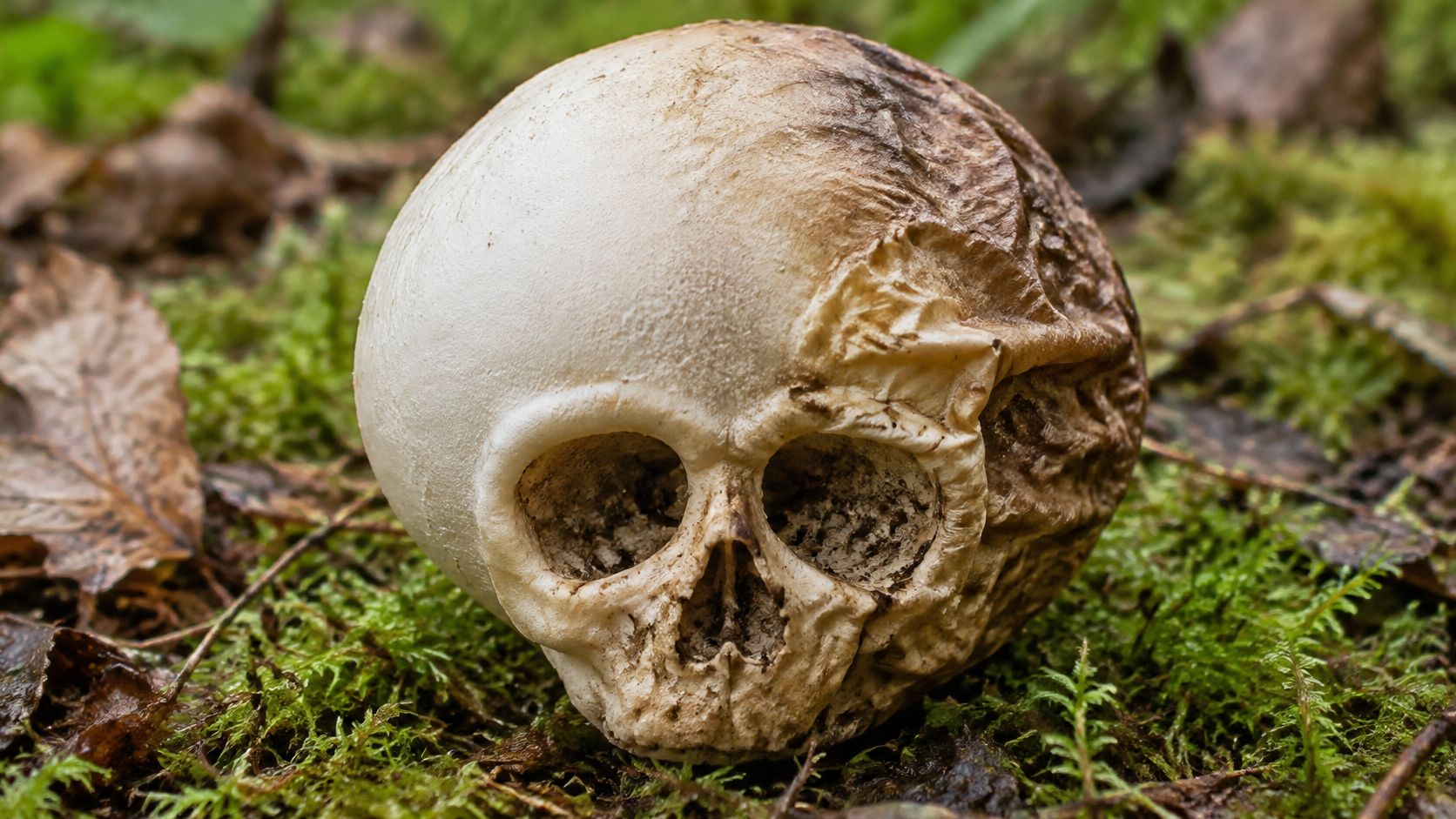
The fruiting body begins relatively smooth. As it develops, its surface becomes wrinkled and folded, and the outer wall eventually cracks or flakes away. Inside, the spore-bearing tissue changes toward olive-brown material.
That sequence explains why photographs carrying the same common name can look surprisingly different. A smooth pale specimen and a folded, deteriorating specimen may represent different stages rather than different species. Conversely, unrelated puffballs may look alike while young.
What a photograph can't establish
Photo-identification tools can suggest candidates, but they can't inspect tissue hidden inside an intact mushroom. Lighting can also distort pale colors, and a close crop can conceal whether a specimen grows from wood or soil.
The Mushroom Identification encyclopedia discussion describes a 2025 study using molecular and morphological evidence to distinguish puffball species. Such work helps refine species boundaries and regional records beyond what a dramatic photograph can establish.
Use moving images to observe form and handling, not as an eating verdict.
A useful image-recognition result gives you names to investigate. You still need the base, the cut face, the habitat, and appropriate regional knowledge.
A skull-like shape is a hypothesis to test, not a verdict.
Weathering and damage can further alter an outline. Don't try to assign an exact developmental stage from the depth of the wrinkles; inspect the internal tissue instead.
How to Cut and Check the Interior
The outside can mislead, so a full vertical cut is essential before any eating decision. It can expose disqualifying structures and show maturity, but it doesn't independently prove the species or its safety.
The Calvatia craniiformis species description gives typical dimensions of 5–15 cm tall and 5–10 cm wide, with larger specimens reported. For inspection, it describes a substantial sterile base beneath the gleba, the tissue that produces spores.
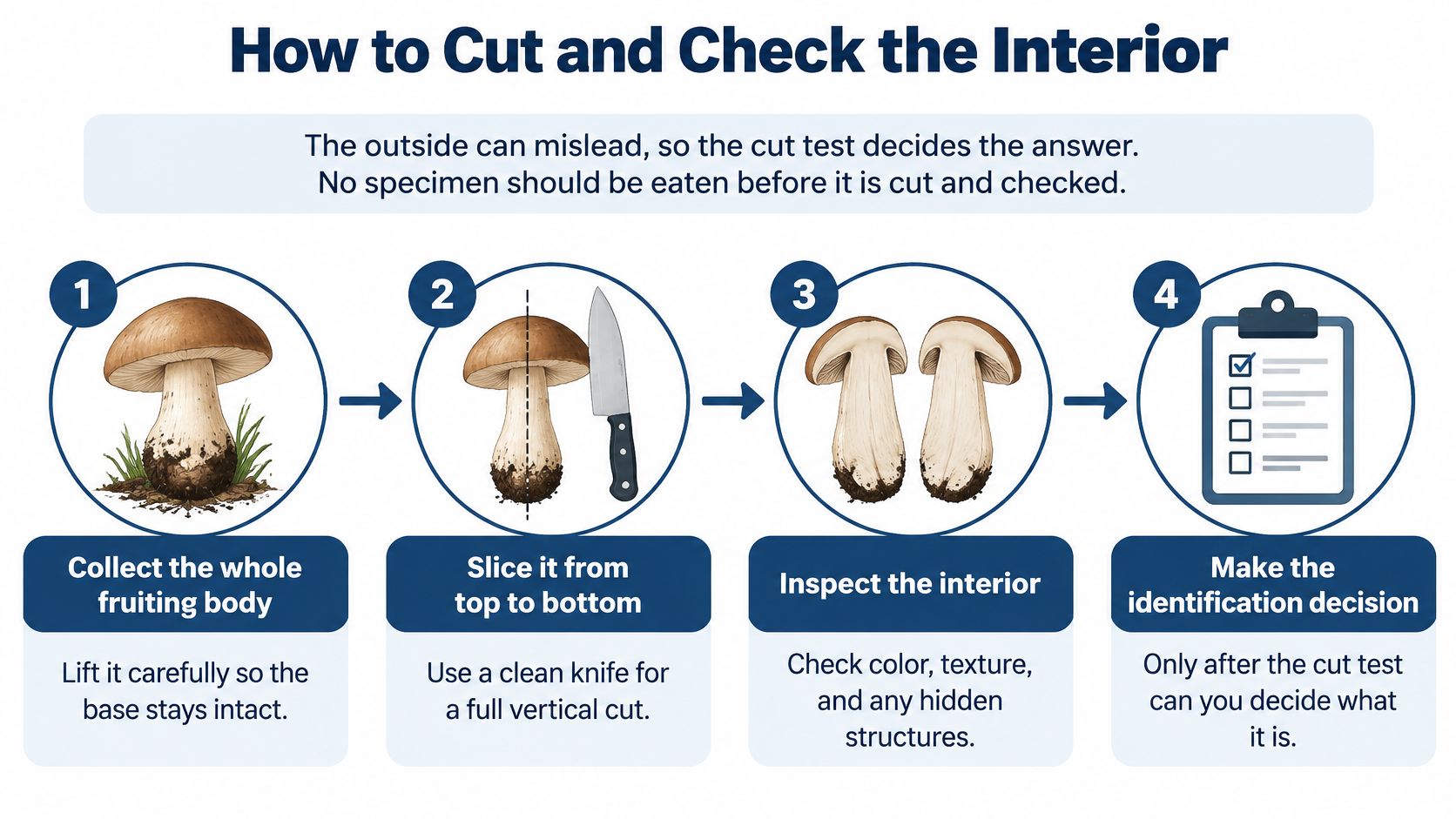
Use this illustrated sequence as a handling reminder, then examine the actual specimen carefully.
Make a complete inspection
Collect the entire fruiting body only where permitted. Lift it carefully so the base remains attached, and keep it cool and separate from other finds in a paper bag or rigid container. A missing base can remove useful identification evidence.
Use a clean knife to slice from the top through the center and down through the base. Gloves help keep your hands clean, but avoiding airborne spore dust matters more than covering your skin. Don't squeeze a mature specimen or hold it near your face.
Find the sterile base. This lower portion doesn't produce the main spore mass and should be distinguishable from the upper gleba. Note its structure and condition; crumbling or decayed tissue isn't a suitable food candidate.
Read the freshly exposed interior in good daylight. Uniformly white, firm tissue is consistent with an immature puffball; yellowish tissue indicates developing spores, while olive-brown powder indicates maturity. Don't trim away a colored area and treat the remainder as an immature specimen.
Look for organized mushroom structures. Gills, a developing cap, or an enclosing sac-like wrapper contradict a straightforward puffball identification. Stop the food assessment and seek expert identification.
Photograph the whole cut face beside a ruler, including the base. Record the substrate and surrounding vegetation so a knowledgeable identifier can evaluate more than a close-up of white flesh.
Preserve useful evidence
Don't wash the specimen before documenting it; washing can remove surface details and attached material. Photograph both halves promptly because drying and handling can change their appearance.
A conventional spore print isn't a substitute for this inspection. Puffballs develop their spores internally rather than dropping them from exposed gills.
A uniformly white, firm interior clears an important screening check. It is not proof of safety, and an uncertain specimen stays off the plate.
Look-Alikes That Can Be Mistaken for It
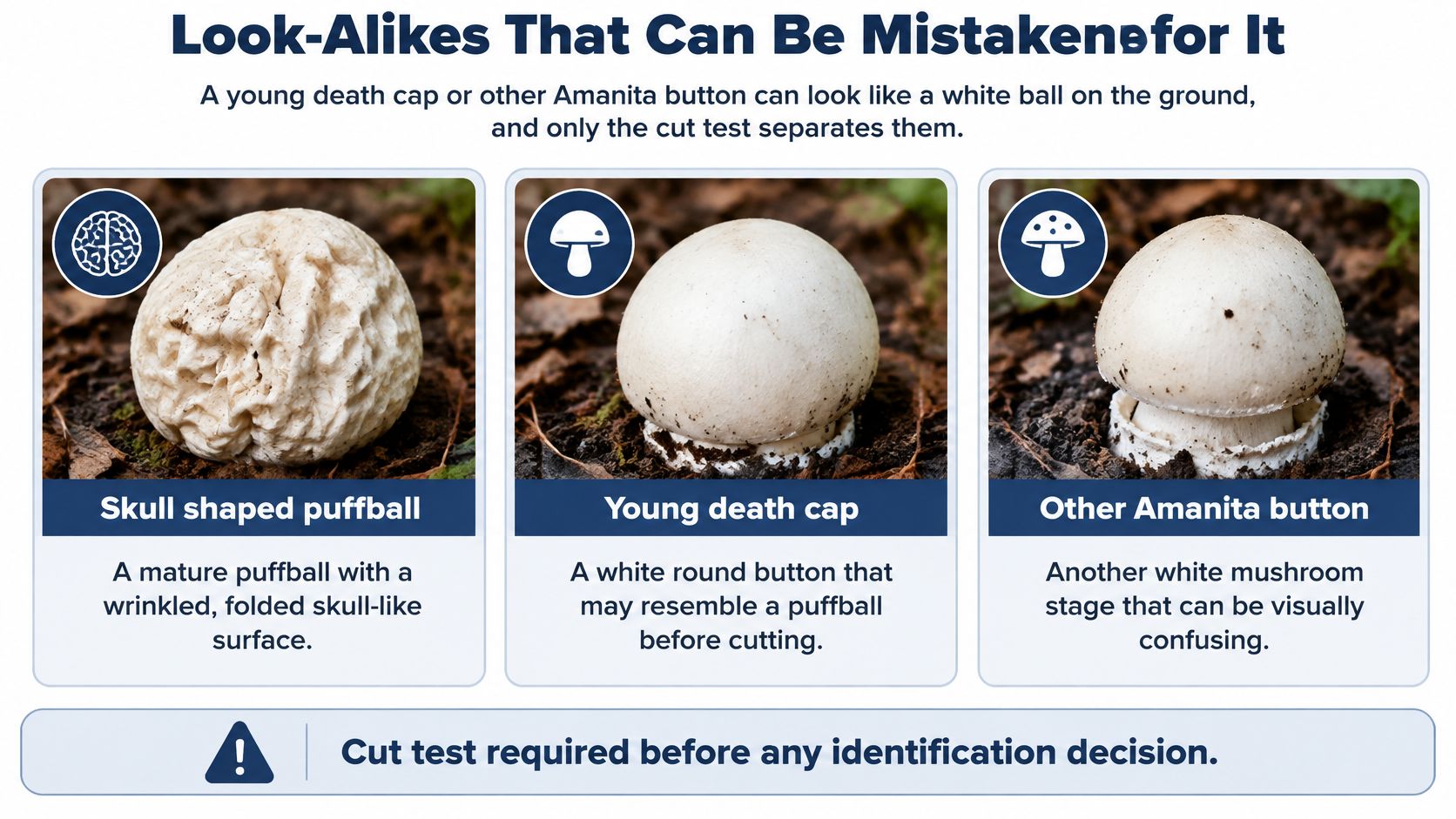
The most dangerous mistake is treating a young death cap or another Amanita button as a puffball. An unopened mushroom can resemble a pale ball while enclosing a developing cap and gills.
A complete cut can reveal those structures. Don't assume that a small opening, a peeled patch, or a glance at the underside is enough.
This comparison illustrates why an intact white exterior can't settle the question.
Compare habitat, skin, and interior together
Look-alikes compared by habitat, skin and interior
Look-alike | Interior |
|---|---|
Giant puffball (Calvatia gigantea) | Often much larger and rounder, with white flesh when young; usually soil-growing, without the characteristic narrowed skull-like base |
Purple-spored puffball (Calvatia cyathiformis) | May overlap in size and grassy habitat; the mature spore mass becomes purplish rather than olive-brown |
Stump or pear-shaped puffball (Lycoperdon pyriforme) | Habitat is the first check: clusters attach to decaying wood, sometimes buried; young interiors may also be white |
Earthball (Scleroderma) | Thick, tough, often scaly skin surrounding a darkening spore mass; not eaten |
Young Amanita button | A developing cap, gills, or enclosing wrapper may be visible in section; some species can be deadly |
Size is useful for comparing candidates, but not for setting a safe boundary. A purple-spored puffball isn't reliably excluded because it seems too large, and a young giant puffball doesn't have to look giant.
Earthballs deserve particular caution because their firm skins can make them feel reassuringly solid. Toughness isn't a safety test. Inspect the entire cut face rather than judging by resistance to a finger press.
Don't turn a comparison into a shortcut
Stump puffballs can appear to emerge from soil when their wood substrate is buried. Brush away loose litter and inspect the attachment without tearing apart the site.
Other mushrooms also change dramatically with age, as the shaggy ink cap identification guide illustrates. A familiar mature appearance doesn't tell you what every immature stage looks like.
The practical distinction is cumulative: habitat narrows the candidates, skin supplies another clue, and the interior can reveal decisive contradictions. If those observations don't agree, don't force the specimen into the name you expected.
When the Skull Shaped Puffball Is Safe to Eat
White doesn't automatically mean safe. White internal tissue is a maturity criterion for an identified edible puffball, not a universal test for edible mushrooms.
An immature Calvatia craniiformis is widely regarded as edible once its identity is confirmed. The qualification matters: an unidentified white ball isn't a food ingredient, even if an image search returns convincing matches.
Edibility verdict by interior stage
Stage | Interior appearance | Verdict |
|---|---|---|
Immature | Firm, uniformly white inside, with no gills or cap outline | Widely regarded as edible once the identity is confirmed |
Developing | Yellowish color beginning in the spore mass | Do not eat; no longer fresh edible tissue |
Mature | Olive-brown, powdery spore mass | Do not eat |
Amanita button | Gills, a cap outline, or an enclosing sac-like wrapper | Never eat as a puffball; some Amanitas can be deadly |
Unverified or uncut | Interior not examined | Do not eat; photograph and leave it |
Treat preparation as a separate safety check
Once an expert has confirmed a suitable specimen, assess its condition and collection site. Reject decayed, waterlogged, or heavily insect-damaged tissue. Avoid collecting food from chemically treated lawns, contaminated ground, or roadside runoff areas.
Cook an edible specimen thoroughly rather than sampling it raw. When trying an identified edible mushroom for the first time, eat only a small portion, and don't mix it with unfamiliar species. Individual reactions can occur even with edible mushrooms.
Cooking doesn't make a poisonous look-alike safe. Neither does peeling, drying, freezing, or cutting away suspicious tissue.
Kitchen boundary: Preparation begins after identification, never instead of it.
Respond promptly to suspected poisoning
If someone has eaten an uncertain mushroom, contact Poison Help or an appropriate poison center for advice. If they feel unwell, seek urgent medical guidance; use emergency services for severe symptoms.
Don't wait for an online identification before getting help, and don't induce vomiting unless a medical professional instructs you to. Keep remaining mushroom material, photographs, and details of when it was eaten available for the treating team.
A reassuring appearance or an initially symptom-free period isn't a reason to delay asking for advice.
Decide Whether to Collect, Report or Leave It
Make the decision in order: identity, condition, then permission. Confirming the species doesn't make an old specimen suitable for food, and finding a fresh edible specimen doesn't give you permission to remove it.
If you can't resolve an identification in the field, documentation is still worthwhile. You don't need to harvest a mushroom to make a useful observation.
Collect, report or leave: action by situation
Situation | Best action | Reason |
|---|---|---|
Interior uniformly white and firm, identity confirmed by an expert, collecting legal | Collect a small sample if desired and cook it thoroughly | Immature tissue is the only stage treated as edible |
Interior yellow, olive, or powdery | Leave it in place and don't eat it | Spores are developing or mature |
Identity uncertain at any stage | Photograph it from several angles, leave it, and submit a record | Shape alone can't confirm the species |
Found on private property without permission | Leave it and ask the owner before collecting or entering | Access and collection require permission |
Found in a park or protected area | Check posted rules and the land manager's guidance | Collection may be prohibited or restricted |
Someone ate it and has symptoms | Contact a poison center promptly; seek emergency care for severe symptoms | Fast medical advice matters most |
Check the rules for the actual site
A city park, national forest, open-space property, and protected natural area can have different collection rules. Don't assume that permission for personal-use mushroom gathering on one property applies to another.
Check the managing agency's current guidance before removing a specimen, including for identification. On private land, ask the owner first. If collecting isn't allowed, leave the mushroom intact and work from photographs.
Regional mushroom guides can help you understand habitat and local possibilities, but they aren't collecting permits. A guide to mushrooms in Illinois, for example, provides regional context rather than permission to harvest at a particular site.
Make your observation useful
Photograph the specimen from above and from the side, including its attachment and surroundings. Add a clear cut-face photograph only if collecting or cutting is permitted. Record the date, location, substrate, and whether nearby specimens appear similar.
Submit the observation to iNaturalist, a local mycological society, or an extension office that accepts mushroom inquiries. Keep the identification tentative unless a qualified reviewer confirms it. A verified observation can improve regional knowledge; an eating decision requires its own careful assessment.
Don't publicly disclose a precise location if doing so would compromise private-property privacy or a sensitive site. You can often share fuller location details privately with a reviewer.
Leaving an uncertain puffball is a successful field decision. You've preserved the fungus, avoided a preventable risk, and gathered evidence that can make your next identification more informed.
Colorado Cultures offers mushroom-growing supplies, essential tools, and classes for people who want to build practical mycology skills. To explore home cultivation as a separate, controlled activity from wild mushroom identification, visit Colorado Cultures for supplies and educational opportunities.
Comments