
Chicken of the Woods Growing at Home
Home cultivation of chicken of the woods is possible on hardwood logs, but it's far slower and less reliable than growing oysters or shiitake, with outdoor fruiting often taking 6 months to 1.5 years after colonization. A practical starting point is hardwood sawdust spawn, shade, and enough patience for a seasonal fungus that may not fruit on your schedule.
The popular advice that you can treat every gourmet mushroom as if it were an oyster mushroom is misleading. Laetiporus has a close relationship with wood, host trees, moisture, and seasonal conditions, so the first question isn't “Which grow bag should I buy?” It's which Laetiporus are you growing, and what kind of wood does that organism naturally use?
That distinction changes the entire project. A log-grown chicken of the woods culture is better understood as a long-term outdoor experiment than as a predictable indoor crop. You're trying to recreate a host relationship that normally develops in living, injured, dying, or fallen hardwood, not asking a fast colonizer to consume a prepared block.
Why Chicken of the Woods Growing Is Harder Than It Looks
Chicken of the woods belongs to Laetiporus, a genus adapted to decomposing wood. Oysters can move quickly through many cellulose-rich materials, and shiitake has a well-established log and block cultivation tradition. Laetiporus can colonize hardwood, but fruiting is more selective and less standardized for a home grower.
One independent cultivation guide describes a process using sawdust spawn on hardwood logs or stumps. After inoculation, the logs may spend 2–3 months indoors at about 70°F for colonization, yet outdoor fruiting can still take 6 months to 1.5 years to appear, as explained in the Mushroom Mountain chicken of the woods cultivation guide. That timeline alone separates this project from the quick feedback beginners often expect from oyster grow bags.
Why generic substrate advice fails
The phrase “hardwood mushroom substrate” covers too many different biological situations. Oak, beech, sweetgum, cherry, and other hardwoods don't offer identical chemistry, moisture retention, or microbial competition. Even within Laetiporus, closely related species can favor different hosts, so a recipe that works for one isolate may perform poorly with another.
Peer-reviewed work on Laetiporus sulphureus places favorable mycelial growth around 25–30°C and pH 6–8, providing a useful incubation baseline rather than a guarantee of fruiting. A review also describes supplemented hardwood media, including sawdust combined with straw or bran, as supportive for vegetative growth while recognizing that fruiting remains more difficult than for many cultivated mushrooms. The research is summarized in this peer-reviewed Laetiporus growth study.
Practical rule: Treat colonization and fruiting as separate problems. A culture can grow vigorously through wood and still fail to produce brackets.
Commercial spawn availability is also more limited than it is for common oyster or shiitake varieties. For a hobbyist, the sensible approach is to begin with a small number of suitable hardwood logs, record the source and identity of the culture, and accept that inconsistent flushes are part of the biology rather than proof that every step was wrong.
The Mushroom Behind the Name
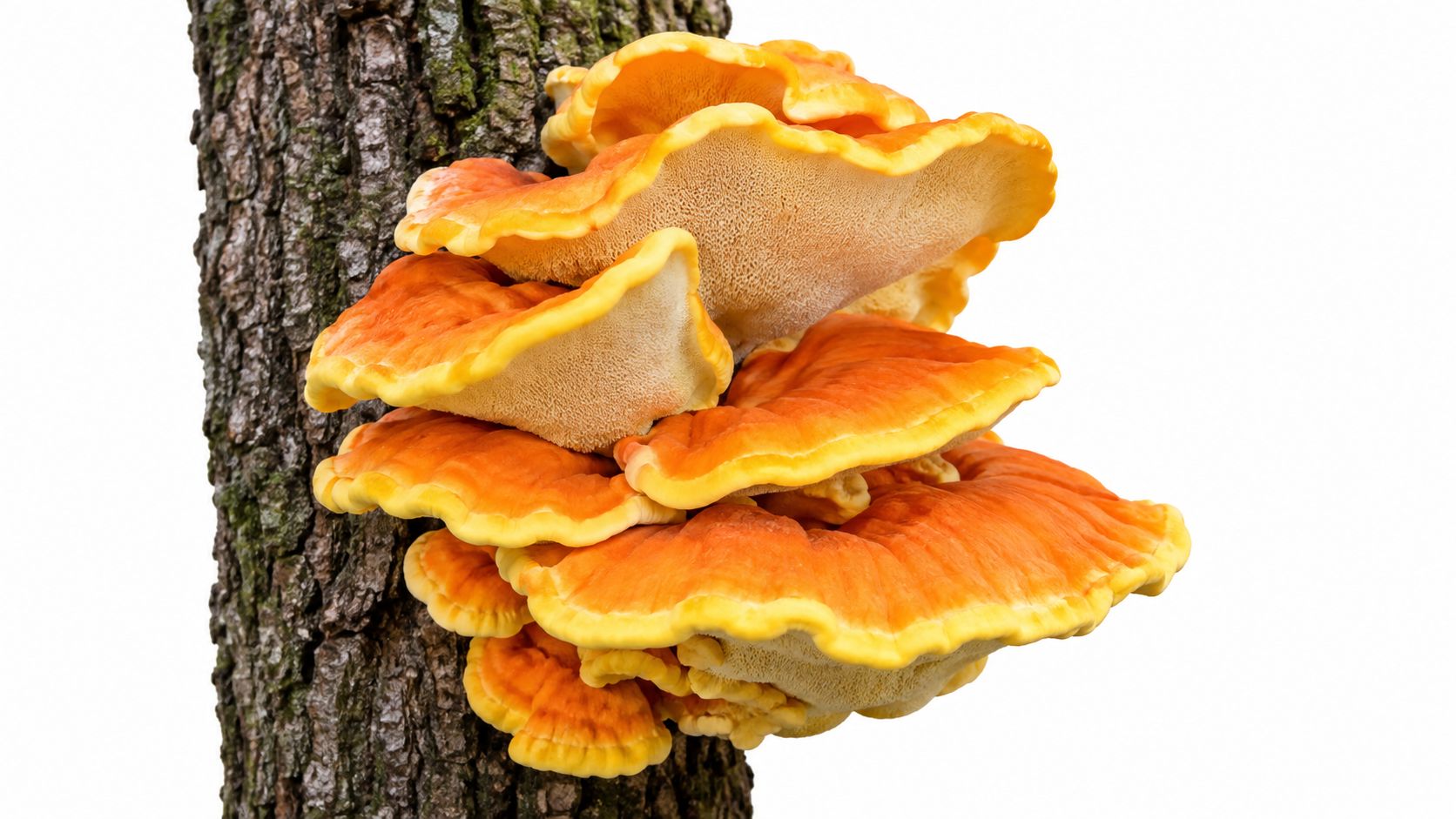
The name describes the texture of a young fruit body, not a close relationship to poultry. Laetiporus produces shelf-like or overlapping bracket clusters with vivid orange, yellow, or sulfur-toned surfaces. The underside has fine pores, where spores are released, rather than the gills found on many familiar cap-and-stem mushrooms.
Start with species and host
Laetiporus sulphureus is the classic chicken of the woods associated with bright brackets on hardwood trees and stumps. Oak is a frequent host, while related records and cultivation discussions also involve trees such as cherry, beech, sweetgum, and eucalyptus. That list shouldn't be treated as a universal recipe, because host preference can vary across the Laetiporus group.
A recent Northern Woodlands discussion of chicken of the woods highlights the identification problem. Lookalikes and species complexes can appear nearly identical while preferring different trees. For example, Laetiporus huroniensis is described there as growing exclusively on eastern hemlock, which is one reason blanket instructions to use any available log can produce confusing results.
Learn the field traits
A mature bracket can become tough and less appealing quickly, so freshness matters for both identification and eating quality. The classic visual combination is a bright orange-yellow cluster attached to wood, with a pore surface underneath and a white spore print. A gilled orange mushroom isn't chicken of the woods because its color looks similar.
Fruit bodies generally appear during a seasonal window that may run from late spring into early fall, depending on local climate and the individual host. Wild specimens can seem to appear suddenly because the visible bracket develops much faster than the hidden mycelium that established inside the tree. That contrast is important for growers. The visible mushroom may be rapid, but the biological preparation for fruiting is not.
Foraging vs Growing
Foraging and cultivation answer different questions. Foraging asks where a productive host is fruiting now. Growing asks whether you can establish the right Laetiporus culture in suitable wood and wait for it to develop. The second route is a long biological project, not a faster version of oyster or shiitake production.
Factor | Foraging | Growing at Home |
|---|---|---|
Access | Depends on legal access to suitable woods, trees, and stumps | Requires suitable hardwood, spawn, tools, and a place for logs |
Timeline | Fast once a fruiting tree is located | Slow, with outdoor fruiting often taking 6 months to 1.5 years after inoculation and colonization |
Learning curve | Strong identification and tree knowledge are essential | Requires species selection, inoculation, moisture management, and long-term observation |
Harvest pattern | Seasonal and dependent on finding a productive host | Smaller or inconsistent flushes are possible, with weather influencing results |
Main risks | Misidentification, poor specimen quality, illegal access, and unsafe harvests | Contamination, unsuitable wood, drying, competing fungi, and mistaken identity |
Best fit | Someone seeking a seasonal food harvest and outdoor practice | Someone interested in a patient mycology project |
The contrast comes from the fungus's relationship with its host. A forager can locate a living fruit body on a compatible hardwood and harvest it while it is fresh. A grower must first provide wood that suits the culture, protect the inoculated material from drying and competitors, and wait for hidden mycelium to establish before any bracket appears.
Foraging also teaches the clues that cultivation cannot simplify. Study the tree, the point of attachment, the pore surface, the cluster's color, and its seasonal condition. Those observations help explain why an oak stump may support one culture while an unidentified bag of chips may produce nothing. They also help separate a genuine specimen from an orange mushroom that only looks similar.
The two approaches strengthen each other. Field observations can guide culture and wood choices, while a home project lets you watch how a selected culture behaves over time. A poor result may reflect unsuitable host wood or a mismatch between culture and tree, rather than one faulty drilling session.
Growing chicken of the woods makes the most sense when patience and observation are part of the reward. If dependable food on a short schedule matters more, oysters or shiitake are more suitable starting points.
Inoculating Logs and Stumps
Choose the wood before choosing the tool. Fresh, disease-free hardwood is the safer starting point, especially oak or another host known to support the particular Laetiporus culture. The supplied cultivation guidance recommends using about 2 lbs of spawn per log and placing inoculated logs in shade, with watering when rainfall is absent for more than two weeks. See this guide to plug spawn mushrooms for general handling context, but don't assume instructions for shiitake automatically transfer to Laetiporus.
A practical workflow
Select suitable wood. Use clean hardwood that hasn't been sitting long enough to dry out or become heavily colonized by other fungi. Oak or mixed hardwood is a more defensible choice than an unidentified log.
Prepare the inoculation points. Drill holes across the log in an organized pattern. The exact hole pattern should match the spawn format and tool, while the main objective is to place living spawn into protected wood rather than leaving it exposed on the surface.
Insert spawn carefully. Sawdust spawn can be packed into drilled holes, while plug spawn is tapped into place. A palm inoculation tool or compatible angle-grinder adapter can make repetitive work easier, but clean handling still matters more than speed.
Seal each opening. Melted beeswax or food-grade cheese wax helps retain moisture and limits entry points for competing organisms. A thin, complete seal is preferable to a thick coating that cracks or detaches.
Incubate in shade. A crib stack can support initial incubation, while a lean-to arrangement can improve access and airflow later. Keep the logs protected from direct sun and avoid allowing them to become persistently dry.
The goal isn't to keep the wood saturated. It's to prevent the moisture swings that stall a slow colonizer. Inspect the logs periodically, protect them from prolonged drying, and avoid moving them constantly. Every disturbance makes it harder to tell whether the culture is progressing.
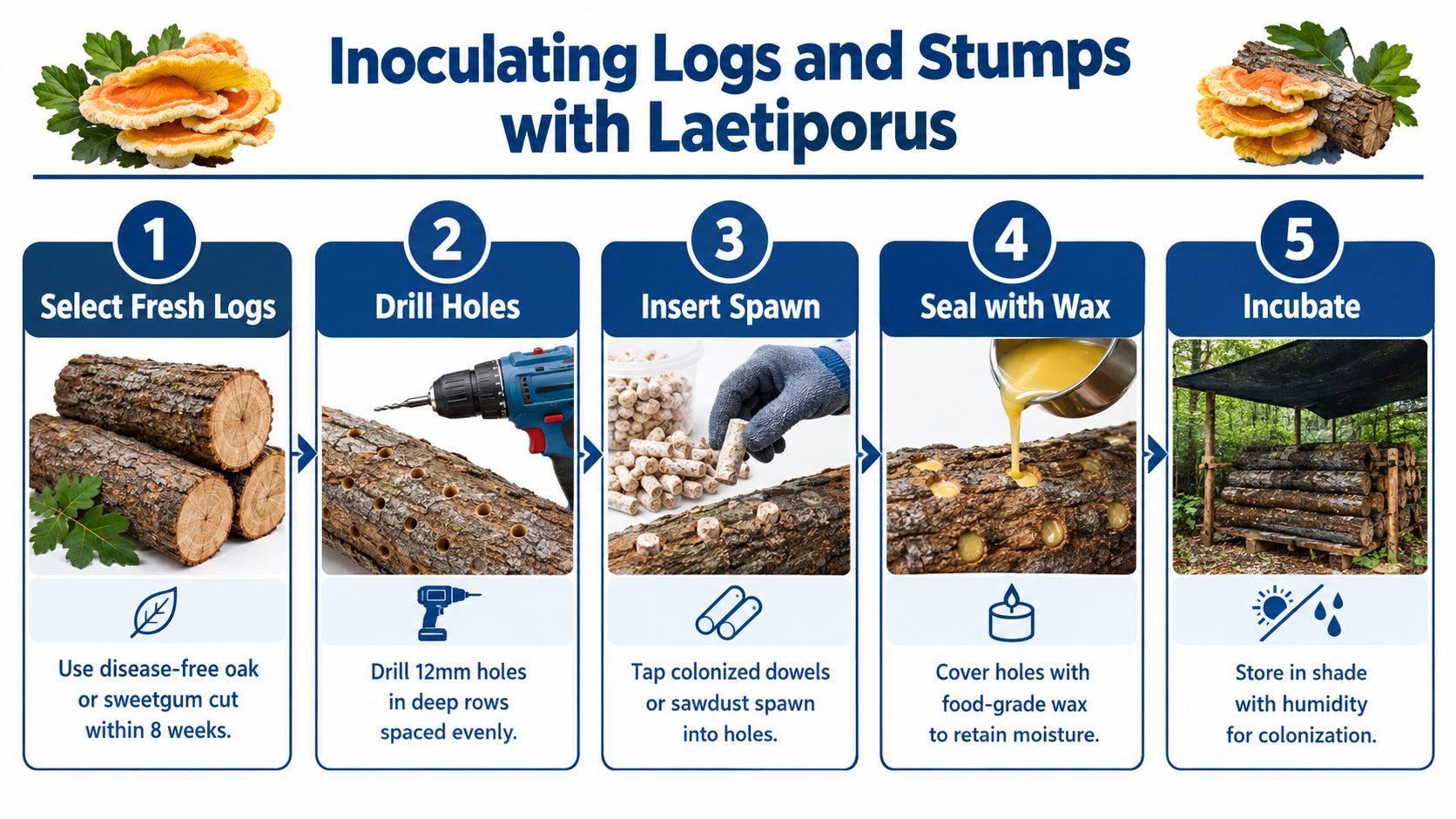
A visual process can help you keep the sequence straight, especially when preparing several logs. The accompanying video provides another demonstration of the inoculation concept:
Substrate Science for Laetiporus
Laetiporus is a wood-decay fungus, so substrate selection affects more than nutrition. The material needs to provide a structure the mycelium can occupy, retain moisture without becoming stagnant, and resist faster competitors during the long colonization period.
Peer-reviewed research reports that Laetiporus sulphureus grows most favorably on PDA and MEA at 25–30°C and pH 6–8. Sorghum performed strongly as a spawn medium, and thorough mixing with gypsum and calcium carbonate improved growth, suggesting that both available carbon and pH buffering influence colonization vigor. These findings appear in the Laetiporus sulphureus cultivation research.
Why supplementation can help
Trials involving Thai Laetiporus strains achieved complete colonization and primordia formation on sawdust supplemented with rice bran and calcium carbonate. The result supports a useful principle: a lignocellulosic base may need nutrient enrichment and pH stabilization before it can support the transition from vegetative growth to early fruiting. The Asian Journal of Mycology trial provides that specific research context.
Substrate | Colonization Time | Fruiting Success | Notes |
|---|---|---|---|
Hardwood sawdust with an appropriate supplement | Can support vigorous vegetative growth under controlled conditions | Primordia formation is possible in trials, but reliable home fruiting remains difficult | Use a culture-specific formula and careful moisture control |
Plain hardwood chips | Often less predictable | Usually a weak choice for controlled fruiting | Large particles create uneven moisture and exposed gaps |
Straw or mixed agricultural waste | May support some growth when combined with hardwood materials | Less aligned with the species' natural host relationship | Don't treat a successful oyster recipe as a Laetiporus recipe |
Hardwood logs or stumps | Slow, seasonal colonization | Outdoor fruiting can occur, but timing is variable | Closest to the fungus's natural wood-based setting |
For indoor blocks, a prepared hardwood mushroom substrate can simplify the material side of the experiment. Still, laboratory colonization isn't the same as outdoor fruiting. In a log, rainfall, drought, temperature changes, insects, and competing fungi all influence what happens after inoculation.
Realistic Fruiting Timelines
Chicken of the woods does not follow the quick schedule familiar from oyster mushrooms. A log can look unchanged while Laetetiporus mycelium establishes inside the wood. Visible brackets arrive late, so their absence does not show when colonization began or prove that the culture failed.
An independent cultivation reference places outdoor fruiting at 6 months to 1.5 years after inoculation and indoor colonization. Its guidance on shade, moisture during extended dry periods, and using a substantial amount of spawn per log fits a slow, seasonal process rather than a dependable harvest calendar.
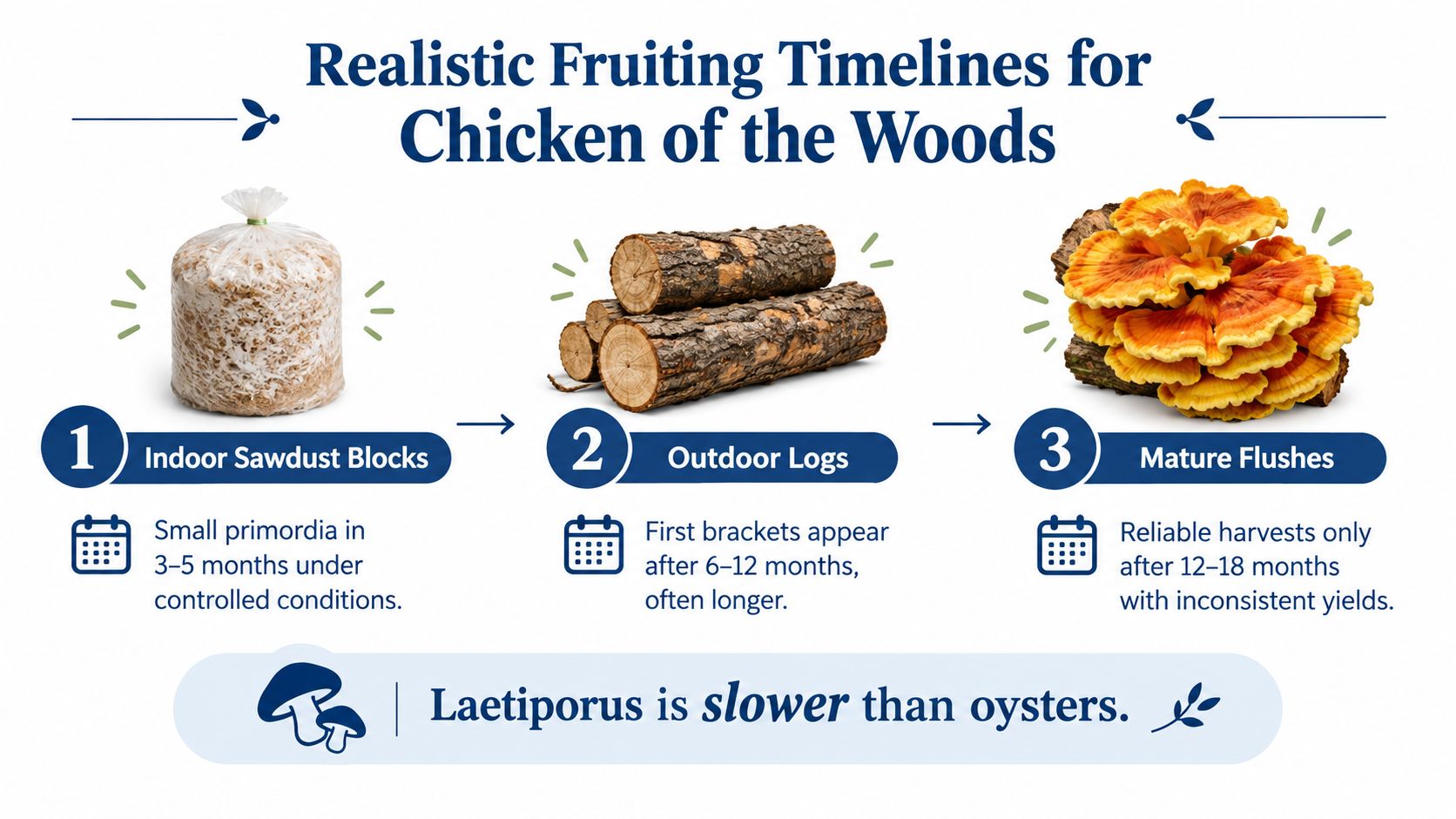
Read the seasons, not just the calendar
A practical outdoor sequence may look like this:
Spring: Inoculate fresh hardwood when conditions permit, then move the logs into shade.
Summer: Protect them from direct sun and maintain moisture through dry weather.
Autumn: Check for signs of establishment. No brackets yet is not evidence of failure.
Following warm season: Inspect more closely for primordia and young clusters.
Later seasons: Keep monitoring the same logs because fruiting depends on weather and may be irregular.
Cool conditions, drought, and competing organisms can postpone visible growth. An indoor block might develop reproductive structures sooner than an outdoor log, yet indoor fruiting remains difficult to predict and may not resemble the large wild clusters associated with the mushroom.
A better measure of progress is biological rather than monthly. Ask whether the culture remains viable, the wood holds suitable moisture, and the host environment continues to support colonization. That patience is part of chicken of the woods growing, not a sign that the method has failed.
Safety, Lookalikes, and Edibility
Correct identification is necessary, but it isn't the whole safety standard. Laetiporus species and close relatives can vary by host, and an orange bracket on wood isn't enough evidence by itself. Confirm the pore surface, growth form, host tree, overall color, freshness, and local species possibilities before eating anything.
The chicken and hens mushroom guide can help clarify that common names are not interchangeable. “Chicken of the woods” may refer to multiple Laetiporus types, and closely similar species can have different host associations. A culture grown on a log inherits the identity and edibility questions of that culture. Cultivation doesn't magically make an uncertain species safe.
Handle the food carefully
Young, fresh brackets are generally more appealing than old, dry, or fibrous specimens. Cook thoroughly, start with a small portion, and pay attention to how your body responds. Some people experience gastrointestinal upset even after correct identification, particularly when specimens are undercooked, old, or harvested from unsuitable host trees.
Avoid raw consumption, and be especially cautious with fruit bodies from yew, cedar, or conifer hosts, where tree-associated compounds may create additional concerns. People with mushroom allergies, pregnant individuals, children, and immunocompromised people should seek qualified medical or mycological advice before consuming wild mushrooms, and children and immunocompromised individuals should avoid wild specimens entirely.
Alcohol can also complicate reactions for some people. If a specimen smells sour, feels slimy, shows advanced decay, or has been exposed to contamination, discard it rather than trying to rescue the harvest. Food safety begins before the pan, with identity and host selection.
Is Chicken of the Woods Growing Worth It
Chicken of the woods growing is worth the effort for a particular kind of hobbyist. You need to enjoy long observation, wood science, seasonal uncertainty, and careful documentation. You shouldn't choose it as your first project if your main goal is a quick, repeatable supply of mushrooms.
The species offers a distinctive payoff. You're working with a fungus that many people only encounter by chance in the woods, and you can observe how a Laetiporus culture interacts with hardwood over time. That educational value can justify a project even when the harvest is modest or delayed.
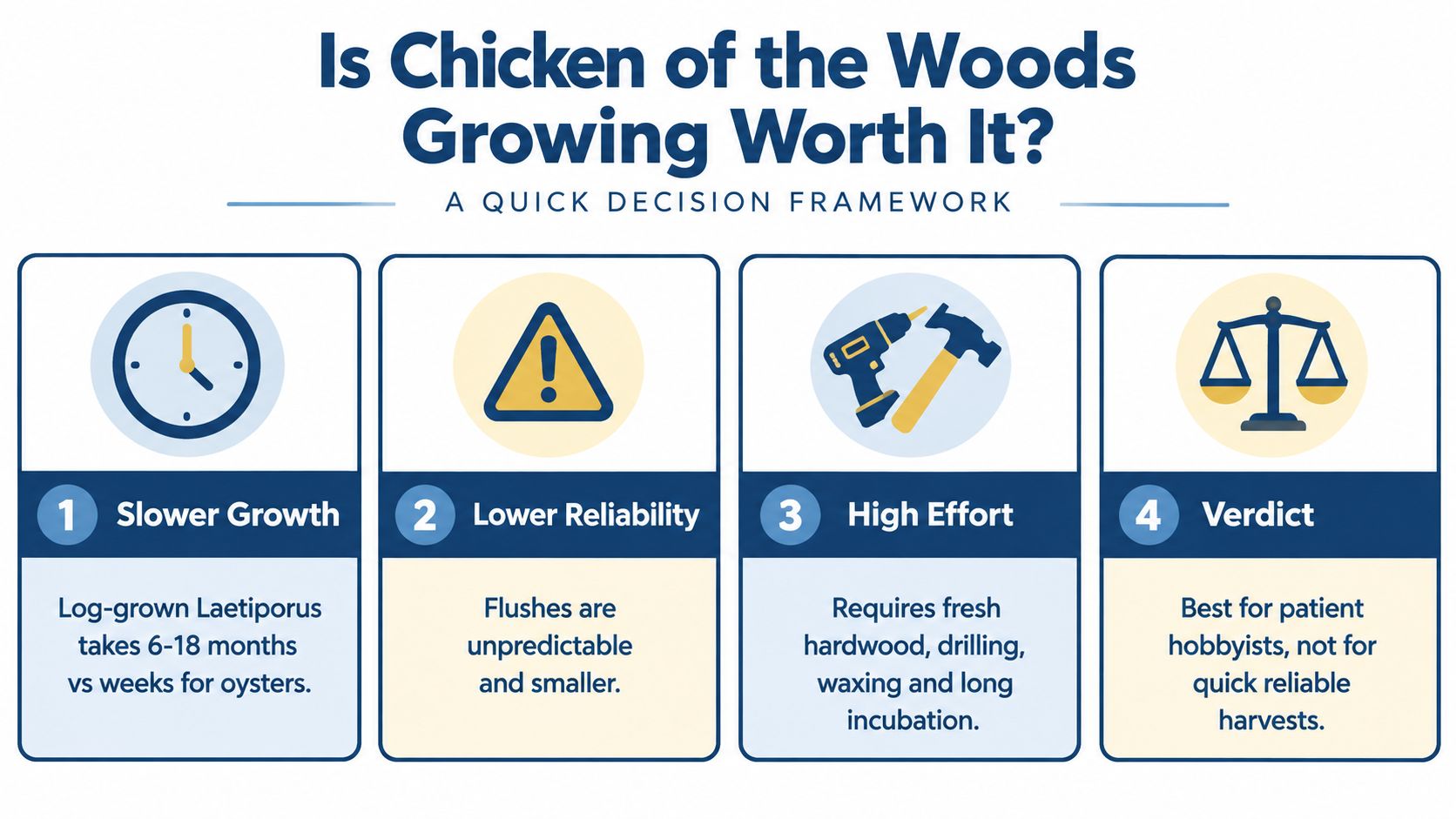
Choose your next move
If you want to try it, keep the first attempt manageable:
Choose a culture with a clear identity. Ask the supplier which Laetiporus type is being offered and what host wood the culture is intended to use.
Prepare suitable hardwood. Fresh oak or another compatible hardwood is a stronger starting point than a random bag of chips or an unidentified stump.
Track conditions. Record the wood type, inoculation date, spawn format, shade level, rainfall, watering, and any signs of competing fungi. Documentation turns an uncertain result into useful information for the next attempt.
Pair it with a faster species. Oysters or shiitake can provide more immediate cultivation feedback while Laetiporus develops in the background.
The central decision is simple. If you want predictable harvests, start with oysters or shiitake. If you're drawn specifically to Laetiporus, start small, use the host and substrate evidence carefully, and treat fruiting as a welcome outcome rather than a promise.
Colorado Cultures offers mushroom cultures, sterilized grain bags, hardwood substrates, grow bags, grow kits, tools, and educational support for home cultivators, including a listed Chicken of the Woods culture. Visit Colorado Cultures to explore supplies and choose a practical starting point for your chicken of the woods growing project.
Comments