
How Fast Do Morels Grow? Timelines from Spawn to Harvest
The familiar advice that morels grow in 3–10 days leaves out the most important question: when did you start counting? That estimate generally refers to visible mushroom expansion, not the time required to establish a colony, pass through cold conditioning, and initiate fruiting, a distinction highlighted by cultivated morel timing research.
A morel that seems to appear overnight hasn't necessarily completed its life cycle overnight. For growers and foragers, the useful answer separates what happens below the surface from what happens after a mushroom becomes visible.
Why Morel Speed Has Three Different Clocks
How fast do morels grow? There's no single answer, because people use “growth” to describe different biological stages. A grower counting from inoculation and a forager watching an emerging mushroom aren't measuring the same process.
The overnight-morel myth confuses discovery with development. Finding a mushroom today doesn't tell you when its underground preparation began, or even when its earliest visible structure formed.
The clocks you're actually measuring
Colonization: Mycelium, the growing fungal network, spreads through its substrate and matures. This is the establishment phase, not mushroom production.
Fruiting initiation: A prepared colony responds to environmental conditions and begins producing primordia, the earliest recognizable mushroom structures.
Post-pin expansion: Those small structures develop into larger fruiting bodies. This is the phase an observer can watch above the surface.
Practical rule: Before accepting a growth estimate, ask what event starts the clock and what event ends it.
Cultivated timelines begin with a deliberate action, such as inoculating substrate. Wild timing is harder to define because you usually encounter an established colony without knowing its history.
That distinction changes your expectations. If you've just inoculated a growing system, you're waiting for establishment and reproductive readiness. If pins have appeared, you're watching the final developmental phase, but you're still not looking at an automatic harvest signal.
The honest answer is therefore a set of stage-specific ranges, not a universal countdown. Identify the stage first, then use evidence that matches the species, growing method, and endpoint you're interested in.
Morel Growth Timeline From Spawn to Harvest
The table separates the stages reported in Morchella importuna cultivation research from the longer harvest benchmark in the cultivated timing report linked above.
Stage | Typical duration | Context |
|---|---|---|
Spawn run, mycelium colonizes substrate | 30–40 days | Mycelial maturation before cold care |
Cold conditioning | 20–40 days; approximately 1–3°C in the longer protocol | Reported cold-care descriptions include 20–30 days and 30–40 days |
Fruiting formation and growth | 20–30 days at approximately 2–15°C | Young fruit bodies reached about 2–3 cm tall |
Inoculation to young fruiting bodies | 80–110 days | Total in the reported M. importuna protocol |
Inoculation to harvest | 171–190 days | The separate report describes initial fruiting at 154–175 days, followed by 15–17 days of growth |
Wild morels, spring emergence | No fixed duration | Timing depends on species, elevation, site history, and seasonal weather |
The cultivation-stage ranges come from the linked M. importuna study; the longer harvest timeline comes from the cultivated timing report cited in the introduction.
Read the endpoint before comparing totals
Start with the spawn-run row. This is time spent growing and maturing mycelium before the cold-care phase, not time spent enlarging visible mushrooms. A healthy-looking colony hasn't necessarily reached reproductive readiness.
Cold conditioning follows establishment in the described protocol. Don't treat cold exposure as interchangeable with ordinary incubation, or subtract it from your schedule because the mycelium already appears active.
The fruiting row ends with young fruiting bodies, which matters when comparing it with a study that reports harvest. A young mushroom is a different experimental endpoint from a mature mushroom ready to collect.
The separate reports also measure their final stages differently. Fruiting formation and growth includes a broader developmental interval, whereas growth after initial fruiting describes a later portion of the process.
Why the totals aren't interchangeable
Different strains, protocols, and temperature regimes can produce different schedules. These reports don't establish a shortest and longest possible duration for every cultivated morel, and their totals shouldn't be averaged into a supposedly universal answer.
For a refresher on the terminology, review the stages of mushroom growth. Keep the general sequence in mind while following a protocol specific to your morel culture.
Record inoculation, the beginning of cold care, first pins, and harvest separately. A single “days growing” entry hides the information you'll need to troubleshoot.
If you're estimating the whole project, count from inoculation. If you're evaluating cold care, count from its start. Only count from the first visible mushroom when your question specifically concerns post-pin development.
What Happens Between First Pin and Harvest
A pin is a bud, not a bloom. The structure has begun, but the mushroom still has to differentiate and enlarge. Its appearance marks a developmental transition, not the completion of growth.
The diagram illustrates that distinction.
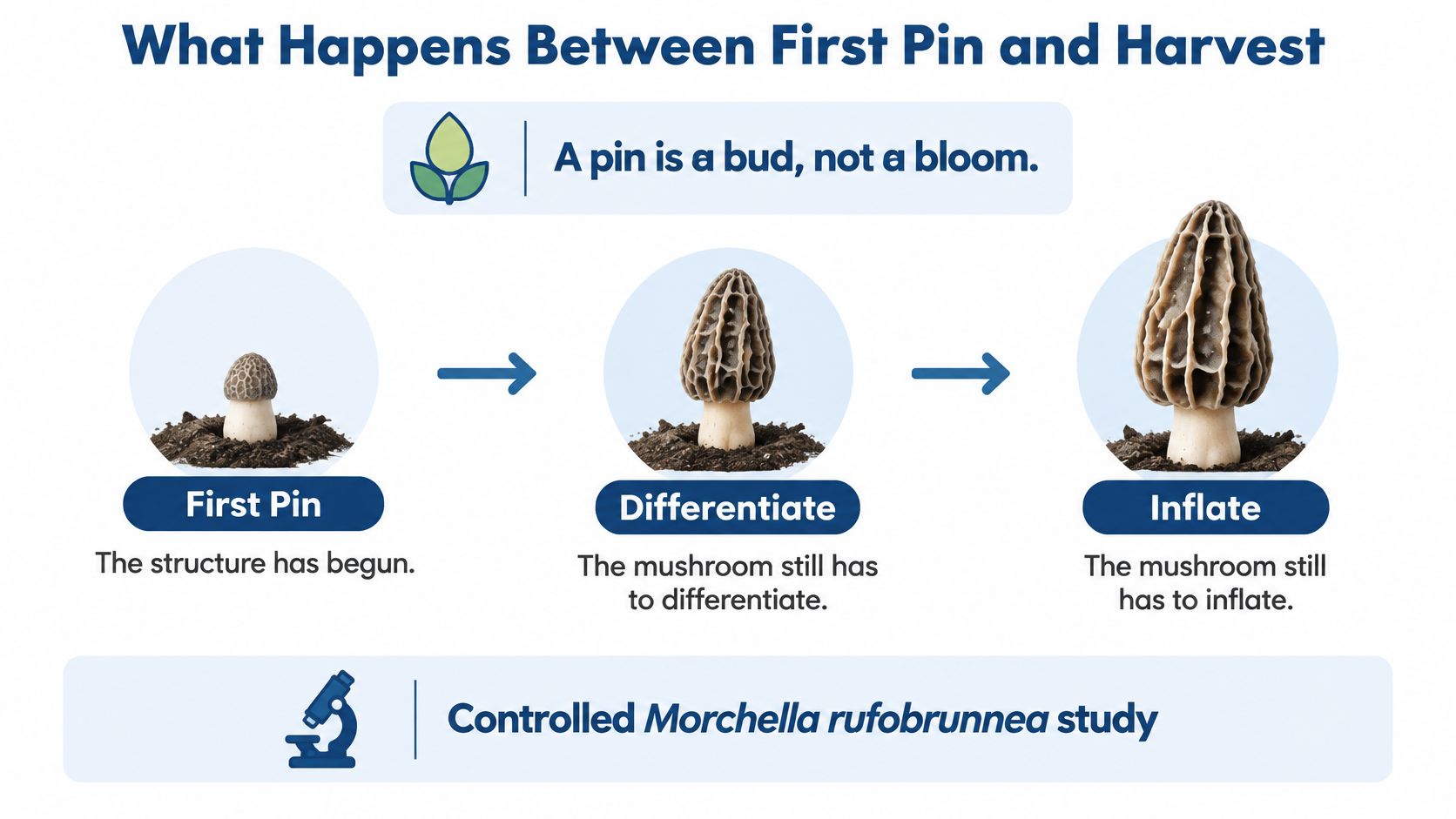
In a controlled indoor study of Morchella rufobrunnea, researchers grew cultures for 7 days at 18°C and 80% relative humidity before using flooding to induce conidiation and begin fruiting. Primordia appeared approximately a week after induction, differentiated during the following 10 days, and developed into mature fruiting bodies about 2 weeks later.
Pin-to-harvest checkpoints
The study recorded the following checkpoints, all counted from induction, not from the first observed pin.
Checkpoint | Days after induction | Note |
|---|---|---|
Primordia appear | About 7 | Earliest pin stage, roughly a week after induction |
Study checkpoint | 9 | Recorded developmental checkpoint |
Study checkpoint | 12 | Recorded developmental checkpoint |
Study checkpoint | 21 | Recorded developmental checkpoint |
Mature fruiting bodies | 34 | Approximate full transition from induction to maturity |
Checkpoint values are from the controlled M. rufobrunnea study linked above.
What a grower should infer
Early in the sequence, the observer sees that reproductive development has begun. During differentiation, the important change isn't height alone. The developing structure is becoming a more complete fruiting body.
The intermediate checkpoints shouldn't be turned into invented harvest rules. Without a documented description for each observation, a checkpoint tells you when researchers examined development, not that every culture must look identical on that date.
For planning, the study supports allowing approximately 3–5 additional weeks after early pins, rather than assuming an immediate harvest, as described in the linked research. That is a species- and protocol-specific allowance, not a promise for outdoor patches.
The useful lesson is patience with observation. Follow the mushroom's development and the conditions around it instead of treating the appearance of a pin as permission to stop managing the growing environment.
Temperature, Moisture and Substrate That Set the Pace
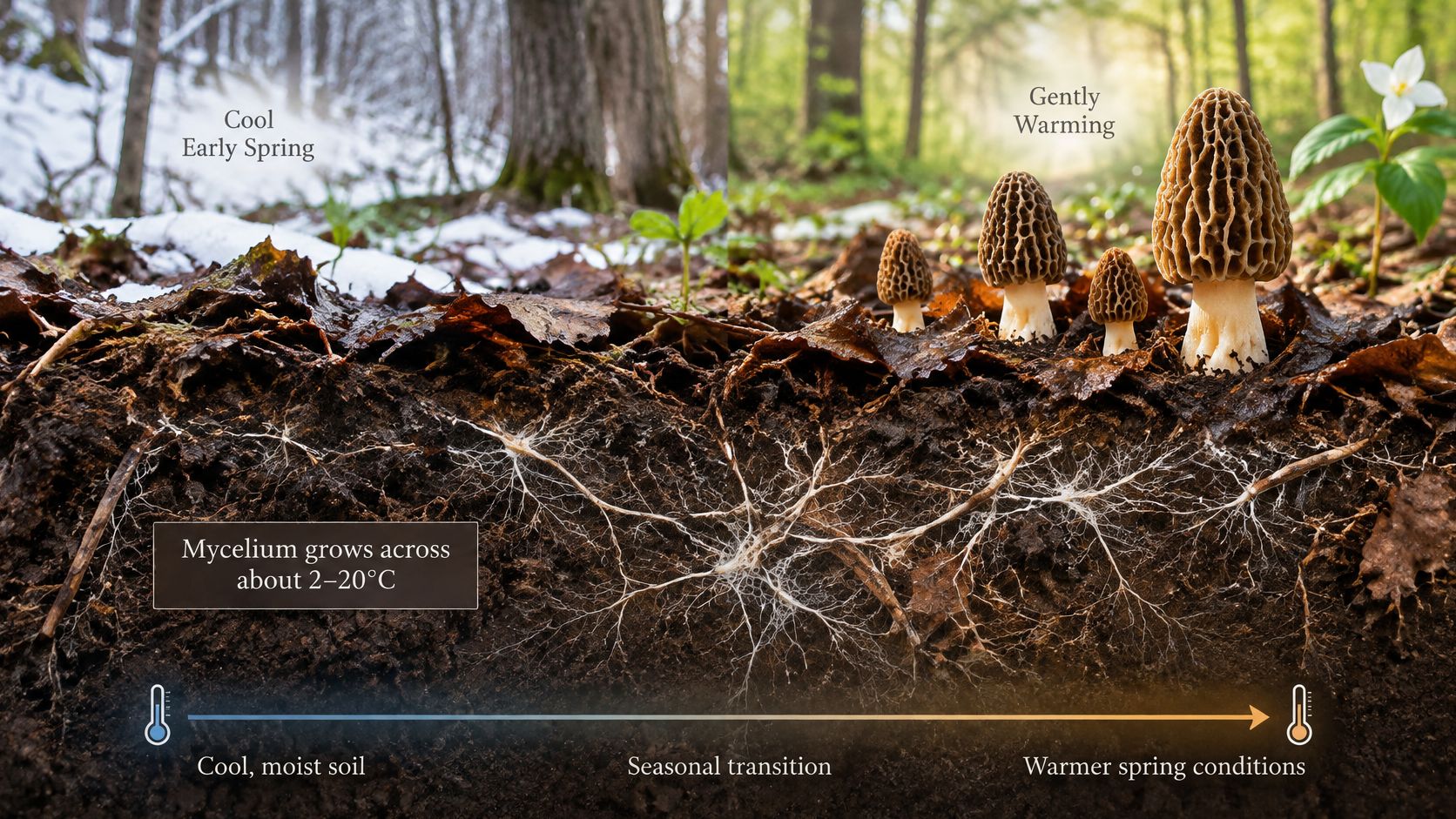
Morel growth depends on temperature transitions, not just on maintaining a warm room. The conditions that support vegetative growth aren't identical to those that favor reproductive development.
This illustration places those changes in a cool, moist seasonal setting.
Match conditions to the stage
The following ranges are reported in the M. importuna temperature and moisture research. They describe particular cultivation conditions, not universal settings for every morel species.
Factor | Favorable range | What the research notes |
|---|---|---|
Mycelial growth temperature | About 2–20°C | Vegetative growth spans this band |
Fruiting trigger temperature | About 6–8°C | Favors primordium differentiation |
Fruit-body temperature | About 2–15°C | Fruit bodies develop poorly above 20°C |
Day–night temperature swing | More than 10°C | Can stimulate differentiation |
Air humidity | 85–90% | Reported during primordium formation |
Soil moisture | 65–75% | Reported for fruiting; mycelial growth occurs at 50–70% |
All condition ranges in the table come from the linked research.
A constant temperature within the vegetative range doesn't reproduce the sequence used to induce fruiting. During establishment, assess mycelial maturation. During cold care, follow the conditioning schedule. During initiation and enlargement, use the reproductive-stage conditions rather than returning to a generic incubation setting.
For broader context, consult this guide to mushroom fruiting temperature, while keeping the morel-specific research as your reference for an actual trial.
Measure moisture rather than guessing
Air humidity and soil moisture aren't interchangeable. A humid atmosphere doesn't tell you how much water is available in the substrate, and watering the substrate doesn't establish the air conditions around developing mushrooms.
Before choosing a meter or interpreting its display, compare soil moisture testing methods from Leaves & Soul. Treat the research percentages as method-dependent measurements, not instructions to make an uncalibrated household meter show the same number.
Substrate belongs in your records too. Note its composition and whether colonization was complete before cold care, so you can distinguish an establishment problem from a fruiting-stage problem.
The accompanying video offers additional visual context for morel cultivation.
Don't respond to a slow flush by automatically increasing heat. Use the stage-specific temperature table to decide whether warming is appropriate, and check moisture before changing several conditions at once.
Wild Morels Versus Cultivated Morels Compared
Factor | Cultivated morels | Wild morels |
|---|---|---|
Starting point | Spawn deliberately introduced into substrate | An established colony whose starting date is usually unknown |
Timeline | Protocol-specific establishment and fruiting stages | Seasonal emergence without a fixed countdown |
Temperature control | Grower manages cold care and subsequent warming | Weather and local soil conditions determine exposure |
Signal to watch | Inoculation records, developmental stage, and temperature log | Soil warming, moisture, and accumulated seasonal conditions |
Predictability | More trackable under controlled conditions | More dependent on site and year |
The most important difference isn't that wild mushrooms necessarily grow faster or slower. It's that a forager usually doesn't know the colony's starting condition.
Laboratory germination isn't a field forecast
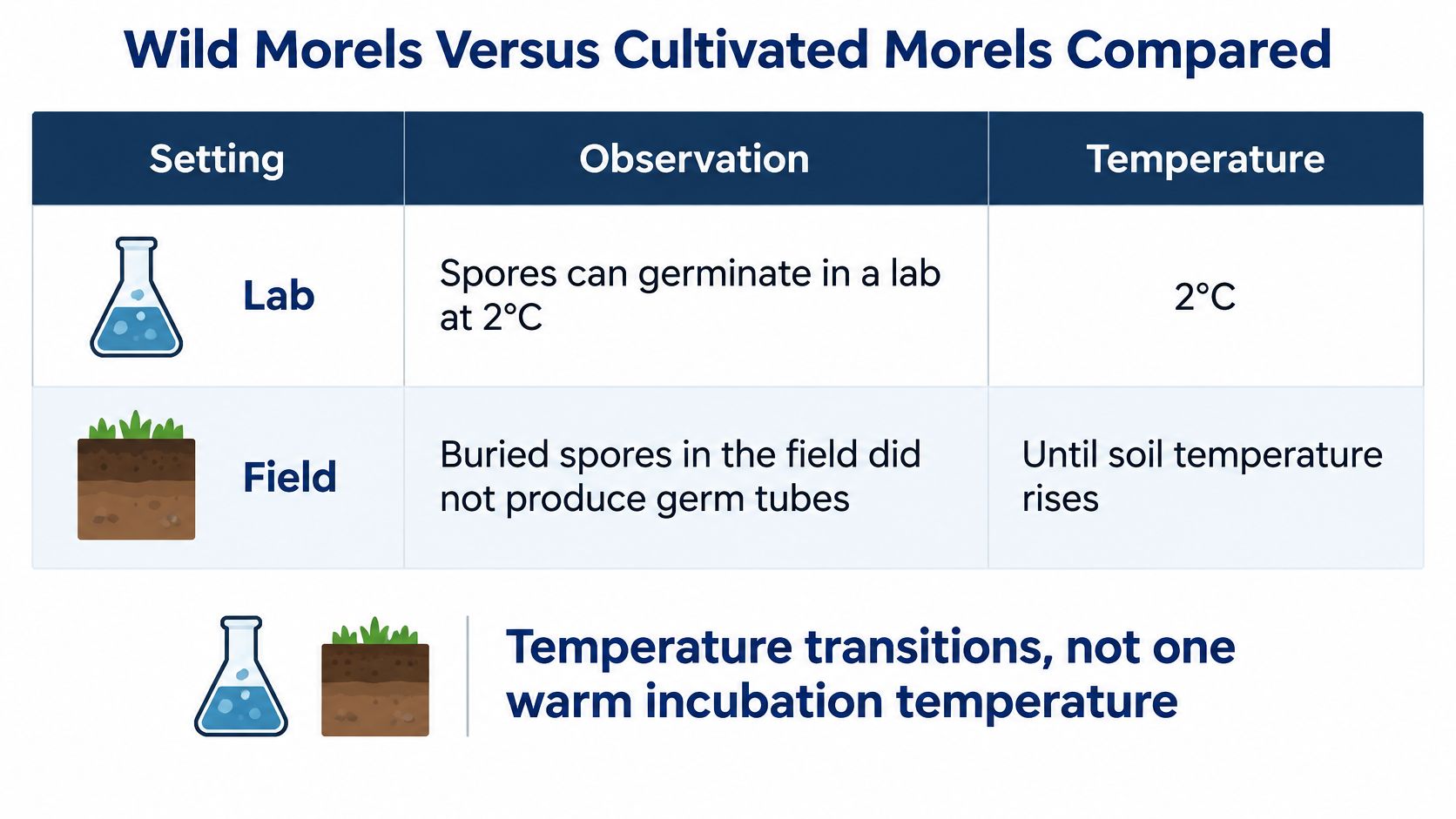
Research comparing morel germination conditions reports that spores could germinate in vitro at 2°C, while buried spores didn't produce germ tubes until soil temperatures exceeded approximately 10°C. Germination was inhibited as soil temperatures rose above approximately 15°C after fruiting-body emergence.
Those observations concern spore germination, not a universal pin-to-harvest schedule. They shouldn't be substituted for the cultivated fruiting conditions in the earlier table.
The illustration emphasizes the distinction between laboratory and field observations.
Accumulated warmth matters more than an afternoon
The same research context links emergence in a reported French population with approximately 424–580 soil-temperature degree-days, an accumulated-temperature measure rather than a count of ordinary calendar days. That observation belongs to that population and calculation method, not to every morel patch.
A temperature threshold is an observation about a particular process. It isn't a universal instruction to start counting down to mushrooms.
You can't safely turn that degree-day figure into a forecast without knowing the calculation's baseline and starting point. In particular, don't begin adding temperatures from whichever warm day you happen to notice.
Foragers should interpret soil warming alongside moisture and seasonal history. A warm afternoon alone doesn't establish that the growing site has experienced the necessary sequence.
Cultivators can plan around a documented protocol because they control and record its starting events. Foragers need a site record instead: where emergence occurred, what the soil conditions were, and how the season progressed.
The evidence discussed here doesn't establish a universal wild day count. That is different from claiming that no published wild timing observations exist.
Plan Your Morel Timing Before You Act
Choose a plan that matches your situation. A forager needs better information about a site; a cultivator needs a documented starting point and a species-appropriate protocol.
If you're watching a wild patch
Track the soil, not just the forecast. Use a soil thermometer at the growing site and record conditions consistently. Keep air-temperature observations separate so you don't confuse the measurements.
Record moisture with warming. Note rainfall and the condition of the soil alongside temperature. Don't assume that a rainfall event proves the patch now has suitable conditions.
Use field thresholds cautiously. The germination observations above explain why laboratory results don't automatically transfer outdoors. They aren't universal emergence dates or harvest cutoffs.
Avoid improvised degree-day forecasts. Unless you have the original calculation method and a reason to apply it locally, use your observations to learn the site's seasonal pattern rather than manufacturing a countdown.
Observe developing mushrooms without treating heat as progress. Continued warming isn't always beneficial. Record changes in visible development alongside changes in the growing environment.
If you're cultivating morels
Choose the protocol before buying supplies. Confirm the species, substrate system, cold-care requirements, and endpoint. A schedule for young fruiting bodies isn't automatically a schedule for mature harvest.
Create separate date entries. Record inoculation, the beginning and end of cold care, induction, first pins, and harvest. Those entries let you identify which stage took longer than expected.
Budget for establishment, not just expansion. Use the complete timeline from your chosen cultivation method. Don't schedule the project around the short visible-growth estimate that prompted your search.
Treat pins as a developmental milestone. Continue monitoring temperature and moisture after they appear. Compare their progress with the matching species and protocol, not an unrelated photograph or countdown.
Assess readiness rather than elapsed time alone. Review the principles behind when to harvest mushrooms, then apply the maturity criteria appropriate to your morel system.
Before you act, write down the question you're trying to answer: time from inoculation, time until initiation, or time after pins. That small distinction prevents a common mistake, using evidence from the wrong stage to judge whether your morels are developing normally.
Colorado Cultures offers sterilized grain bags, substrates, grow kits, and cultivation tools for preparing a documented mushroom-growing project. Visit Colorado Cultures to check current supplies and ask which materials fit your chosen protocol before setting your start date.
Comments