
How to Make Chaga Tea: Safe Brewing Steps and Dosing
If you search for how to make chaga tea, nearly every guide repeats the same advice: drop a piece of chaga into water, boil it hard, and keep going until the brew is as dark as coffee, because darker means stronger and stronger means more benefit. I'd push back on both halves of that. Darkness mostly measures how long you cooked the material and how much water evaporated, and there's no validated serving size of chaga tea for anyone to get "stronger" than.
What decides the cup in front of you is weight, temperature and time, in that order. A ten-gram chunk held at a gentle simmer and a teaspoon of powder steeped for five minutes produce very different liquids, and neither carries a published oxalate figure per cup. That uncertainty is exactly why you weigh your material instead of eyeballing it, and why chaga belongs in the occasional-beverage column rather than the daily-tonic one.
Brewing Methods Compared at a Glance
Two families of preparation show up in writing about chaga, and they behave differently enough that you should pick one deliberately rather than drifting between them.
Method | Material form | Ratio (dry to water) | Temperature | Time |
|---|---|---|---|---|
Quick powder infusion | Fine powder | 1.5 g per 200 ml | 100°C | 3-10 minutes |
Powder tea bag | Fine powder | 1 tea bag per 200-250 ml cup | 80-100°C | Several minutes |
Chunk simmer | Coarse pieces | 1:20-1:30 by weight or volume | 80-90°C | 1.5-3 hours |
Overnight soak plus extended simmer | Coarse pieces | 1:20-1:30 (starting ratio) | About 90°C | Soak overnight, then about 2 hours |
The short infusion is the modern convenience route. A peer-reviewed study tested 1.5 grams of chaga in 200 milliliters of boiled distilled water at 100°C, infused for 3, 6 and 10 minutes before filtration, and the same paper notes that the powdered chaga commonly sold in tea bags is steeped at 80°C to 100°C for several minutes, as described in this comparison of chaga preparation methods. It also documents the traditional route, steeping or boiling pieces for several hours or even several days.
Those two styles trade off cleanly. Powder gives up its color fast and needs no planning, but a ten-minute steep extracts a narrower slice of the water-soluble material than a multi-hour simmer. Chunks take an afternoon and reward you with a repeatable routine, which matters more than peak intensity when you're learning. Commercial instructions land in the same window: Zhi Herbals recommends simmering chaga for about 1-2 hours to extract what it calls the active ingredients.
Treat every quantity in that table as a preparation example, not a therapeutic dose. These are laboratory and historical reference points, not validated human servings.
Reference method for a first batch: coarse pieces, 1:20 to 1:30 by weight, held at 80-90°C for 1.5 to 3 hours. It's the most forgiving routine here, because a small temperature wobble or an extra half hour changes the result far less than it would with powder, and you can repeat it exactly next weekend.
Sourcing Chaga Safely Before You Brew
Measured oxalate in tested chaga powders differed roughly fivefold, from 2.8 to 14.2 grams per 100 grams, according to a review of chaga dosage and oxalate data. That spread is the whole sourcing argument in one line. A teaspoon of powder or a random "piece of chaga" isn't a recipe, it's a guess, and the same volume from two suppliers can represent materially different chemical exposure depending on particle size, processing and concentration.
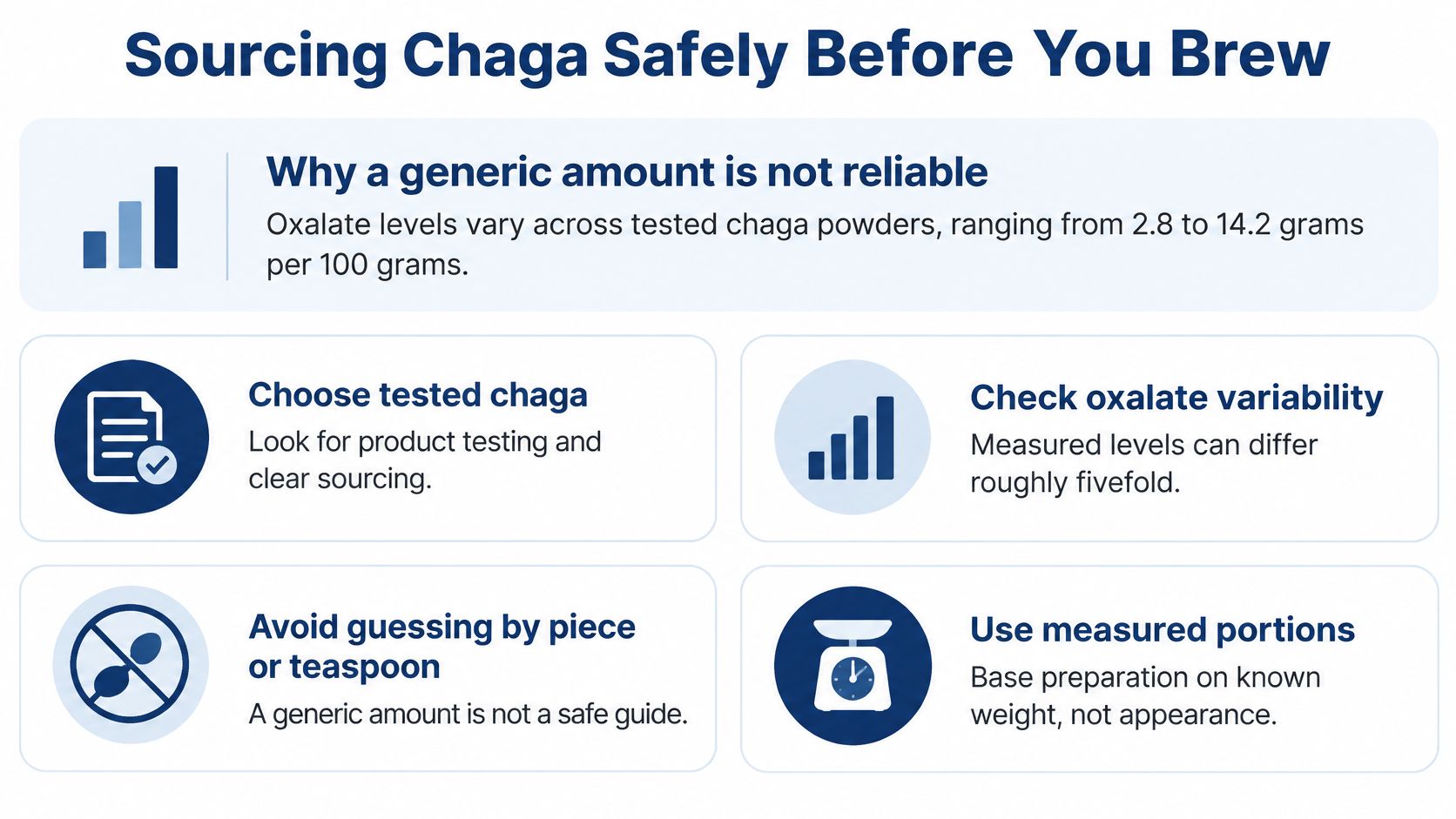
History doesn't close that gap. Inonotus obliquus has been used in folk medicine since ancient times, and by the middle of the 20th century chaga infusions were drunk as a tea substitute in Siberia, as a scientific review of chaga's traditional use records. Long use tells you people drank it. It doesn't tell you what's in your bag.
Run this checklist before anything goes in the pot.
Confirm the species. You want Inonotus obliquus, sold as food-grade material that has been cleaned and dried.
Reject anything soft. Slimy texture, fuzz, or a musty smell means it goes in the compost, not the saucepan.
Ask for batch testing. Identity, mold, heavy metals and adulteration are the four things a supplier should be able to speak to.
Ask where it was harvested. A traceable origin and harvest date beat a nice-looking photograph of birch forest.
Skip wild material you can't identify. Birch conks have lookalikes, and guesswork is the wrong basis for a decoction you'll drink for months.
If you're building a routine around several fungi, this overview of reishi and chaga for immune health is a sensible companion read on how the two are usually combined.
One habit pays for itself: note the supplier, purchase date and weight of every batch. When a cup tastes off or a supplier changes, you'll know which bag to blame.
Safety Limits and Who Should Skip Chaga Tea
Natural and traditional are not safety categories. A plant or fungus being old doesn't make a concentrated daily dose harmless, and chaga is a good example of why that distinction matters.
Neutral medical guidance is explicit that chaga's efficacy and safety have not been established in clinical trials, while documented case reports associate sustained, high-dose use with oxalate nephropathy and acute kidney injury, as set out in a BCCDC risk assessment of chaga mushroom tea. Those cases involved large amounts over months, not a cup at a weekend breakfast. They still set the boundary of what you should assume.
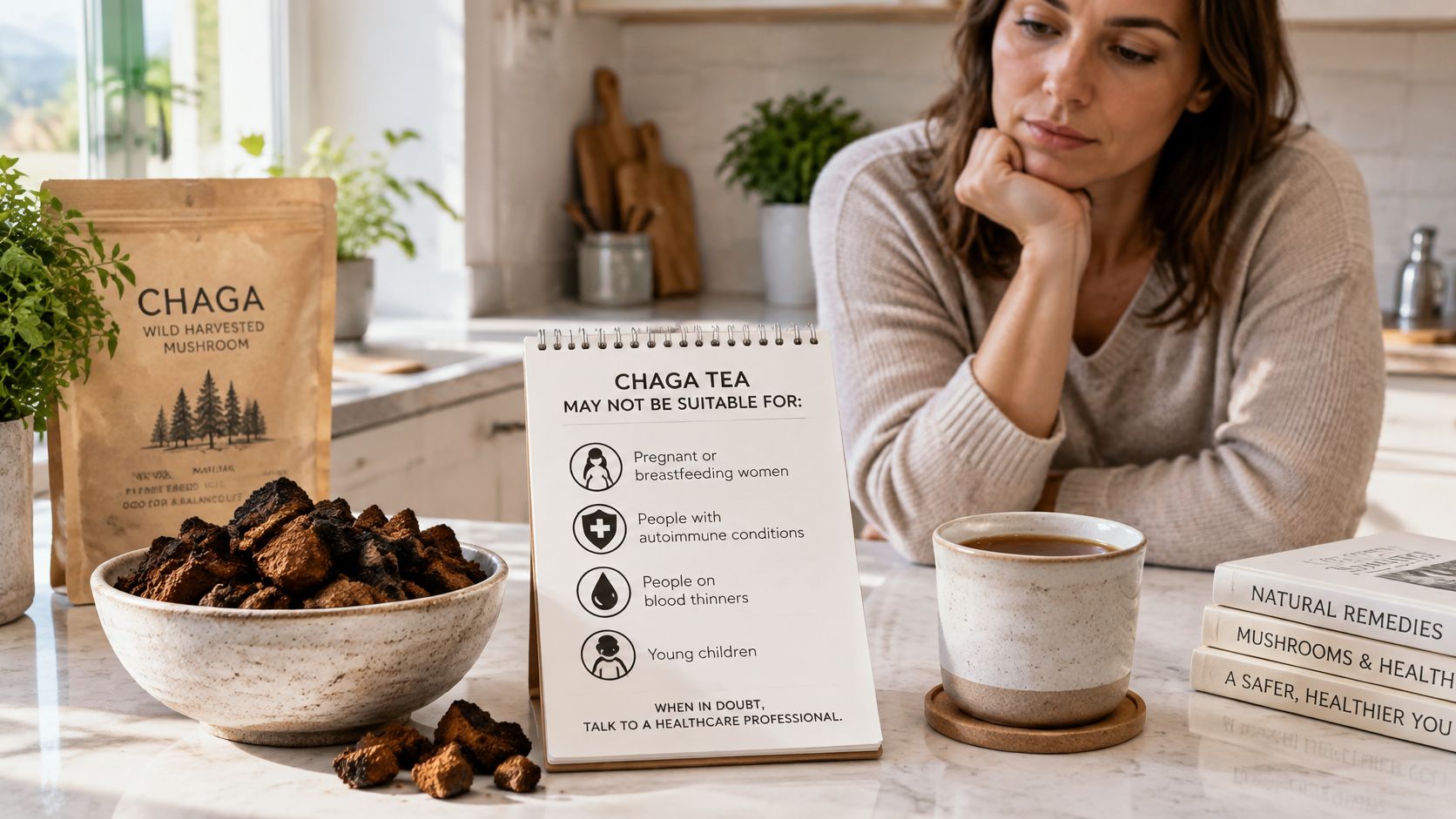
The compound behind the concern is oxalic acid, reported as a principal organic acid in chaga water extracts. Here's the frustrating part: the amount of oxalate delivered by a typical cup has not been measured. That single gap rules out the sentence every recipe wants to write, namely that a given steeping time, temperature or serving size is definitively safe. Any claim that six minutes is fine and twenty is reckless, or that strained tea is automatically easier on the kidneys than powder, is unsupported by published work.
Why no serving size is safe by default
There's no validated human dose and no safe daily limit to work back from. I won't invent a number to fill the space. What you can control is exposure: keep the batch modest, keep the frequency low, drink water alongside, and get a pharmacist's review if you take anything for bleeding risk or blood sugar. Concentrated powder is a different exposure profile from a strained decoction, and repeated high-dose powder is the pattern that appears in the case literature.
If you'd rather work with a concentrated preparation than a brewed cup, that's a separate method with its own handling rules, and our guide to making a chaga mushroom tincture covers it properly.
This short video is a useful companion to the guidance in this section:
Check your own situation against this before the first cup.
Situation | What to do |
|---|---|
Kidney disease | Avoid regular use and ask a clinician first |
History of kidney stones or other oxalate-risk condition | Consult a clinician before any regular use |
Bleeding-risk medication | Check with a clinician or pharmacist before drinking |
Diabetes medication | Ask a clinician about possible interactions |
Pregnancy or breastfeeding | Seek clinician advice before consuming |
Healthy adult, occasional cup | Keep it occasional and drink water alongside |
Stop drinking chaga and seek prompt medical care if you get pain in your side or back, notice reduced urine output, or see blood in your urine. Those aren't symptoms to monitor for a week.
How to Brew Chaga Tea Step by Step
This is the chunk simmer, the routine from the comparison table, written as a sequence you can repeat. The point of each step is control: you're trying to extract steadily without concentrating anything by accident.
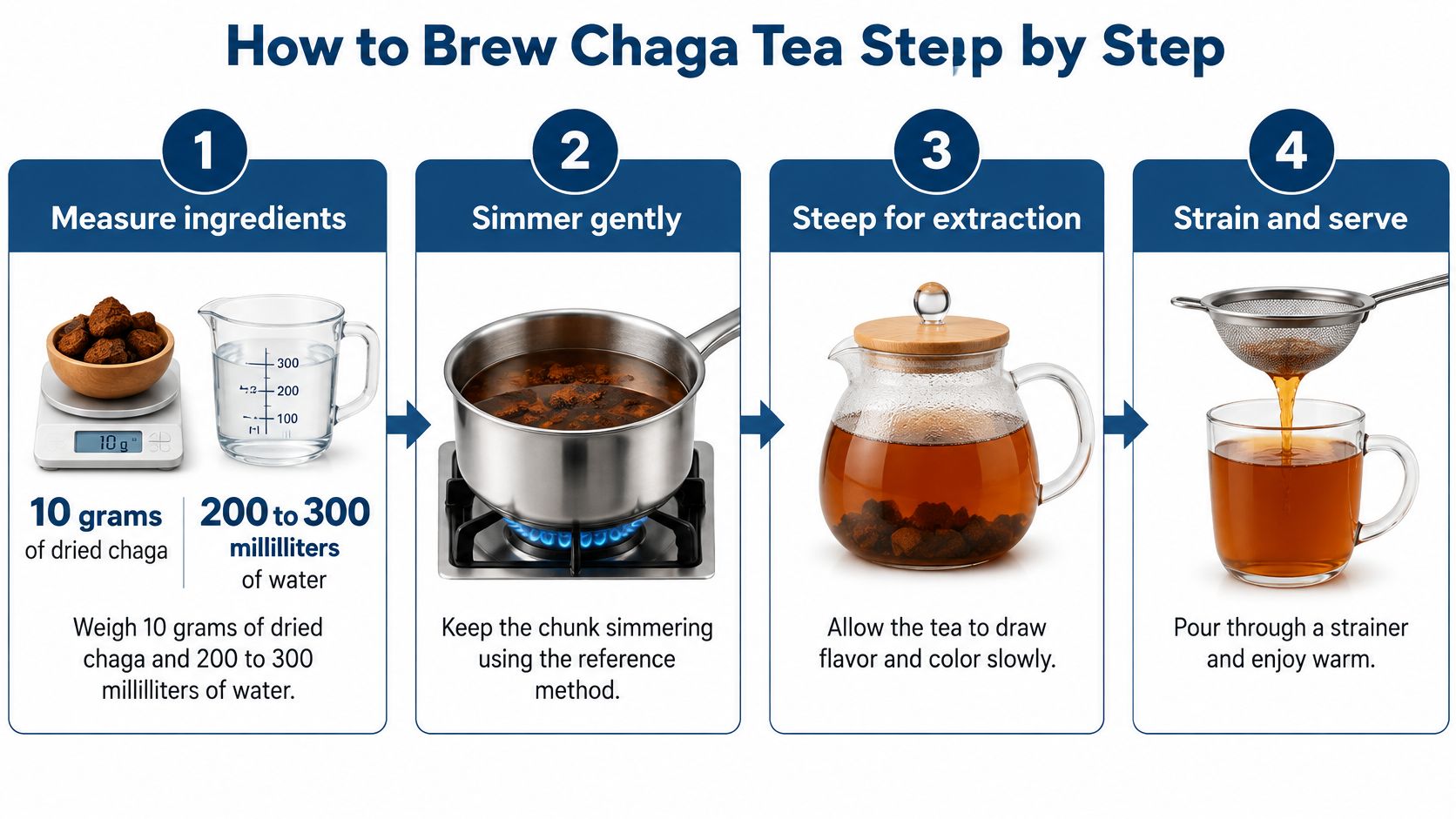
Weigh the chaga and the water. Ten grams of dried chaga to 200-300 milliliters of water sits inside the 1:20 to 1:30 range described in a study of chaga hot-water extraction, which used roughly 80°C to 90°C for 1.5 to 3 hours. A scale makes the batch repeatable. A spoon doesn't.
Break the pieces down and rinse them. Small pieces or coarse powder expose more surface to water. A quick rinse under the tap clears dust. The common slip is leaving a single large cube, which barely extracts in the time available.
Soak overnight if you want the longer route. Cold water contact before heating is the extended option. No validated cold-infusion time exists, so treat this as a head start on the same decoction, not a separate recipe.
Hold a gentle simmer with the pot partly covered. Aim for small bubbles, not a rolling boil, and top up the water that evaporates. Aggressive boiling drives off liquid and concentrates the batch, which is the mistake that makes home results unpredictable.
Strain hot through a fine filter or clean cloth. Hot liquid passes through paper and mesh more cleanly, and you avoid leaving the spent material steeping while it cools.
Run one extraction per batch. A second simmer on the same chunks is optional. Combine the two runs only when you've planned to, so you know what you're drinking.
Refrigerate promptly in a sealed glass jar. Cool it, cap it, chill it. Avoid reheating the same liquid repeatedly.
The one habit that fixes most bad batches: keep the pot at a bare simmer and replace the water you lose. Concentration is the variable that makes a home batch inconsistent, and it's the one you fully control.
A finished batch is clear, tea-colored and earthy-smelling, and it never tastes sour. Judge it on aroma and appearance rather than darkness alone.
Strength and Batch Size Without Guesswork
There's no validated human dose or safe daily limit for chaga tea, so the target isn't a strong batch. It's a small, repeatable one you can adjust with your eyes open.
Say you set aside a Saturday. You weigh 10 grams of chunks into 250 milliliters of water, simmer gently for two hours, strain, and pour into two small jars. You drink a modest serving that evening, note how you feel, and leave the rest for later in the week. If that goes fine, the following batch is where you change one variable, not five.
Most attempts at a "stronger" cup raise concentration without improving the tea. The usual culprits:
Boiling hard to speed things up, which drives off water and leaves a more concentrated liquid than you intended.
Reducing the batch by simmering it down, which is concentration by another name.
Reading darkness as potency. Color tracks time, particle size and evaporation far more than it tracks anything useful.
Reheating the same jar through the week instead of warming a single serving.
Treating cell or animal findings as proven human benefits.
Research yields describe purification-style extraction, not a cup. A controlled optimization study on chaga's outer conk predicted a crude polysaccharide maximum at 98°C, a 32:1 water-to-solid ratio and 173 minutes, and measured 24.64% ± 0.48% across three verification runs, as reported in this chaga extraction optimization study. That's a research benchmark from a process that includes purification steps, not a target for a kitchen pan.
Keep batch size small, start with a light serving, and pour out anything that smells sour or shows fuzz.
Storing Chaga Tea and Simple Flavor Variations
Storage is where a good batch goes wrong. Four rules cover it.
Chill fast and seal it. Strained tea goes into a sealed glass jar in the fridge as soon as it's cool enough to handle.
Reheat portions, not the jar. Warm what you're about to drink and leave the rest cold.
Keep dry chaga dry. Dried pieces stay in a sealed container away from light and moisture until you weigh them out.
Use chilled tea within a few days and discard it if it smells sour, looks cloudy with growth, or tastes flat and wrong.
Flavoring is easier to get right than storage, mostly because timing decides whether a spice helps or takes over. Brew a plain batch first so you know what you're seasoning, and freeze the surplus in ice cube trays so you can warm a single cup.
Variation | Ingredients and timing | Notes |
|---|---|---|
Plain strained tea | Nothing added | Best for judging the base flavor |
Lightly sweetened | Honey or maple syrup stirred into warm strained tea | Add after straining, not during the simmer |
Cinnamon and ginger | 1 cinnamon stick and 3 thin ginger slices during the last 20 minutes | Strain out spices before storing |
Clove and orange peel | 2 cloves and a strip of orange peel during the last 15 minutes | Remove peel before storing |
Iced | Chill strained tea and serve over ice | Make within a few days |
The timing column isn't fussiness. Cinnamon left in for the full two hours turns bitter and woody, and orange peel oils go harsh when they're cooked hard. Twenty minutes at the end gets the aroma without the bite.
One thing flavoring doesn't change is the chaga. Honey, spice and citrus don't reduce oxalate or soften any of the limits in the safety table, so the same rules apply to every variation on this list.
Confirm Your Batch Before Your First Cup
Five checks decide whether you drink this batch or start over.
Identity. The material is Inonotus obliquus, food-grade, cleaned and dried, from a source you can name.
Measurement. You weighed the chaga and the water at 1:20 to 1:30, and you wrote the numbers down.
Temperature and time. The pot stayed at 80-90°C for 1.5 to 3 hours without a rolling boil.
Handling. It was strained hot, cooled, and refrigerated promptly in a sealed jar.
The sensory test. It smells earthy and looks like tea. No sourness, no fuzz, no cloudiness that wasn't there yesterday.
Then run your own situation against the safety table before you pour. If kidney disease, a stone history, bleeding-risk medication, diabetes medication, pregnancy or breastfeeding applies to you, that's a clinician conversation first, not a tasting note.
Make one small batch this week. Log the material, weight, time and temperature, then taste it warm and again cold, because the flavor shifts and you'll want to know which version you like. If the identity of the chaga is uncertain, or anything about the batch looks or smells wrong, tip it out and start again with a verified source. A small first batch costs you an afternoon. A confident second batch costs you nothing, because you already have the numbers.
If you'd rather work with chaga and other fungi beyond the teapot, Colorado Cultures supplies Denver-area growers with sterilized grain bags, all-in-one grow bags, substrates, grow kits and cultures for home and lab work, each backed by printable instructions and video tutorials. Our team in Lakewood and Englewood answers growing questions by email, phone or over the counter, and our Tuesday Deals keep core supplies affordable while you build a routine. Visit Colorado Cultures to see current supplies, class dates and wholesale options before your next project.
Comments