
Sulfur Shelf Mushroom: Identify, Cook and Stay Safe
Popular advice treats the sulfur shelf mushroom as an easy beginner find. See bright orange shelves, check a photo, cook it well, and you're done. That's the wrong order, and it's where people get sick.
A shelf can match every photo and still be a poor choice for the pan. Appearance doesn't settle edibility. The host tree, the exact species, the age of the bracket, and your own sensitivity all change the verdict. Start with the tree, not the color, and many confusing cases become simple. If you can't name the host, you can't judge the mushroom.
Edibility by Host Tree at a Glance
A sulfur shelf mushroom on hardwood is usually edible when young, while the same mushroom on a conifer or black locust is frequently toxic. That's the rule to learn before you learn recipes.
Sulfur shelf, Laetiporus sulphureus, is a bright orange to yellow bracket fungus. It grows in overlapping shelves on dead or living trees, often in late spring and early summer. Young edges are soft and moist. Older brackets pale, dry out, and turn fibrous.
The Host Tree Verdict
Host tree | Edibility verdict | What to do |
|---|---|---|
Oak or other hardwood trunk or log | Typically edible when young | Confirm ID, cook thoroughly, try a small portion first |
Other deciduous hardwood (beech, maple, birch) | Typically edible when young | Same checks, skip fibrous older brackets |
Conifer (pine, spruce, fir, hemlock, cedar) | Frequently toxic | Do not eat |
Black locust | Frequently toxic | Do not eat |
Unknown or buried host | Cannot be judged | Do not eat |
Edibility here is substrate-dependent, not a property you can read from color alone. Michigan State University Extension reports that L. sulphureus collected from hardwoods is typically edible, whereas specimens growing on conifers or locusts are frequently toxic.
That warning matters in Colorado, where conifers are common and a bright shelf on pine can look just like one on oak. Don't let a familiar shape override an unfamiliar host. Walk around the tree, look at bark, needles or leaves, fallen acorns or cones, and the wood itself. Photograph the host before you cut anything.
Practical rule: Identify the mushroom, identify the host tree, and write down both before you consider eating.
Harvest only young, tender, actively growing margins if the host passes. Mature brackets become fibrous and less palatable, even from a good host. Cook thoroughly, and eat only a small portion the first time because individual sensitivity can occur.
Don't use a wild find for a classroom tasting or a culture trial unless an experienced mycologist has confirmed it. Host chemistry and contaminating organisms are uncontrolled variables. The same caution applies to health claims you may see online. Laboratory activity from compounds in the mushroom doesn't establish a safe human dose or a clinical benefit, so treat medicinal claims as research topics, not reasons to eat more.
How to Identify Sulfur Shelf Mushroom in the Field
Work through these checks in order. A specimen that fails one check doesn't get rescued by passing the others.
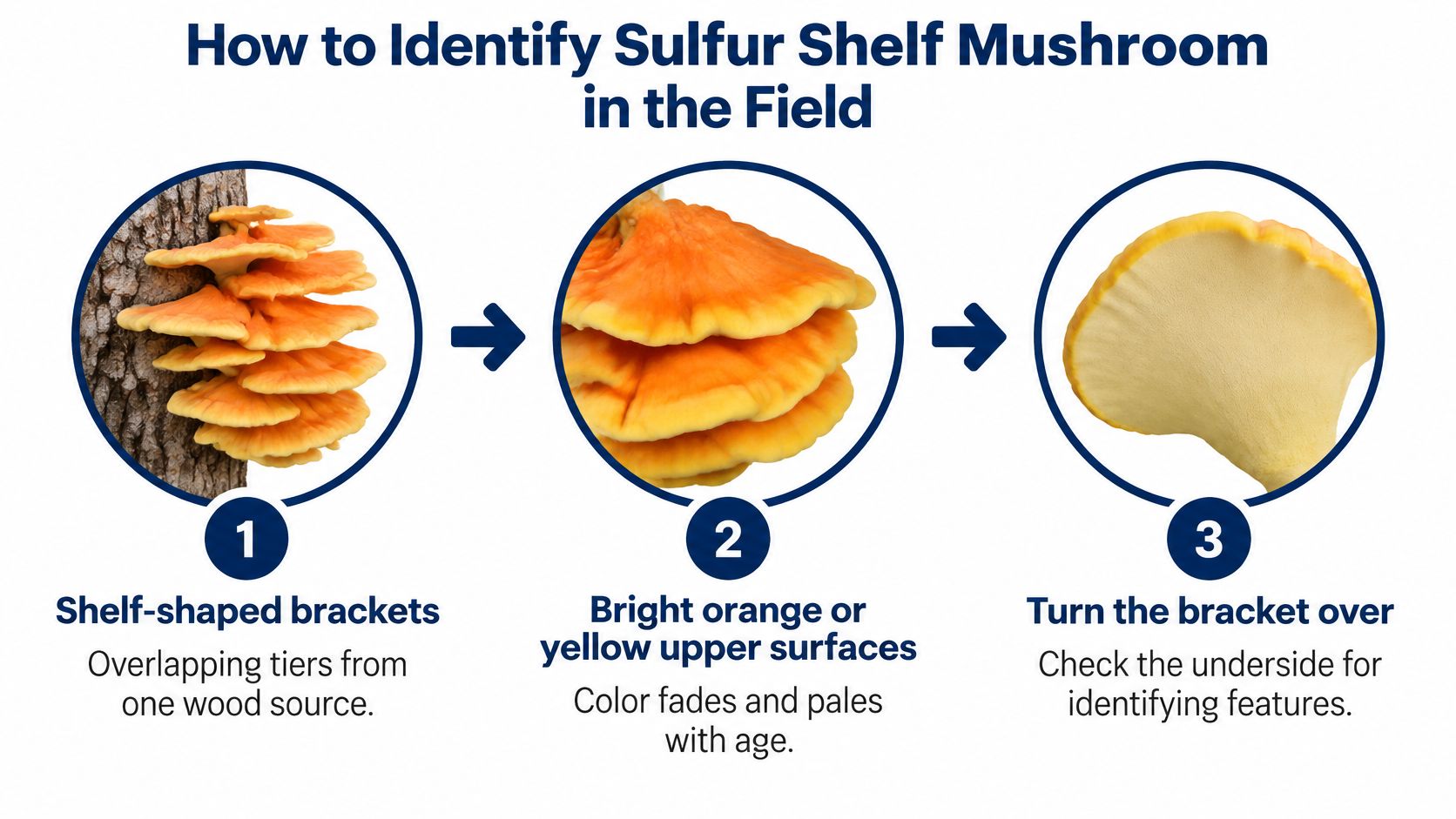
Seven Field Checks
Look at the overall growth. Sulfur shelf forms shelf-shaped brackets that overlap in tiers from one wood source. They attach directly to wood, with no real stem. A cluster of separate capped mushrooms on stems is something else.
Check the upper surface. Young brackets show bright orange or yellow upper surfaces, often with a paler yellow growing edge. Color fades and pales with age, sometimes to tan or almost white. An old, pale bracket can still be sulfur shelf, but it's past eating quality.
Turn the bracket over. The underside should show tiny pores, not gills, on a pale yellow surface with a fine texture. This is the most decisive check. If you see blade-like gills, stop. That isn't sulfur shelf.
Press and bend the flesh. Young specimens feel soft, moist, and tender, and they tear into strands. Older growth dries, toughens, turns chalky, and crumbles in your hand. Texture tells you about age, which affects both flavor and digestibility.
Name the host. Record the tree or log species and whether the wood is living or dead. Look at bark, leaves or needles, and what's on the ground nearby. The host check comes before any eating decision, not after harvest.
Check the wood and the placement. Clusters sit on wood at the base of trees, on stumps, or on fallen logs. Under and around the bracket, brown rot often breaks the wood into brown cubical fragments. Finding that pattern supports the identification.
Take a spore print if you're unsure. Place a piece underside down on paper and leave it for several hours. The print is pale whitish to yellowish. A spore print supports an ID, but it doesn't replace the pore and host checks.
What to Record Before You Leave
Take clear photos in natural light, with a coin or glove for scale in one shot.
Top view: Shows the tiered shelves and true color
Underside view: Shows pores and their color, with no gills hidden in shadow
Attachment point: Shows shelves meeting wood directly, with no stem
Host tree: Shows bark, and a leaf or needle cluster if you can reach one
Add the date and location to your notes. An expert who later reviews your find needs all of that, not just one beauty shot of orange shelves. Phone apps can suggest a name from a photo, but they can't press the flesh, inspect the pores up close, or identify a leafless host in winter condition.
Say you find vivid shelves on a fallen trunk, but the bark has sloughed off and no leaves remain. You may have sulfur shelf, yet you don't have a host. Treat it as an observation, photograph it, and leave it. A specimen that matches every visible feature still needs the host check before it goes in a pan.
Lookalikes and How to Tell Them Apart
Bright brackets look alike from ten paces away. Up close, two tests separate most of them: the underside first, the host second.
The jack-o'-lantern, Omphalotus, is the confusion that matters most. It's pumpkin orange, grows in clusters from wood or buried roots, and often appears at tree bases where you'd hope to find sulfur shelf. Turn one over and you'll see true gills running down a real stem. Sulfur shelf has pores and no stem. Eating jack-o'-lantern causes severe stomach upset, so this single check prevents the worst common mistake.
When the Lookalike Is Sulfur Shelf Itself
A shelf on a conifer can share the same colors, pores, and tiered shape as one on oak. Your eyes won't warn you. The host does, because conifer-grown specimens are frequently toxic. This is why a photo match alone isn't permission to eat.
Other Laetiporus species create a quieter problem. Mushrooms labeled sulfur shelf can belong to several genetically distinct species that look nearly identical in the field. Only DNA reliably separates some of them. That doesn't make every find dangerous, but it does mean confident local knowledge matters more than a generic field guide entry. Polypores with unfamiliar pore color or growth habit deserve the same pause, whether you're comparing them with sulfur shelf or with species such as the white cheese polypore.
Lookalike | Key difference | Risk if eaten |
|---|---|---|
Jack-o'-lantern (Omphalotus) | Gills under the cap, not pores, grows in clusters from wood or buried roots | Toxic, severe stomach upset |
Sulfur shelf growing on conifers | Same colors and shape, but the host is a conifer | Frequently toxic from host-tree compounds |
Other Laetiporus species | Nearly identical in the field, only DNA reliably separates them | Unknown, avoid unless the species is verified |
Other bracket fungi | Check pores versus gills, flesh texture and host | Avoid if unsure |
A Three Question Test
Run this test out loud before any harvest:
Pores, not gills: Is the underside clearly pored?
Hardwood host: Can you name the tree, and is it a hardwood?
Species confidence: Would you defend this ID to an experienced identifier?
If any answer is no, leave it. Another shelf on a known oak is worth waiting for.
Don't talk yourself past a failed check because the color looks right. Color is the weakest evidence you have.
Where and When Sulfur Shelf Grows
You'll find sulfur shelf far beyond one forest type. It's a cosmopolitan wood-decay fungus reported across boreal, temperate, and tropical climatic zones, with records spanning Europe, Africa, South America, and Asia, according to a 2018 study in Scientific Reports. That same study used taxon-specific molecular primers to examine 70 samples and detected L. sulphureus in 24, an incidence of 34.28%.
It spreads widely because it isn't picky about one tree. It colonizes decaying logs, stumps, and the trunks of both coniferous and deciduous trees. For a forager, that breadth is both good news and a warning. You may encounter it often, but you still have to judge each host on its own.
What Brown Rot Tells You
Ecologically, sulfur shelf is a brown-rot fungus. It breaks down cellulose and hemicellulose while leaving much of the wood's lignin behind. The infected wood turns brown and cracks into cubes, losing strength as it decays.
That biology gives you search tips. Look for old oak stands, park trees with wounds, roadside stumps, and fallen hardwood logs. Check the shaded side of trunks and the ends of cut logs where moisture lingers. A shelf often returns to the same host in later years because the fungus lives inside the wood, so mark productive trees in your notes and revisit them.
Natural fruiting generally happens on dying trees in late spring and early summer, when water and nutrients move actively between roots and crown. Warm weather after rain is a good time to check known hosts. Don't expect a fixed calendar date. Elevation, moisture, and the condition of the tree shift timing from site to site.
Remember the second side of this biology. The fungus can infect living trees and act as a forest pathogen, not just a recycler of dead wood. Don't inoculate trees or move infected wood near valuable hardwoods. Treat a find on a living yard or park tree as a forest-health observation as well as a possible food find.
Harvesting and Preparing Sulfur Shelf Safely
Good preparation starts at the tree. If the host or the underside fails your checks, there's nothing to harvest.
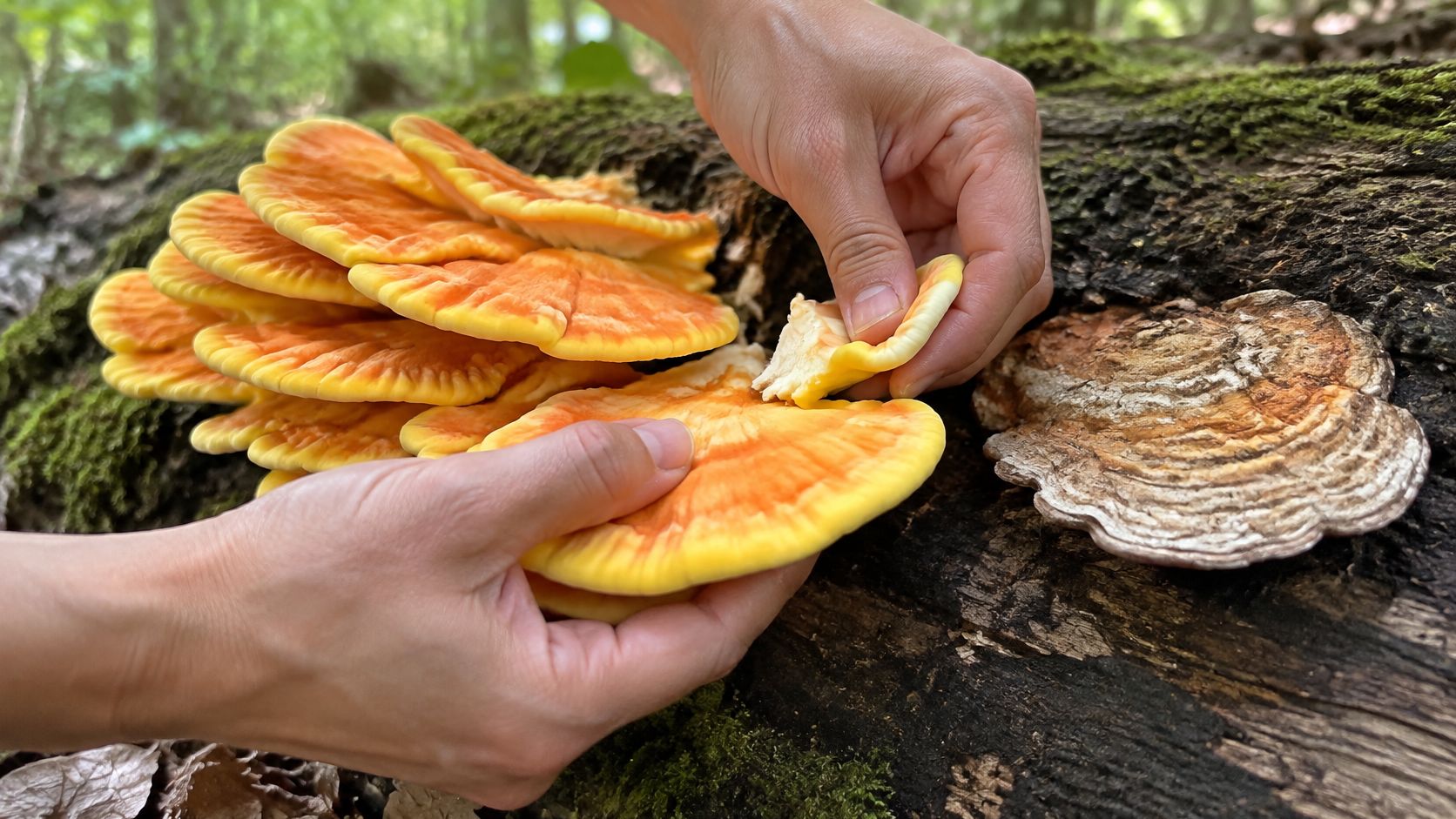
Harvest and Cooking Steps
Take young margins only. Actively growing edges are tender, while mature brackets become fibrous and bitter. Leave chalky, crumbly sections on the tree.
Cut or turn gently. For stemmed mushrooms we teach picking by gently turning until you feel a small break, avoiding pulling up substrate. Apply the same care here with a clean knife at the base of the shelf, rather than tearing wood away with the bracket.
Pick before spores drop. Mushrooms should be picked before spores drop for the best results and flavor. Young pores and firm, moist flesh signal that window.
Trim hard at home. Cut away woody, discolored, insect-damaged, or soil-touching parts. Brush off debris instead of soaking the pieces, which makes them soggy.
Pre-scald, then cook thoroughly. Briefly boil or pre-scald the pieces, discard that water, then sauté or cook them through. Never eat sulfur shelf raw or undercooked.
Start with a small portion. Eat a few bites, then wait before serving yourself more. Sensitivity varies from person to person, even with a correctly identified hardwood specimen.
Stop if symptoms appear. Seek medical care for cramps, vomiting, hives, dizziness, weakness, or any breathing difficulty.
A peer-reviewed review in Foods reports gastrointestinal upset and rare reactions including allergy, hives, dizziness, cramps, vomiting, weakness, and anaphylactic shock, with poisoning associated particularly with raw or undercooked specimens. It recommends pre-scalding or brief boiling followed by thorough cooking, and it prefers deciduous-tree specimens over conifer-grown ones.
The short video below shows the hands-on handling sequence, from checking the bracket to getting clean pieces ready for the pan.
If you cook more than you'll eat that day, cool the leftovers promptly. Practical guidance on storing sautéed mushrooms in the freezer can help you portion cooked pieces so they reheat well instead of turning rubbery. Freezing doesn't fix a doubtful identification, so label containers with species, host, and date.
Cooking reduces risk, but it doesn't remove it. Misidentification, host-tree exposure, and individual intolerance are three separate risks, and heat only addresses part of the picture. That distinction also applies to other wild species people rush to try, such as the shaggy ink cap mushroom, where timing and preparation change the outcome.
Sustainable Foraging Tips
Take less than you could. A shelf you harvest carefully can fruit again from the same host next season.
Cut the young edge only: Leave at least half of the bracket and any younger growth on the tree, using a knife or clean snips rather than tearing.
Protect the wood: Never pull up wood, bark, or substrate, and don't strip whole clusters or logs from one tree in a single outing.
Respect living trees: Skip stressed, rare, or valuable living trees, and skip any host in a park, preserve, or protected area unless the rules allow collection.
Check permission first: Get permission on private land and confirm the rules for public forests before you go.
Carry finds dry: Use a paper bag or basket rather than plastic, which traps moisture and speeds spoilage.
Don't spread decay: Don't move wood or bracket pieces to new trees or sites, since that can move decay toward healthy hardwood.
Record every find: Note host, location, and date, and report unusual sightings on living trees to a local forestry office.
Collect only what you'll eat, and leave the host in better condition than a torn, stripped trunk.
Growing Sulfur Shelf at Home and Why It Is Hard
A clean, humid bag fruits many gourmet species. Sulfur shelf does not follow that pattern. It is an advanced, experimental project, and a full block of mycelium is not a harvest.
Outdoors, a fruiting shelf depends on the right hardwood host and on the exact species growing in that wood. A sawdust bag only imitates the log. It does not erase the match between fungus, wood, and temperature, which is why a bright white block can still stall.
A 2026 cultivation study in northern Thailand, published in the Asian Journal of Mycology article, described the species as notably under-domesticated, reported that nearly no tropical cultivation protocols existed before the work, tested 12 substrate formulations, found that two strains colonized sorghum grain, and recorded only limited, temporary colonization with no fruiting after six months on logs.
Colonization Is Not a Harvest
Stage | Documented result | Reliability for beginners |
|---|---|---|
Grain colonization | Two strains fully colonized sorghum grain | Moderate, and only with a tested strain |
Log cultivation | Limited, temporary colonization, and no fruiting after six months | Low |
Nutrient-balanced sawdust bag | Rapid, complete colonization and primordia formation in two formulas | Moderate, because primordia are not a mature crop |
Mature fruiting bodies | Not obtained in the Thai bag trials | Low, experimental only |
Sawdust bags did better than logs in those trials. Two nutrient-balanced formulas colonized completely and formed primordia. Mature fruiting bodies still did not appear.
Primordia work like buds on a branch. They mean the fungus is attempting to fruit. They are not the bracket you would cook. Mycelium filling a bag is closer to roots filling a pot: the growth below can look finished while nothing above it is ready to pick.
Mature fruiting may need cooler conditions, a longer cool period, or wider day-night temperature swings than steady warm incubation. More mist will not create a temperature signal the culture never got.
Track each stage on its own line, as you would when learning about mushrooms growing on a log:
Culture maintenance: Keep a documented strain alive and clean.
Spawn production: Expand that culture onto grain.
Vegetative colonization: Let mycelium fill the substrate.
Primordia initiation: Note the first visible beginnings.
Completed fruiting: Count only mature brackets, if any form.
Write down strain name and provenance, substrate formula, moisture, and incubation conditions for every attempt. A culture marked only "sulfur shelf" hides which strain you grew, so the next run cannot be compared with the last. Use a defined lignocellulosic mix, such as sawdust supplemented with rice bran and calcium carbonate for nutrition and pH buffering, and change one factor at a time.
Keep the trial contained. Do not inoculate living hardwoods outdoors, and do not leave colonized wood near trees you want to protect. One fully recorded run teaches more than five bags with no notes.
Decide Whether to Forage or Experiment
You have three sensible paths, and each has clear conditions.
Forage only when the host is a named hardwood, the underside shows pores, the flesh is young, and you're confident in the species. Harvest young margins, cook them thoroughly, and eat a small first portion. If doubt remains, get an expert identification in person.
Skip it when the shelf grows on a conifer, black locust, or an unknown host. Skip anything with gills, a doubtful underside, or old, chalky flesh. Leaving a mushroom is a successful foraging decision, not a failed outing.
Experiment with cultivation only as a controlled trial. Use a documented culture, and record strain, substrate formula, moisture, temperature, and timing. Expect colonization before fruiting, if fruiting comes at all. We provide mycology and lab supplies that suit that kind of documented work, and a mycology class can help you plan sterile technique before you spend money on bags.
The rule to remember: Identify the host, identify the mushroom, then decide.
If you're ready to move from field notes to a documented cultivation trial, visit Colorado Cultures for mycology and lab supplies, sterilized substrates, and classes that build clean, repeatable technique. Bring your strain records and questions, and we'll help you choose materials that fit an experimental sulfur shelf project without promising a harvest the biology can't guarantee.
Comments