
Oyster Mushroom Cultivation Training: A Complete Guide
You're standing in a kitchen with a bag of spawn, a stack of straw, and a phone full of mushroom videos, but the first real question is still the same, what do you do next so the bag doesn't turn into a green mess? That's where oyster mushroom cultivation training earns its place. It turns scattered tips into a repeatable workflow, so you're not guessing at sterile technique, humidity, or when a cluster is ready to harvest.
Why Oyster Mushroom Cultivation Training Is Worth Considering
A first class usually starts with someone who's already ruined a few batches. They're the person who can point to a cloudy petri dish, a wet straw bag, or a caps-too-small fruiting block and say exactly where the process went sideways. That kind of coaching matters because beginners often don't fail at the “fun” part of growing, they fail at the invisible parts, like cleanliness, moisture, and timing.
Practical rule: if you're learning from videos alone, you can memorize steps without understanding failure points. Training makes the failure points visible before they cost you a crop.
The value is speed, but not the shallow kind. A structured course compresses months of trial and error into a guided session, so you leave with a documented workflow instead of a half-remembered recipe. That's especially useful when you're deciding whether this is a hobby or the beginning of a small business, because the business version depends on consistency, not luck.
Training also helps you avoid the expensive loop of “buy, fail, replace.” One contaminated batch can waste spawn, substrate, bags, and your time. A good instructor shows you how to judge when a problem is contamination, when it's just too much moisture, and when the room conditions are the actual issue.
For a beginner, that difference is huge. You're not just paying for information, you're buying fewer dead ends.
What Oyster Mushroom Cultivation Training Actually Covers
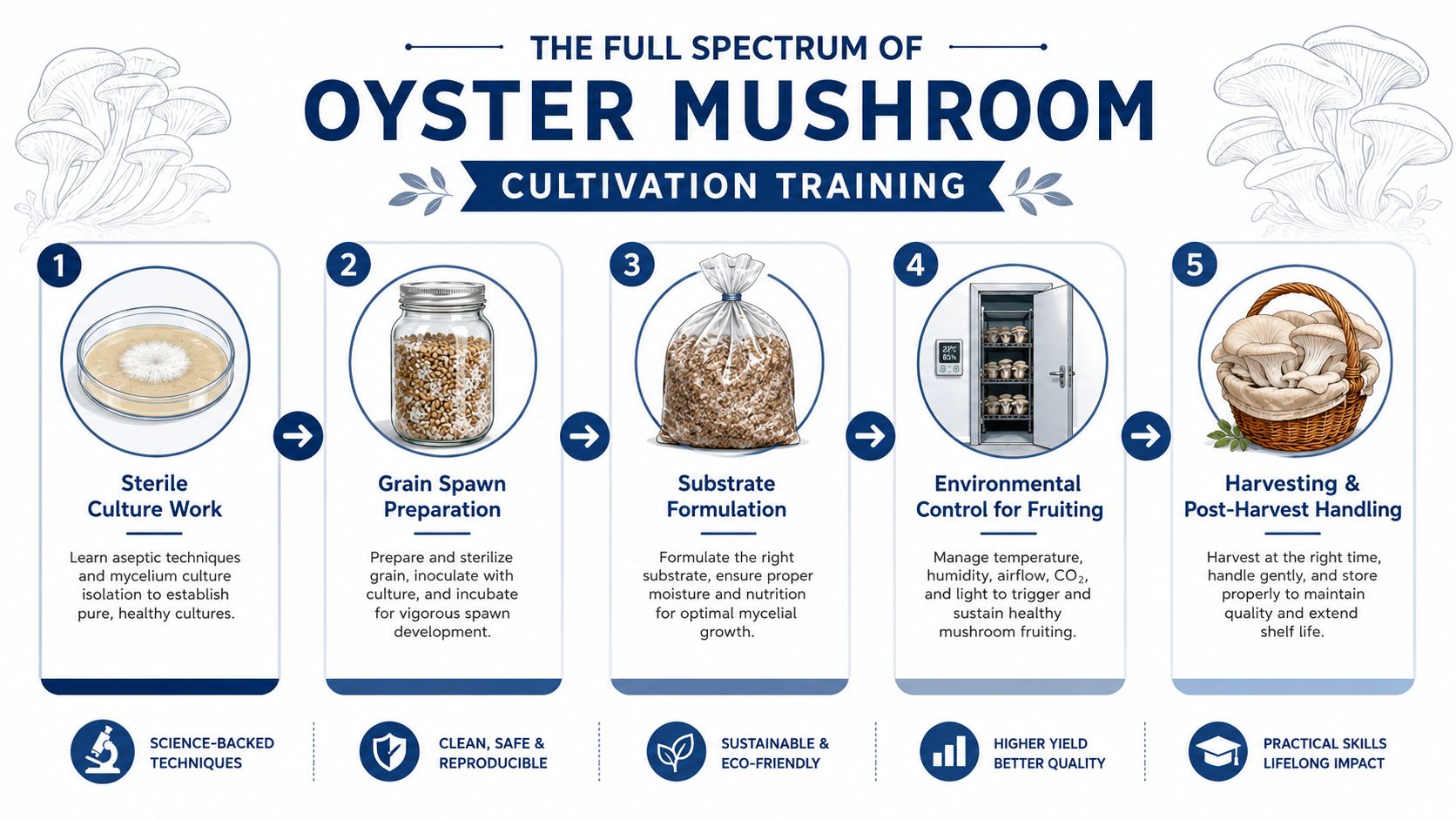
Oyster mushroom cultivation training should cover the whole chain, from clean culture work to post-harvest handling. Think of it as moving a mushroom from “invisible biology” to “marketable crop” in a series of controlled steps. If one step is sloppy, the rest of the chain gets weaker.
The five stages you should expect
Sterile culture work is the starting line. You learn to handle agar plates, transfers, and clean inoculation so the mushroom mycelium gets a fair head start over molds and bacteria.
Grain spawn preparation is the bridge. You're teaching the fungus to expand in a food source that can later seed your growing substrate, the way a small starter dough spreads through a larger loaf.
Substrate formulation is where the material choice matters. Straw, sawdust, or a supplemented mix all behave differently, so training should explain why one substrate suits a low-budget home setup while another fits a more controlled grow.
Fruiting room management turns a colonized block into mushrooms. That means humidity, indirect light, airflow, and harvest timing, not just “put it in a box and wait.”
Harvest and post-harvest handling finishes the job. Good training teaches you how to pick clusters cleanly, cool them properly, and keep quality from dropping after the harvest window.
Serious programs also explain what the class is not. It's not a foraging lecture, not a cooking demo, and not just a spore print activity for curiosity's sake. A real course should connect the grow room to the household kitchen and, if you want to sell, to small-scale business realities too.
Core Skills You Should Expect in the Curriculum
A useful curriculum builds skill in the same order a grower uses it. The 2024 training study on mushroom cultivation, which tracked 65 participants across 14 subcategories, found large gains after structured instruction, including packaging and marketing rising by 75.38%, insect-pest and disease management and processing/value addition each rising by 72.31%, medicinal values improving by 69.23%, and drying procedures for oyster and shiitake mushrooms improving by 66.15%. That pattern matters because it shows the class shouldn't stop at production, it should prepare you for handling, preservation, and sales readiness too. 2024 mushroom cultivation training study
Core curriculum modules and skill outcomes
Module | Skill Taught | Graduate Outcome |
|---|---|---|
Clean lab basics | Agar work and transfers | You can isolate healthy culture instead of starting with contaminated material |
Spawn expansion | Grain-to-grain movement and inoculation hygiene | You can multiply spawn without losing sterility |
Substrate prep | Pasteurization or sterilization checks | You can prepare a block that colonizes evenly |
Fruiting setup | Bag, bucket, or tent management | You can trigger pins and keep them from aborting |
Crop care | Humidity, air exchange, contamination ID | You can troubleshoot deformities before they spread |
Harvest handling | Picking, cooling, storage, and drying | You can keep quality after the flush |
Business basics | Sales channels and simple recordkeeping | You can decide whether you're growing for home use or resale |
The biggest thing to look for is lab time. Lecture can explain a sterile loop, but your hands need to learn what “clean” feels like when you pour agar, seal a bag, or open a jar without contaminating it. If a class only talks through the steps, you're still missing the muscle memory.
A curriculum gap shows up when a class ignores sales, food safety paperwork, or how to handle a bad batch. The Colorado Cultures pearl oyster project is useful as a practical reference point because it shows how grow instructions, equipment, and species selection can be tied together instead of treated as separate topics.
In-Person vs Online vs Hybrid Training Formats
The format changes the learning outcome as much as the curriculum does. In-person training gives you real tools, real contamination problems, and immediate feedback, which matters a lot when you're first learning sterile work. Online training is better when you already understand the basics and need a flexible refresher, while hybrid programs split the difference.
Training format comparison
Criterion | In-Person | Online | Hybrid |
|---|---|---|---|
Cost | Usually higher because of space, materials, and instructor time | Usually lower | Middle ground |
Feedback quality | Immediate and specific | Delayed, often limited to comments or email | Strong on lab day, lighter afterward |
Hands-on practice | Highest | Low unless you practice on your own | Good, but concentrated |
Accountability | Strong, because you're present in the room | Self-directed | Moderate |
Best fit | First-timers who've never poured agar or inoculated grain | Learners who already keep a clean workspace | People who want theory online and lab work in person |
If you want a broader framework for choosing between live and self-paced learning, the guide for choosing training formats lays out the tradeoffs clearly. The basic rule is simple, if you've never autoclaved grain or handled agar, in-person training saves a lot of trial and error.
Online works when your problem is refinement, not first contact. If you already know how to keep a clean work surface and you mostly need to fill in gaps around fruiting or substrate choice, self-paced learning can be enough. Hybrid fits the middle, especially when theory is easy to study at home but sterile technique needs a real lab.
If a bag turns green and you don't have a teacher nearby, the lesson arrives late and costs more.
How to Choose the Right Course for Your Goals
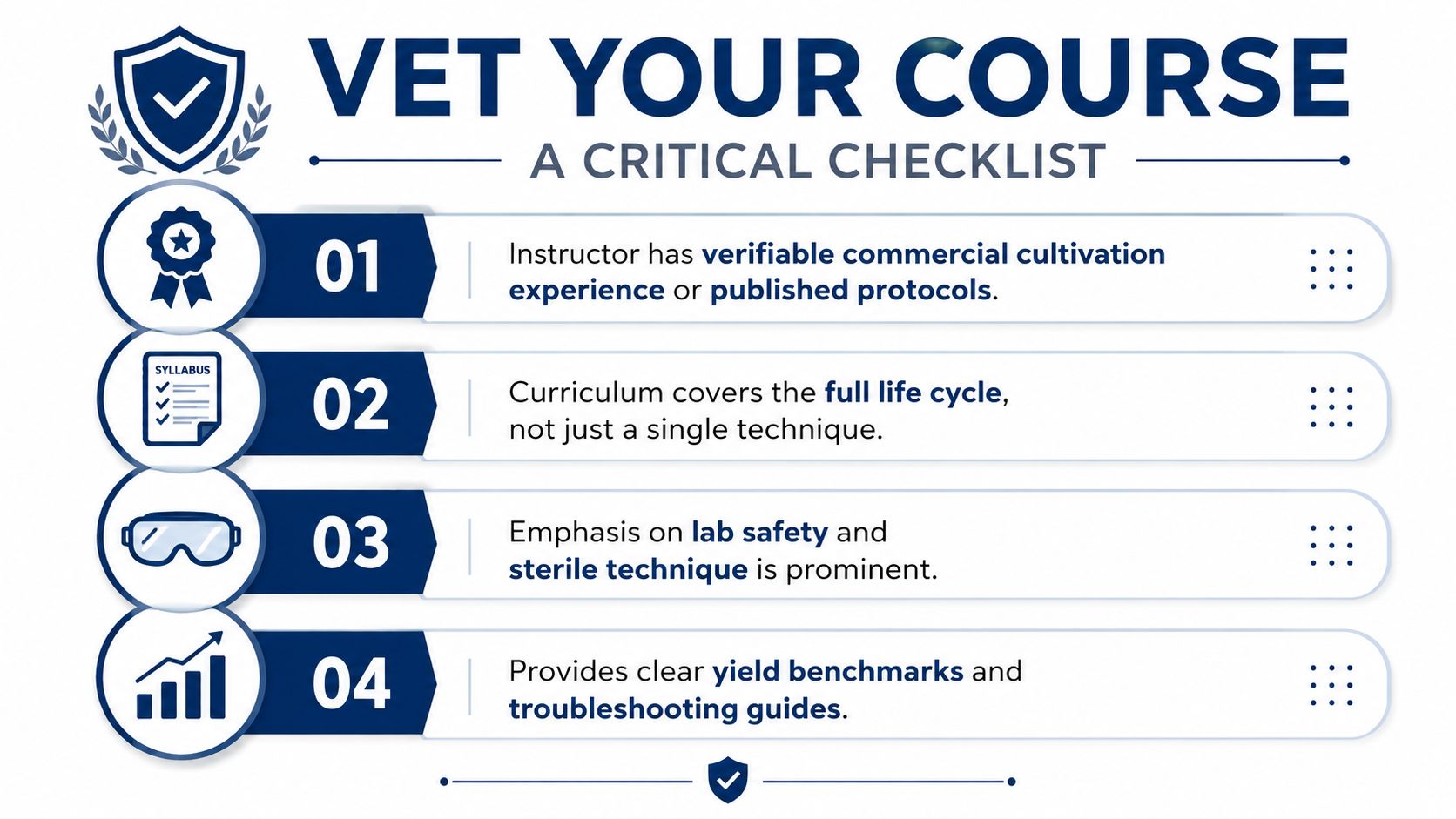
A serious course should look more like a working lab than a hobby meetup. Start with the instructor. Ask whether they've run commercial crops, published protocols, or trained through an established supplier or extension setting, because that matters more than polished social media posts.
Class size matters too. If the room is too big, you won't get enough feedback while you're doing delicate work like transfers or inoculation. If it's very small, the course may be thin on demand or too narrow in scope, so look for a group that's small enough for hands-on coaching but large enough to suggest real use.
What to check before you enroll
Instructor credibility: Look for commercial experience, documented protocols, or supplier partnerships.
Lab access: Make sure you'll pour plates, inoculate bags, and handle the tools yourself.
Class depth: The syllabus should cover the whole life cycle, not just one trick.
After-class support: Ask about recordings, follow-up sessions, troubleshooting channels, or office hours.
Outcome match: Choose intro training if you're curious, and a deeper certificate if you plan to sell.
The right course also tells you what happens after the last session ends. Follow-up support matters because contamination questions usually show up at home, not during class. A private group, a troubleshooting email path, or access to fresh spawn after training can keep a beginner from stalling out.
For growers who are trying to connect cultivation skills with physical space planning, garden ai design is a useful example of how site layout thinking can support a growing setup, even though mushroom rooms have different needs from outdoor gardens.
What Structured Training Can Actually Change
Training changes behavior first, then output. In the India field evidence, 100 village women were trained in a 2008 to 2009 program, and follow-up found that 49% developed their mushroom cultivation skills, 57% saw mushroom farming as a profitable alternative business, post-training output increased by 88%, productivity increased by 89%, and the number of mushroom growers rose from 2 to 19. Another extension study found that among 20 tribal participants in a 200-hour skill-development program, 40% adopted oyster mushroom production afterward and earned between 0.25 lakh and 4.00 lakh rupees. India extension study on oyster mushroom training
Those numbers matter because they show training isn't just education, it's conversion. A beginner becomes a grower when they can repeat a clean cycle without panic, and a grower becomes a seller when they can deliver predictable quality to a buyer. Structured instruction helps on both fronts.
The psychological shift is real too. The first flush stops feeling like luck and starts feeling like a process you understand. That confidence changes how you troubleshoot, because you're no longer guessing from the outside when the room needs more air, the substrate is too wet, or the spawn quality is weak.
For small-business growers, the business case is just as important. Buyers, lenders, and food buyers want signs that you understand hygiene, sourcing, and basic crop management before they trust you with repeat orders. Training can be the difference between a hobby tray and a product line.
Colorado Cultures Classes and Local Denver Options
Colorado Cultures runs practical mycology classes through its CC Classroom program, including an introductory oyster mushroom workshop and an all-day intensive format. The company also sells take-home kits, and its storefront at 4321 W 38th Ave gives students a place to restock spawn, substrate, and tools after class through the store location and visit details. That makes the class part of a wider support loop instead of a one-time event.
Colorado Cultures CC Classroom offerings at a glance
Class Format | Duration | Take-Home Component | Best For |
|---|---|---|---|
Introductory oyster workshop | Short introduction | Starter materials and instruction | Curious beginners |
All-day intensive | Full-day lab focus | Hands-on practice and class notes | First-time growers who want guided practice |
Follow-up troubleshooting visit | By arrangement | Equipment and spawn restock | Students who need help after their first run |
The advantage of a local format is feedback. If a student comes back after class with a contaminated bag or a question about fruiting room setup, the conversation can happen in person, with the tools on the counter. That's much easier than trying to diagnose a grow through a few blurry photos and a text thread.
Practical rule: if your goal is selling mushrooms, not just learning about them, choose training that includes a path back to the instructor after your first home run.
Denver-area growers also have other community options, including Colorado Mycological Society meetings and CSU Extension short courses. Those don't replace hands-on cultivation training, but they do give you more local context and a broader mycology network. Colorado Cultures sits in the middle of that ecosystem as a practical, retail-plus-classroom option for people who want supplies and instruction in the same place.
Putting Your Training Into Practice at Home
The first week after class matters more than the class itself. Set up a small fruiting corner with a tote, plastic sheeting, indirect light, and a simple misting routine, then keep it separate from dusty storage or kitchen traffic. A clean corner beats a fancy room that never gets used.
Within 48 hours of training, inoculate your first bucket or bag while the sterile habits are still fresh. If you wait too long, confidence fades and shortcuts creep in. That first block doesn't need to be perfect, it needs to be done while the process still feels familiar.
A simple home logging habit
Pinning date: Write down when the first pins appear.
Harvest weight: Record what each flush gives you.
Contamination notes: Mark any green, wet, or foul-smelling spots.
Room changes: Note misting, light, and airflow adjustments.
That notebook becomes your second teacher. By the second and third batches, you'll see patterns that are hard to notice in the moment, especially when the room is dry or the airflow is too weak. If you live in Colorado, pay attention to indoor winter dryness and the more humid summer monsoon stretch, because fruiting behavior can change when the room air changes.
For an approachable side lesson on everyday microbial management, the beginner's guide to home composting is useful context, since it helps you think clearly about decomposition, moisture, and cleanliness in a home setting. The point isn't to turn your grow room into a compost pile, it's to build a better instinct for what organic material does when moisture gets out of balance.
If you're using a kit, the full-flush grow kit instructions can help you translate the class into a first harvest at home. Once you've done one cycle, the next step is to stay plugged into the local grower community through Q&A sessions, mushroom clubs, and follow-up workshops. That's how one class becomes a skill you can use.
The best time to move from interest to practice is now, while the basics are still fresh. Visit Colorado Cultures to explore oyster mushroom classes, take-home supplies, and practical support that can help you turn a first grow into a repeatable routine.
Comments