
Turkey Tail Mushroom Cultivation at Home: A Practical Guide
You've opened a bag of turkey tail culture expecting an oyster-style takeover. Instead, the grain looks barely changed, a thin leathery mat is spreading at the surface, and you're wondering whether anything is happening at all. That reaction is common because Trametes versicolor doesn't behave like a fast, fleshy gourmet mushroom.
Turkey tail mushroom cultivation rewards a different mindset. The species is a wood-decaying polypore that puts energy into tough mycelial growth and thin, banded brackets rather than heavy caps. Your substrate, moisture balance, fresh-air exchange, and patience matter more than adding more inoculum. Research now documents both indoor fruiting and log-based production, but it also shows that output can vary sharply with substrate composition and cultivation method.
Why Turkey Tail Behaves Differently from Other Mushrooms
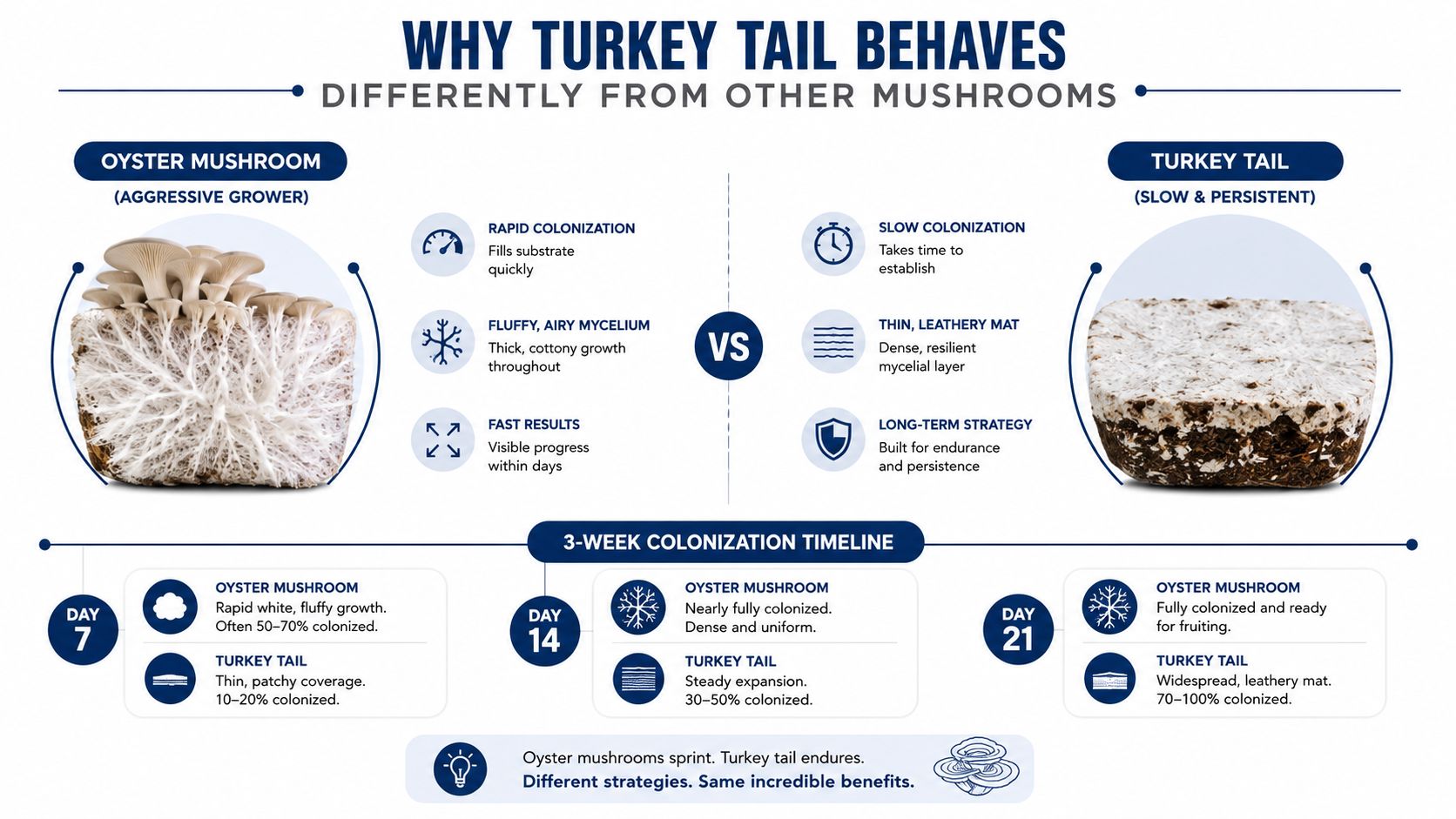
A first-time grower often makes the same mistake. They treat turkey tail like an oyster mushroom, use a nutritious grain-heavy formula, keep conditions warm and wet, and expect aggressive white colonization. Turkey tail may instead form a fine, leathery surface, progress unevenly, and appear reluctant to fruit.
That behavior makes more sense once you classify the organism correctly. Turkey tail is a white-rot polypore, adapted to digest lignin-rich woody material. Its natural structure is a thin, overlapping bracket with concentric bands, not a thick stem and broad cap. The useful harvest is often dried biomass or extract material, so a block that looks unimpressive beside an oyster block may still be developing normally.
Why substrate chemistry matters
The most important decision happens before inoculation. A lignocellulosic substrate gives turkey tail the carbon structure it evolved to use, while excessive easily available nutrition can increase contamination pressure and leave you with a block that is rich but poorly balanced.
That doesn't mean supplementation is useless. It means supplementation has to match your objective. A lightly supplemented sawdust formula can shorten the production cycle, while a richer formulation can improve biological efficiency if your sterilization and bag handling are reliable. Research on supplemented sawdust found that 90% sawdust and 10% wheat bran produced a fast timeline, while 70% sawdust and 30% wheat bran reached the stronger yield and biological-efficiency result, creating a practical speed-versus-yield trade-off (supplemented sawdust cultivation research).
Bench rule: If the substrate is wrong, increasing inoculation volume usually won't solve the problem. Fix the carbon source, nitrogen level, moisture, and cleanliness first.
Turkey tail can also look stalled when it's working slowly through a dense material. In a 2026 log study, visible fruiting appeared on about 68% of inoculated logs, with first signs arriving after an average of 327.5 days, or roughly 10.8 months (2026 Trametes versicolor cultivation study). That timeline is a useful correction to oyster expectations. For a cultivation overview and project-specific growing context, compare the Turkey Tail project information from Colorado Cultures.
Choosing Between Logs and Sawdust for Turkey Tail
The choice between logs and indoor blocks is less about which method is universally best and more about what you want to control. Logs give you a durable outdoor system with fewer sterile transfers after inoculation. Sawdust blocks give you a faster, more measurable cycle, but they demand pressure sterilization, clean inoculation, and closer environmental management.
Research has documented both approaches. Log cultivation is possible, although the 2026 study reported a mean yield of 1.395% fresh weight and 2.791% biological efficiency, figures that illustrate why logs are better understood as a long-game biomass project than a high-volume gourmet crop (documented log fruiting study). Indoor supplemented sawdust can be more productive, but only when the added nutrition doesn't overwhelm your sterile workflow.
Compare the two routes before buying supplies
Variable | Hardwood Logs | Supplemented Sawdust |
|---|---|---|
Best use | Long-term outdoor fruiting and low-intervention cultivation | Controlled indoor production and faster testing |
Timeline | Slow and variable, with fruiting potentially taking many months | Faster under optimized supplemented systems |
Substrate | Fresh, healthy hardwood | Hardwood sawdust or pellets with a measured supplement |
Contamination exposure | Lower after successful inoculation, but exposed to weather and competing fungi | Higher during preparation because supplemented material requires strict sterilization |
Infrastructure | Drill, spawn, wax, shade, and reliable moisture access | Pressure sterilizer or canner, filter-patch bags, clean workspace, and fruiting chamber |
Labor pattern | Front-loaded inoculation, then periodic moisture and condition checks | Repeated batch work, sterile transfers, bag inspection, and environmental adjustment |
Yield expectation | Variable, often modest on a fresh-weight basis | More measurable, with strong dependence on formula and process control |
Main failure | Logs dry out, fruit late, or are outcompeted | Bags contaminate, overheat, or fruit before full colonization |
Pick the method that fits your space
Choose logs if you have a shaded outdoor location and you're comfortable waiting through changing seasons. Logs suit growers who value persistence over scheduling and who want to observe decomposition rather than run a tightly timed production room.
Choose sawdust if you want to compare formulas, monitor colonization, and work toward repeatable batches. An Indian cultivation study recorded spawn-run completion in 18 to 20 days at 25±2°C, while an Iranian report identified 70% sawdust plus 30% wheat bran as the strongest substrate in its trial, yielding 159 g/kg with 45.5% biological efficiency over a total cultivation period of about 39.7 days (regional turkey tail cultivation research). Those figures aren't promises for a home setup. They show how much the production route depends on controlled substrate and environmental conditions.
Preparing Substrate and Inoculating Your Grow
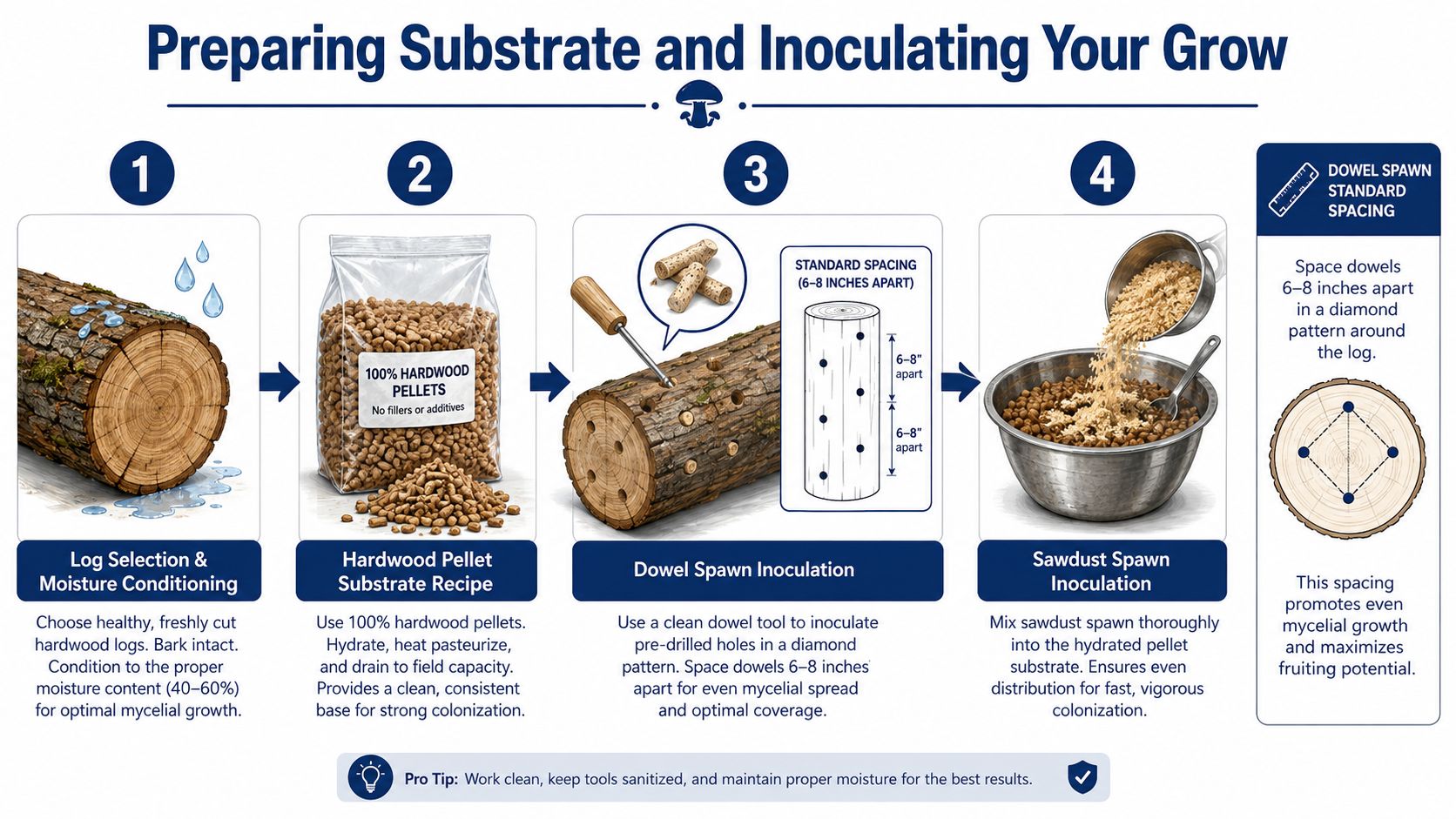
Good turkey tail cultivation starts with moisture that is available to the mycelium but not pooling inside the bag. For an indoor trial, hardwood fuel pellets provide a consistent carbon base, while wheat bran supplies nitrogen and other nutrients. A practical starting point is 80 parts hardwood material to 20 parts wheat bran, then adjust only after you can produce clean, fully colonized blocks.
The exact formula shouldn't become a superstition. A separate study found strong fruiting on 80% sugarcane bagasse, 12% horse manure, and 8% poultry manure, reaching 158.33 g per 500 g bag and 31.5% biological efficiency at a 31:1 carbon-to-nitrogen ratio. Its nitrogen-free substrate performed substantially worse, with biological efficiency at 11.50%, which supports a measured supplementation strategy rather than a wood-only assumption (substrate chemistry and domestication study).
Prepare an indoor block
Hydrate the base. Add water gradually to hardwood pellets until the material is evenly expanded and holds together when squeezed without releasing free water. A wet substrate that leaks or feels muddy is more likely to develop bacterial problems.
Blend the supplement. Mix wheat bran thoroughly through the hydrated hardwood material. Uneven pockets create uneven growth, and concentrated nutrient patches can become contamination hotspots.
Bag and sterilize. Fill filter-patch bags without compressing the substrate into a brick. Supplemented sawdust should be sterilized, not merely pasteurized. The plan benchmark is 15 psi for 90 minutes, followed by complete cooling before inoculation.
Inoculate cleanly. Use a still-air box or HEPA-filtered flow hood, wipe tools and work surfaces with alcohol, and keep the bag opening exposed for as little time as possible. A spawn rate of 5% to 10% of wet substrate weight is a workable starting range.
Seal and inspect. Fold or seal the bag according to its design, then check for tears, poor filter adhesion, or trapped wet spots. Incubate the inoculated block around 70°F to 75°F at the beginning of colonization.
For log cultivation, select fresh, sound hardwood that still retains moisture. Drill an organized pattern, insert dowel or sawdust spawn, seal the openings with wax, and place the logs in shade where they can be checked and watered without sitting in constant saturation. The exact spacing matters less than consistent coverage and moisture retention, so avoid leaving large uncolonized sections between inoculation points.
This agar-to-culture handling guide is useful when you're expanding a verified culture before moving it into a production substrate.
Inspect bags during incubation without opening them. A clean block should progress steadily, while sour odors, slimy patches, colored growth, or a wet collapsed filter area justify isolation and disposal rather than rescue attempts.
Incubation and Fruiting Parameters That Actually Work
Turkey tail needs a deliberate environmental shift. Keeping a fully colonized block in warm, stagnant incubation conditions can produce dense or distorted growth instead of the thin, fanned brackets people expect. Fruiting requires cooler air, high humidity, light, and enough fresh-air exchange to prevent carbon dioxide from accumulating around the block.
The Indian cultivation benchmark used 25±2°C with 80% to 85% relative humidity during fructification (Indian cultivation report). That's a useful regional reference, but it shouldn't be treated as a universal recipe. Your block, bag geometry, culture, and chamber airflow will change the result.
Use a staged environmental change
During incubation, keep the block protected from direct light and avoid repeatedly opening or handling it. The goal is complete internal colonization, not a bright white surface alone. A block that looks colonized on top can still contain uncolonized pockets underneath.
When the block is fully established, introduce fruiting cues gradually:
Cooler air: Move away from the warm incubation range and use a cooler fruiting environment.
Higher humidity: Maintain a humid surface without allowing water to pool in folds or on developing brackets.
Fresh air: Increase exchange enough to prevent lumpy, compact growth and encourage broad bracket formation.
Light: Provide consistent indirect light so the organism can orient its fruiting structures.
The main practical mistake is changing every variable at once without observing the block. If pins stall, first check whether the surface dried out. If the growth becomes thick and misshapen, inspect fresh-air exchange. If bacteria appear in the substrate, revisit moisture and sterilization rather than increasing ventilation.
Parameter snapshot
Parameter | Incubation | Fruiting |
|---|---|---|
Temperature | Warm, stable conditions around the low-to-mid 70s°F | Cooler conditions suited to bracket development |
Humidity | Enough to prevent bag drying | High humidity with no standing water |
Air exchange | Limited disturbance while the block establishes | Regular fresh air to reduce carbon dioxide buildup |
Light | Dark or subdued | Indirect light introduced consistently |
Block status | Fully colonizing and protected | Fully colonized with an exposed fruiting surface |
Common error | Opening or fruiting too early | Maintaining stagnant air or drying the surface |
A strong indoor system balances speed and yield. The sawdust research showed that lighter supplementation can shorten the timeline, while a richer formula can produce more biomass when contamination control is strong (supplemented sawdust production benchmarks). That's why a reliable grower records the formula and environmental response instead of copying a single recipe forever.
Harvesting Drying and Processing Your Flush
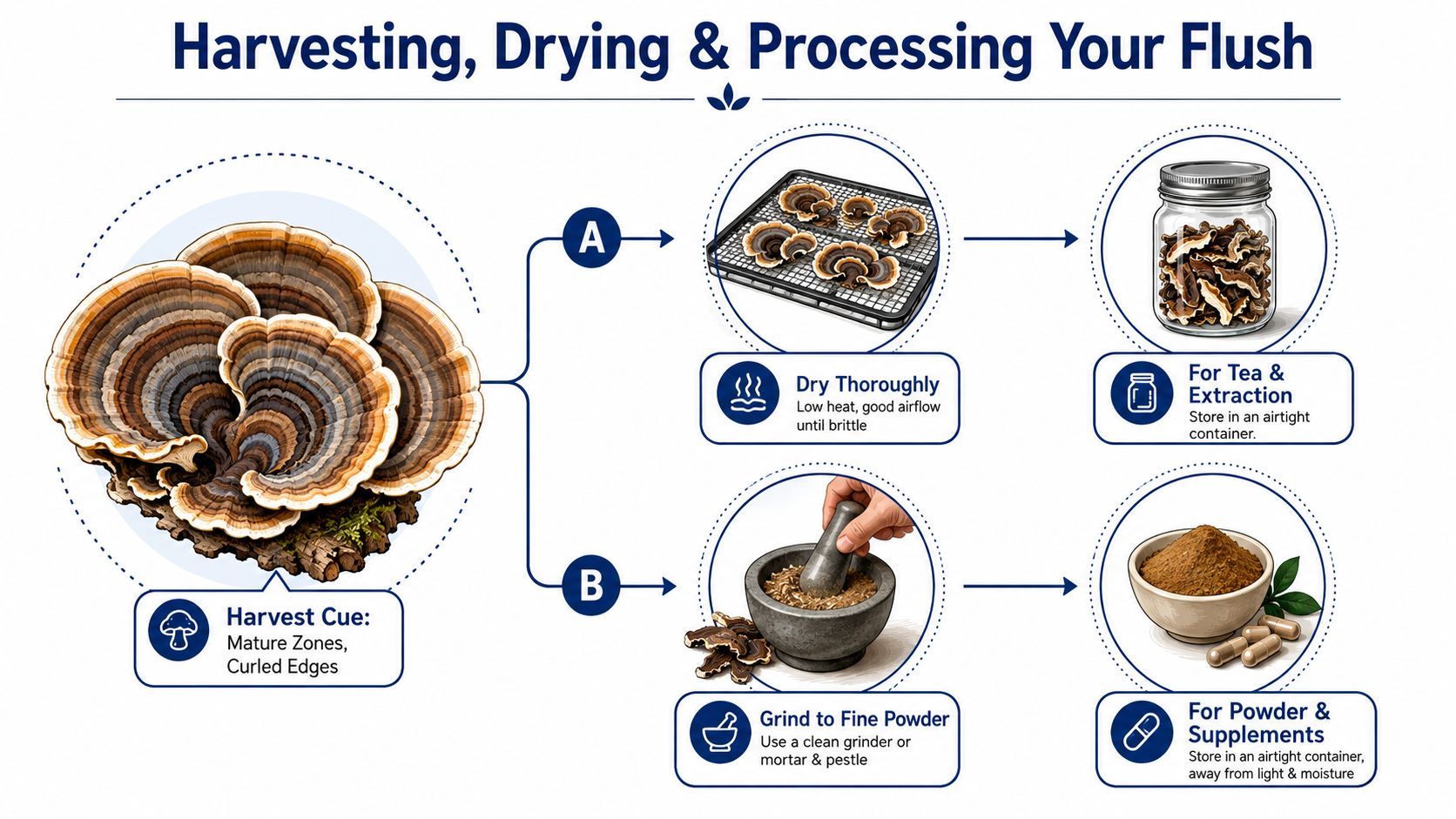
Turkey tail brackets tell you when they're ready through structure rather than size. Look for clearly separated color zones, firm flexible tissue, and edges that remain slightly curled inward. Harvest before the brackets become waterlogged, brittle, insect-damaged, or contaminated with debris.
Cut the brackets cleanly with a sanitized knife or scissors. Brush off wood and casing material, but don't soak the harvest, because extra surface water slows drying and can encourage spoilage.
Choose the processing route
If you want pieces for tea or culinary experimentation, slice the brackets thinly and spread them in a single layer. A dehydrator set around 95°F to 115°F can remove moisture without cooking the material. Continue until the pieces are brittle rather than bendable.
For research or personal biomass processing, some growers harvest the usable fruiting material from the block, dry it thoroughly, and grind it into powder. Don't confuse powdered homegrown material with a standardized extract. The concentration of compounds can vary with culture, substrate, maturity, drying, and extraction method.
Harvest judgment: Early cutting turns the block over faster, but later, better-developed brackets give you more mature material to work with. Choose based on whether you value rapid turnover or a more complete harvest.
Drying and storage
Drying is finished when the thickest pieces snap cleanly. Cool the material before packing it, because warm dried mushrooms can create condensation inside a sealed container. Store the dried pieces or powder in an airtight, light-protected container and label it with the culture, substrate, inoculation date, harvest date, and processing method.
A useful workflow separates the harvest into two batches. Keep intact pieces for decoction, and mill only what you plan to use soon. Fine powder exposes more surface area to air and moisture, so it deserves especially careful packaging.
Colorado Cultures' Fungi Fuel flushing enhancer instructions can help you understand product-specific handling when you're working with a compatible grow system, but it doesn't replace the basic requirements of clean harvest, complete drying, and accurate labeling.
Medicinal Use Ethics and Responsible Sourcing
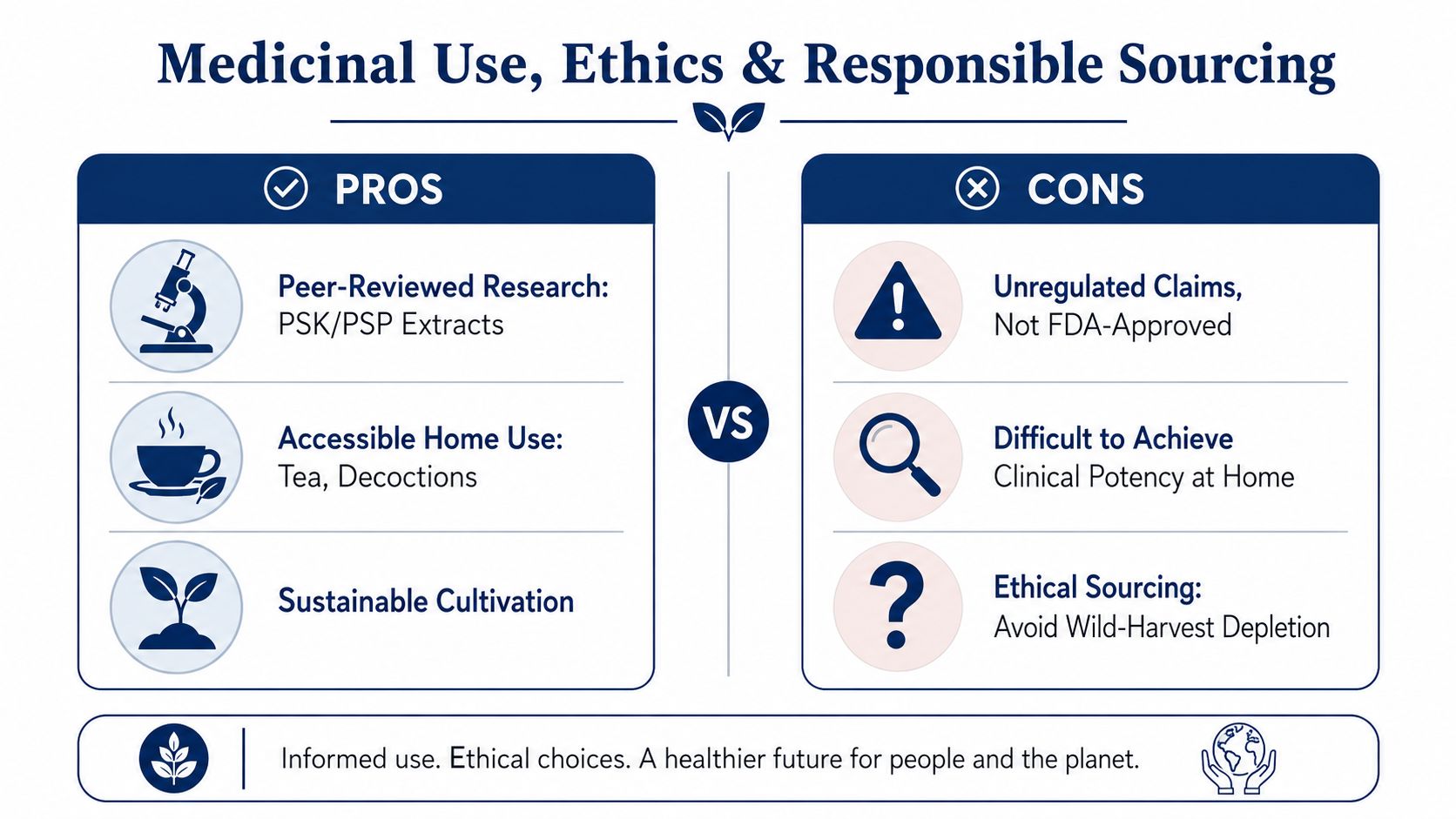
Turkey tail has a legitimate research history, but that fact doesn't justify promising medical outcomes from a homegrown tea. Research has examined compounds and extracts associated with turkey tail, including PSK and PSP, while a home cultivator usually produces variable fruiting bodies or mycelial biomass rather than a standardized clinical preparation.
That distinction matters. An extract made under controlled manufacturing conditions isn't equivalent to dried brackets ground in a kitchen. The species, substrate, maturity, extraction method, storage, and contamination controls all influence what ends up in the finished material.
Match the product to the purpose
Ask what you're trying to make before you grow:
Fresh brackets: A small personal harvest for observation, drying, or tea preparation.
Dried material: A clearly labeled biomass sample with known culture and substrate history.
Research material: A cultivation experiment where you track formula, environment, yield, and processing without making health claims.
Commercial supplement: A regulated product pathway that requires far more than successful fruiting.
The FDA does not approve dietary supplements to diagnose, treat, cure, or prevent disease, so product labels and marketing must stay within applicable boundaries. Anyone managing a health condition, taking medication, or considering mushroom products for a therapeutic purpose should consult a qualified healthcare professional rather than substituting a home preparation for medical care.
Responsible sourcing starts before the bag arrives. Buy cultures or spawn with clear species identification, keep vendor records, and avoid collecting from wild stands when you can't confirm local permissions or ecological impact. Turkey tail is widespread, but that doesn't make every wild patch an unlimited resource.
Ethical standard: Grow for learning and personal use, document what you produce, and never turn uncertain homegrown material into a confident medical promise.
A verified culture also reduces the identification risk that comes with wild collection. That still doesn't make every home batch clinically standardized, and it doesn't eliminate the need to discard material with contamination, unclear identity, or poor storage history.
Colorado Legality Permits and Final Checklist
Colorado growers should separate personal cultivation from commercial processing and sales. Growing Trametes versicolor for personal observation, research, or private use is a different activity from selling powders, extracts, teas, or products that make health-related claims. The second category can involve food safety, labeling, business, and federal supplement requirements that don't apply in the same way to a private grow.
Before scaling beyond a hobby setup, check current guidance from the Colorado Department of Agriculture and the FDA's dietary supplement information. Those agencies and your local authorities may distinguish between growing a mushroom, processing it, packaging it, and marketing it. Don't assume that a product is permissible because the species itself is legal to cultivate.
Outdoor logs create another local consideration. A county, municipality, landlord, or homeowners association may regulate outdoor structures, visible storage, drainage, nuisance conditions, or commercial activity. Verify the rules that apply to your property before building a large shaded log yard or inviting customers to collect material.
Keep the operation defensible
Use a simple record system from the first inoculation:
Culture records: Record the species, vendor, lot information, and date received.
Substrate records: Note the wood source, supplement, moisture adjustments, and sterilization cycle.
Environmental records: Log incubation and fruiting observations, including unusual odors, wet spots, or stalled growth.
Contamination protocol: Isolate questionable bags, seal contaminated material before disposal, and clean the work area before the next batch.
Label accuracy: If you share biomass, identify it as homegrown material and include the culture, substrate, harvest date, and processing method.
Marketing restraint: Don't describe tea, powder, or extract as treating a disease or producing a guaranteed health result.
For a Denver grow shop bench, the most useful final checklist is simple. Start with a verified culture, choose logs or sawdust based on your available time and equipment, measure substrate moisture, sterilize supplemented blocks properly, wait for complete colonization, and document every batch. Turkey tail rewards careful observation more than rushed intervention.
Colorado Cultures offers sterilized grain bags, substrates, all-in-one grow bags, grow kits, and mycology tools for home cultivators and research-focused growers. If you're building a turkey tail project in the Denver area, visit Colorado Cultures to find cultivation supplies, instructions, and in-person or online support.
Comments