
Turkey Tail Mushroom Grow Kit Guide for Beginners
You've opened the box, found a pale block inside a filter-patch bag, and now you're wondering whether it's ready to fruit or needs to sit untouched for weeks. That uncertainty is normal. A turkey tail mushroom grow kit is beginner-friendly, but it won't behave like an oyster kit that quickly produces thick, dramatic clusters. Turkey tail, Trametes versicolor, is a slow wood-decay fungus with thin, layered, leathery brackets, so the most useful skill is learning to read progress without forcing it.
The milestones matter more than a promised harvest date: a healthy block colonizes, matures, responds to fresh air and light, forms pins, and then develops small shelf-like fruit bodies. Some blocks pause while remaining alive, especially when conditions change. Treat the kit as a controlled cultivation lesson, not a guaranteed shortcut to a large crop.
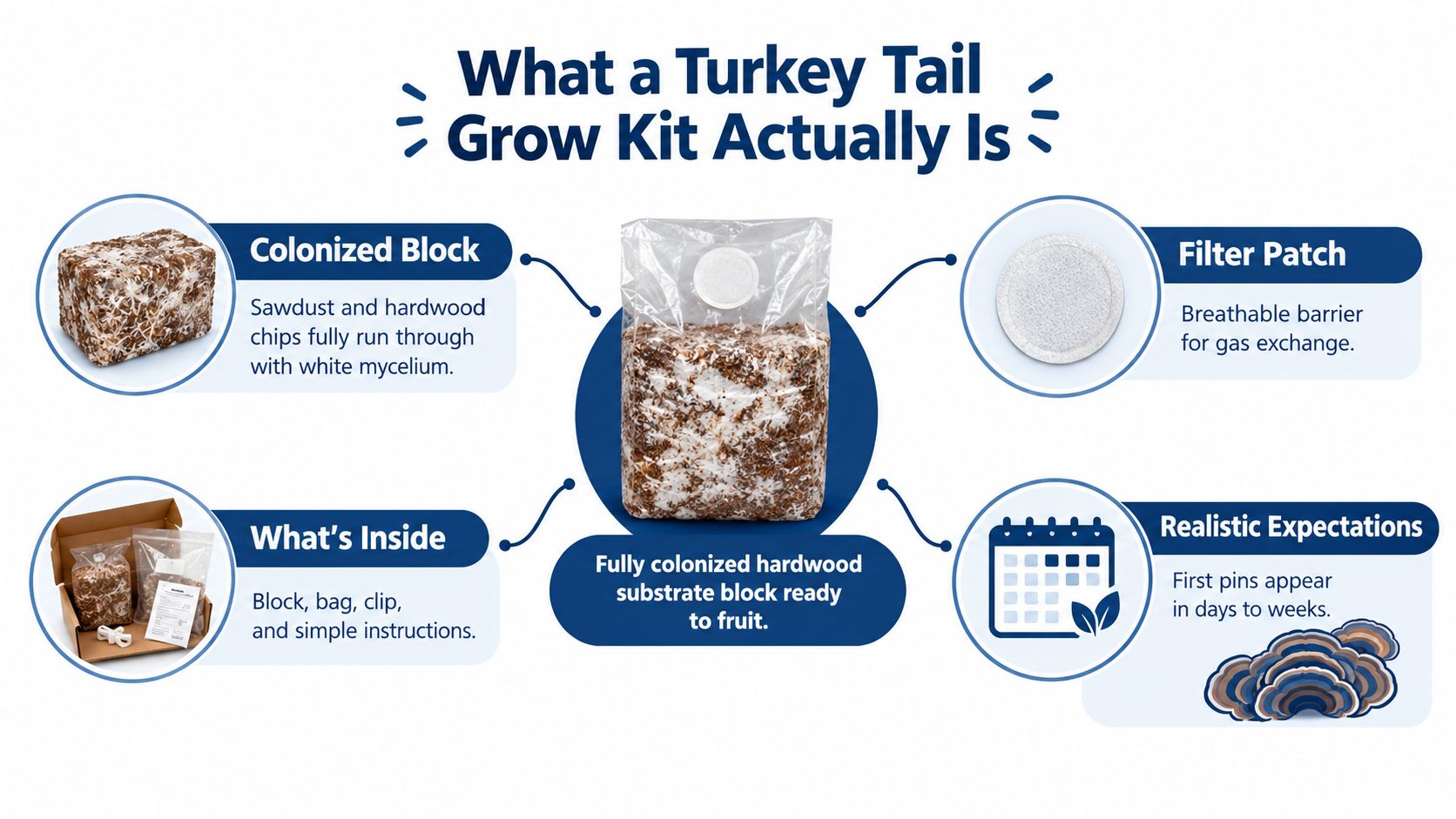
What a Turkey Tail Grow Kit Is
A sealed bag on your shelf can look ready long before it is ready to fruit. Most ready-to-fruit kits contain a fully colonized hardwood-based block inoculated with Trametes versicolor. The substrate may be hardwood sawdust, chips, or another woody blend. A breathable filter patch allows gas exchange while helping protect the culture, and some kits include a clip, spray bottle, protective supplies, and printed instructions.
The kit type determines how much work remains. A log or plug-spawn kit requires outdoor hardwood inoculation and a long establishment period. A ready-to-fruit block has completed much of that incubation. A kit sold as spawn and substrate still requires you to combine materials and wait for colonization. This guide to grow kits for beginners can help clarify those differences before you choose a format.
Readiness comes before routine
Read the block, not the label. White mycelium spread through a firm substrate suggests that the block may be ready for fruiting. Large loose, dark, or visibly uncolonized areas mean it needs more incubation. Cutting openings and misting too soon can dry or stress a block that has not finished establishing itself.
Turkey tail grows on woody and agricultural materials, and its substrate has a substantial cultivation history. A 2024 domestication study reported its strongest result with an S5 formulation containing 80% sugarcane bagasse, 12% horse manure, and 8% poultry manure, producing 158.33 grams of fresh mushroom from a 500-gram substrate bag and 31.5% biological efficiency at a 31:1 carbon-to-nitrogen ratio. Those controlled results are not a household-kit forecast. They show why substrate balance, moisture, sterilization, and environmental control affect performance.
A block can look fully white and still need time before fruiting. Colonization is a visual milestone, not proof that the fungus has reached fruiting maturity. Slow wood-decay fungi may pause while remaining healthy, especially after a change in temperature, handling, or air conditions.
Practical expectation: visible white colonization is not the same thing as visible turkey tail caps.
Turkey tail fruit bodies are thin, tough, and fan-shaped, with layered growth instead of the thick, fleshy caps associated with oysters. For further references on local cultivation interests, browse these regional mushroom sources.
Before opening the kit, gather a clean spray bottle, a humidity tent or simple fruiting chamber, a thermometer, and indirect natural or LED light. The goal is steady observation, gradual changes, and patience with a fungus that may show progress slowly.
Unboxing and First Setup
If the kit arrives while you are rushing through dinner, leave it sealed until you can prepare a clean workspace. Wash your hands, clear a counter or shelf, and set the bag down before cutting or opening anything. Clean handling will not make the culture invincible, but it limits the dust, food residue, and dirty tools that can reach an exposed fruiting surface.
Inspect the bag and block before changing its setup. The filter patch should be intact. A block that is ready to fruit is usually predominantly white and smells earthy or faintly mushroom-like. Green, black, or pink growth, a sour odor, or unusual colored liquid pooling calls for caution. Do not scrape away suspicious material and assume the remainder will recover.
Give the kit a stable home
Choose a quiet shelf away from direct sun, heating vents, air-conditioning blasts, pets, and repeated handling. Research protocols for Trametes versicolor commonly use about 25°C in darkness or low light during colonization, followed by cooler conditions for fruiting (published cultivation research). A stable indoor room and a basic thermometer usually serve a home kit better than a complicated heating setup.
Leave the bag closed during incubation. The filter patch allows gas exchange while keeping the block contained. If the instructions call for more incubation, keep the kit in darkness or low light. A fully colonized block marked ready to fruit should be opened only according to the supplied cutting instructions. A small, controlled opening is easier to manage than a large exposed wound.
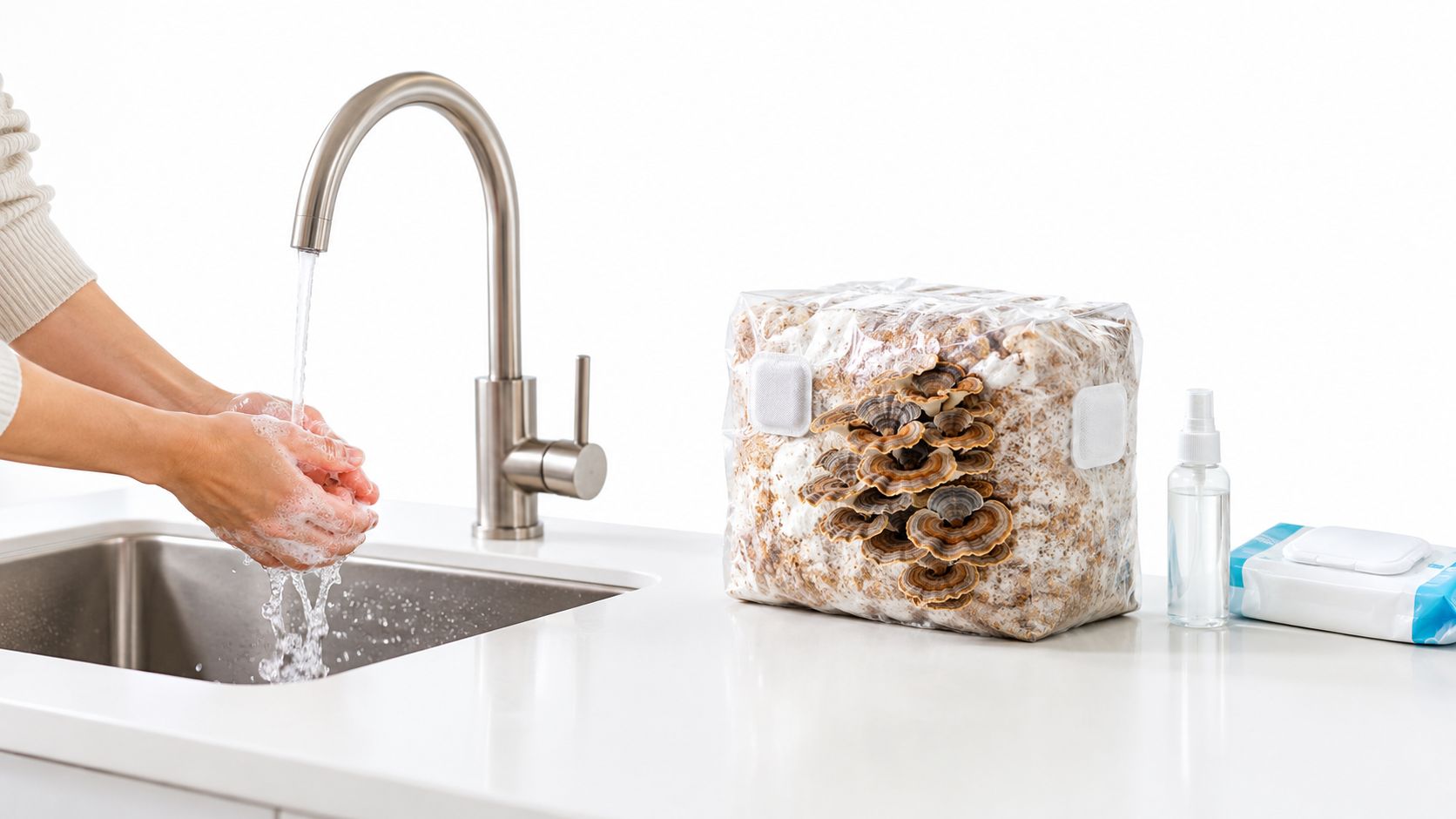
Write the start date on the bag with a permanent marker. Add “incubation” or “fruiting,” then record meaningful changes such as a brown crust, a cut opening, first pins, or drying. This simple log prevents normal slowness from turning into unnecessary handling. Turkey tail can look unchanged for several days while the block continues consolidating internally.
Your first-72-hours check
Make one brief check each day. Confirm that the bag remains intact, the block is away from vents and direct sun, and no new suspicious color or smell has appeared. Do not mist a sealed incubation bag or press the block to test whether it is active.
A fully colonized block can still need time before it fruits. Let it settle in its stable location before making the fruiting cut. During the first few days, success means clean handling, even support, and steady conditions. Patience is part of the setup for a slow wood-decay fungus.
Incubation and Colonization
The first week can feel uneventful. You check the bag, see little change, and wonder whether the turkey tail culture has stopped. On hardwood, that slow appearance is common. Mycelium may spread gradually, turn slightly tan, or form a light brown surface crust while the block continues developing inside.
Separate colonization from fruiting
Colonization is the stage when mycelium fills and binds the substrate. Fruiting comes later, when visible pins develop and expand into thin brackets. A block may be fully colonized without producing caps because it has not yet received the right mix of fresh air, indirect light, moisture, and temperature.
Keep the bag closed during incubation. Do not mist the block, add fruiting light just because the surface looks white, or move it repeatedly to inspect hidden sides. One brief check each day is enough. Extra handling increases the chance of contamination and can damage the developing culture.
Turkey tail can look stalled after a cool night, if the substrate has dried slightly, or when the outer surface has matured before the interior has finished consolidating. Judge progress over several days rather than from one morning to the next. A quiet block can still be healthy.
A brown, leathery-looking surface can indicate maturity rather than failure.
Use milestones, not a harvest deadline
Watch for these changes:
Early spread: white mycelium moves through bare areas of substrate.
Consolidation: the block becomes firmer and more evenly bound.
Surface maturation: sections of the surface turn tan or brown.
Fruiting readiness: the block is fully colonized and ready for a controlled move into light and fresh air.
Research protocols commonly report these temperature and humidity ranges. For a home kit, stable conditions and a clean substrate matter more than forcing a faster schedule. A 2024 domestication study showed nitrogen deficiency substantially lowered yield. The practical lesson is simple: culture performance depends on substrate quality and balance, not merely on adding inoculated material.
Leave a clean block alone if it smells normal and changes slowly. Isolate it if you notice a strong sour or rotten odor, bright green contamination, or spreading black growth, then follow the supplier's disposal guidance. Patience supports a slow wood-decay fungus. It cannot repair contamination.
Triggering Fruiting and Caring for the Block
Move a fully colonized block into fruiting gradually. The priorities shift to moisture, oxygen, light, and temperature, and a dry, exposed shelf can stall a culture that was healthy in the bag. Turkey tail is a slow wood-decay fungus, so fruiting readiness is a milestone, not a harvest deadline.
Some kits call for a cool period; others go straight to fruiting. Follow the supplier's instructions first. If the block feels light or the surface has dried, a soak may restore moisture. Research protocols have used a 24-hour soak followed by draining to bring substrate moisture into an approximately 60% to 65% range. Treat that method as optional, and drain the block completely before returning it to fruiting.
Build a simple fruiting space
A clean plastic bin or a loose plastic bag with ventilation holes can provide a suitable setup. Keep the surface humid and lightly damp, never covered in persistent droplets or standing water. Aim for approximately 85% to 95% relative humidity, a fruiting temperature near 20°C to 24°C, and indirect light for about 8 hours daily. These conditions support steady development, but they do not force a mature block to fruit immediately.
Open or cut only the fruiting area specified by the kit instructions. Early pins may look like tiny white nodules. They gradually flatten and spread into thin, layered brackets with colored bands. Compared with oyster mushrooms, turkey tail fruits are tougher and thinner. Their shelf-like form is normal, so do not wait for thick, juicy caps.
Fresh air must balance humidity. Stagnant conditions can encourage lumpy white growth, while strong airflow dries the surface. Fan the chamber once or twice daily, or use the passive ventilation specified by the kit. If the surface dries quickly, improve the surrounding humidity before misting more often.
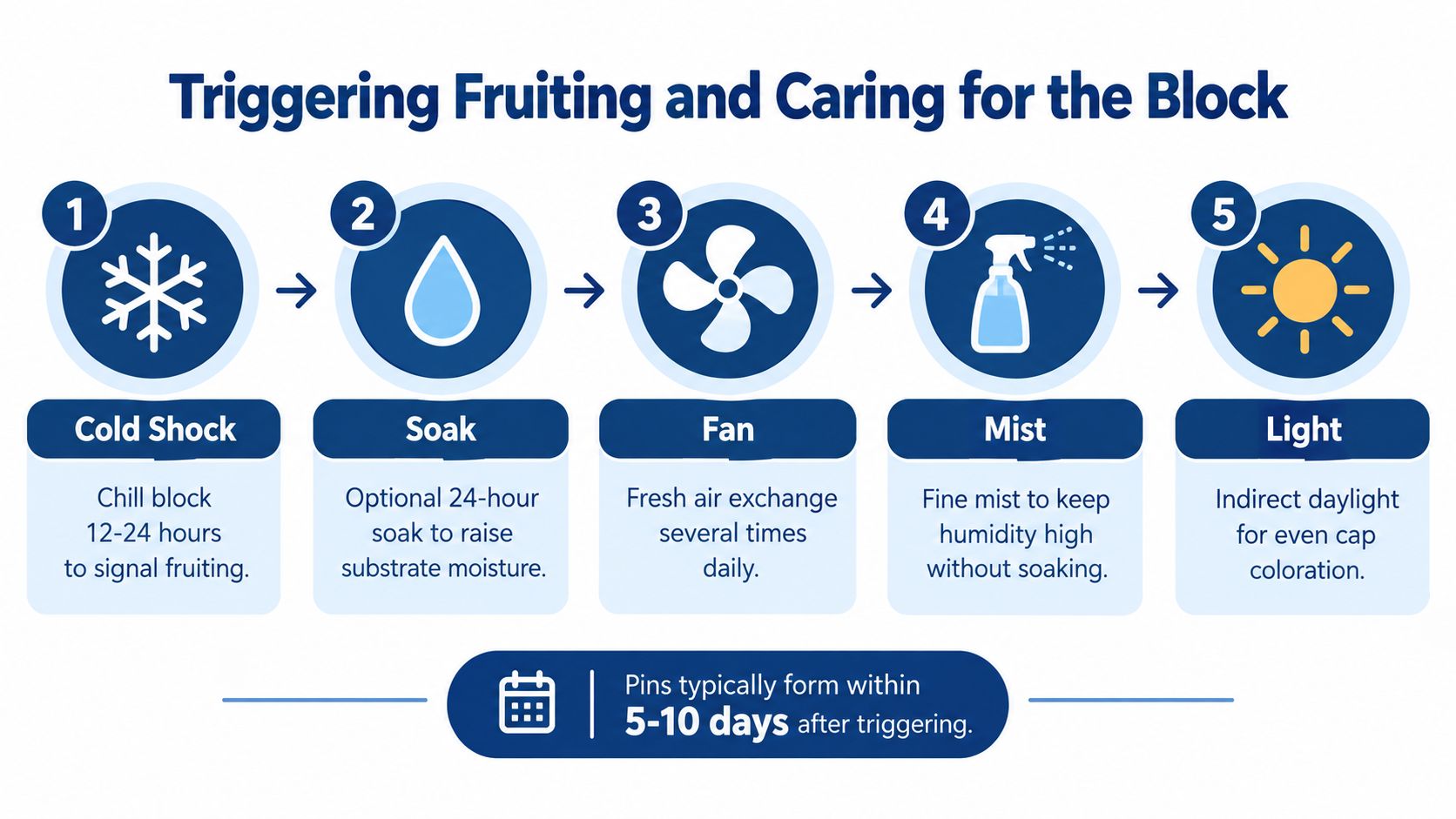
This guide to fruiting an all-in-one grow bag covers useful general handling principles, while turkey tail still requires patience. Use a short routine: mist, fan, look, and walk away. If the surface stays damp, air remains fresh, and the block smells clean, repeated handling usually slows rather than improves progress.
For a visual demonstration of fruiting care, use this video alongside the written kit instructions:
Troubleshooting Common First-Time Problems
A turkey tail kit can look stalled while the block remains healthy. Use the visible symptom as a starting point, change one condition at a time, and allow several days before judging the result. Slow wood decay rewards patience management more than constant intervention.
Quick Troubleshooting Reference
Symptom | Likely Cause | First Action |
|---|---|---|
No pins after fruiting was triggered | Low humidity, unsuitable light, limited fresh air, or an immature block | Check the setup and wait before cutting the bag again |
Fuzzy white growth | Aerial mycelium or excessive humidity | Increase gentle air exchange and monitor color and odor |
Green or black spots | Contamination | Isolate the block and discard it safely if the growth spreads or smells wrong |
Dry, cracked surface | Low humidity or excessive airflow | Move it away from vents and restore steady humidity |
Brown, leathery, inactive-looking block | Slow maturation or a temporary pause | Keep conditions stable while the smell remains clean |
Several quiet weeks do not prove failure. Confirm that the block is colonized, receives indirect light, and is not drying between misting sessions. Visual colonization is only one milestone. The mycelium can have covered the surface while the block still needs time to shift from internal growth to fruiting.
A block may also look brown, firm, or inactive as it matures. Turkey tail fruits are naturally thin and leathery, so the block will not behave like an oyster mushroom kit with large, fast-forming pins. Published cultivation research describes similar temperature and humidity ranges for fruiting, but a home kit can still move slowly because substrate, airflow, and block maturity vary.
Fuzzy white growth deserves observation rather than immediate removal. Healthy aerial mycelium can appear soft or web-like. Concern rises when growth turns green, black, or pink, expands with a clearly different texture, or comes with a sour or rotting odor.
Stop rule: strong sour or rotting odor means you should stop trying to fruit the block.
A cracked surface usually calls for steadier humidity, not heavier misting. Fine droplets on the chamber walls can indicate a suitable environment, while saturating the substrate may create new problems. Reduce drafts, check the thermometer, and give the block time to recover.
Colorado Cultures offers support through email, phone, in-store visits, and video tutorials. A clear photograph can help more than a written description when growth looks unusual. Isolate an uncertain kit from other cultures, avoid mixing wild material into a traceable culture, and do not consume growth you cannot confidently identify.
Harvesting, Yield, and What Comes Next
Harvest turkey tail when the brackets look formed, clean, and firm. Cut or twist them close to the block without tearing away large pieces of substrate. Because the fruit bodies are tough and leathery, thin slices are more practical than eating them whole. Dry them thoroughly before storage or preparation, and use a recipe intended for dried turkey tail rather than treating it like an oyster mushroom.
Yield expectations should stay modest. Indoor research has reported 37.68 grams per bag and 7.65% biological efficiency on a rice-straw and sawdust substrate, while another formulation reported a first harvest around 28 days after fruiting initiation and total yield equal to 7.5% of substrate weight (published cultivation research). Those figures describe specific formulations and conditions, not a standard home-kit result.
After harvest, rehydrate the block only if the supplier recommends it, then let it rest under clean conditions. A later flush may occur, but it isn't guaranteed. Outdoor logs are a separate patience project. One ex-situ study reported fruiting in only 68% of inoculated logs after an average incubation period of 327.5 ± 41.2 days, with mean biological efficiency of 2.79% (ex-situ cultivation study).
A home kit teaches useful discipline: clean handling, stable humidity, controlled fresh air, and careful observation. For questions about preparation and extracts, see this guide to turkey tail tincture. Turkey tail and PSK also have medical significance, but the U.S. National Cancer Institute states that the FDA hasn't approved turkey tail or PSK to treat cancer or another medical condition, so a home-grown block shouldn't be presented as a medical product (NCI PDQ summary).
Before you call the project finished, confirm that you've:
Recorded the milestones: incubation, full colonization, fruiting transition, pins, and harvest.
Checked the fruit bodies: clean, firm, layered growth with no suspicious odor or color.
Handled storage carefully: dried material protected from moisture and contamination.
Chosen the next step: another kit, a hands-on class, or supplies such as sterilized grain bags and all-in-one grow bags.
Colorado Cultures offers turkey tail grow kits, sterilized grain bags, substrates, all-in-one grow bags, tools, classes through the CC Classroom calendar, and support by email, phone, video, or in-store visits. Visit Colorado Cultures to choose your next cultivation step and get practical help before your block enters its next milestone.
Comments