
Contamination Control Mats for Cleaner Grows
You've sterilized the grain, wiped down the still-air box, flame-sterilized the needle, and made the transfer with the care of a surgeon. Then you walk into the grow room in the same socks you wore across the rest of the house, roll a trolley over the floor, and discover green mold spreading through a grain bag that looked perfect at inoculation.
That failure doesn't always begin inside the box. Shoes, wheels, clothing, and floor-level traffic can carry contamination toward the work area, even when your bench technique is careful. Contamination control mats create a simple threshold between the ordinary environment and the cleaner space where you incubate, inoculate, or handle cultures. They won't sterilize a room, but they can reduce one important route of entry.
The Moment a Clean Grow Goes Wrong
A first grow often fails in a confusing way. The cultivator remembers every detail of the inoculation, checks the sterile field, and wonders whether the syringe, grain, or technique was defective. Sometimes that suspicion is justified. Other times, the weak point sits outside the still-air box.
A person enters the incubation area in socks. Later, a cart crosses the same floor, carrying supplies from a less controlled room. Dust, fibers, skin particles, fungal spores, and material from the wheels move along the route. The bag doesn't show a problem immediately. Days later, a green patch appears, and the grower blames the final transfer instead of the traffic that repeatedly introduced particles near the workspace.
Controlled environments treat foot and wheel traffic as a serious contamination pathway. One industry review cites research indicating that traffic contributes 80% to 90% of particles entering controlled environments, while another source reports that a single person walking can generate about 5 million particles per minute from clothing and skin (cleanroom contamination control guidance). Those figures describe controlled environments rather than a typical home grow room, but the principle transfers well: movement creates contamination opportunities.
The useful question isn't “Did I sterilize the bench?” It's “What crossed the doorway before I started?”
A contamination control mat belongs at that doorway. It catches a portion of what arrives on soles and wheels before those particles travel farther. The mat is a first-line entry barrier, not a magic shield, and it works best when paired with hand hygiene, surface cleaning, controlled movement, and sound sterile technique.
What a Contamination Control Mat Does
A contamination control mat functions like a doormat for particles you cannot see. A household mat catches visible mud and grit. A cleanroom-style mat uses an adhesive or polymer surface to capture smaller debris from footwear and wheels before they enter a cleaner area.
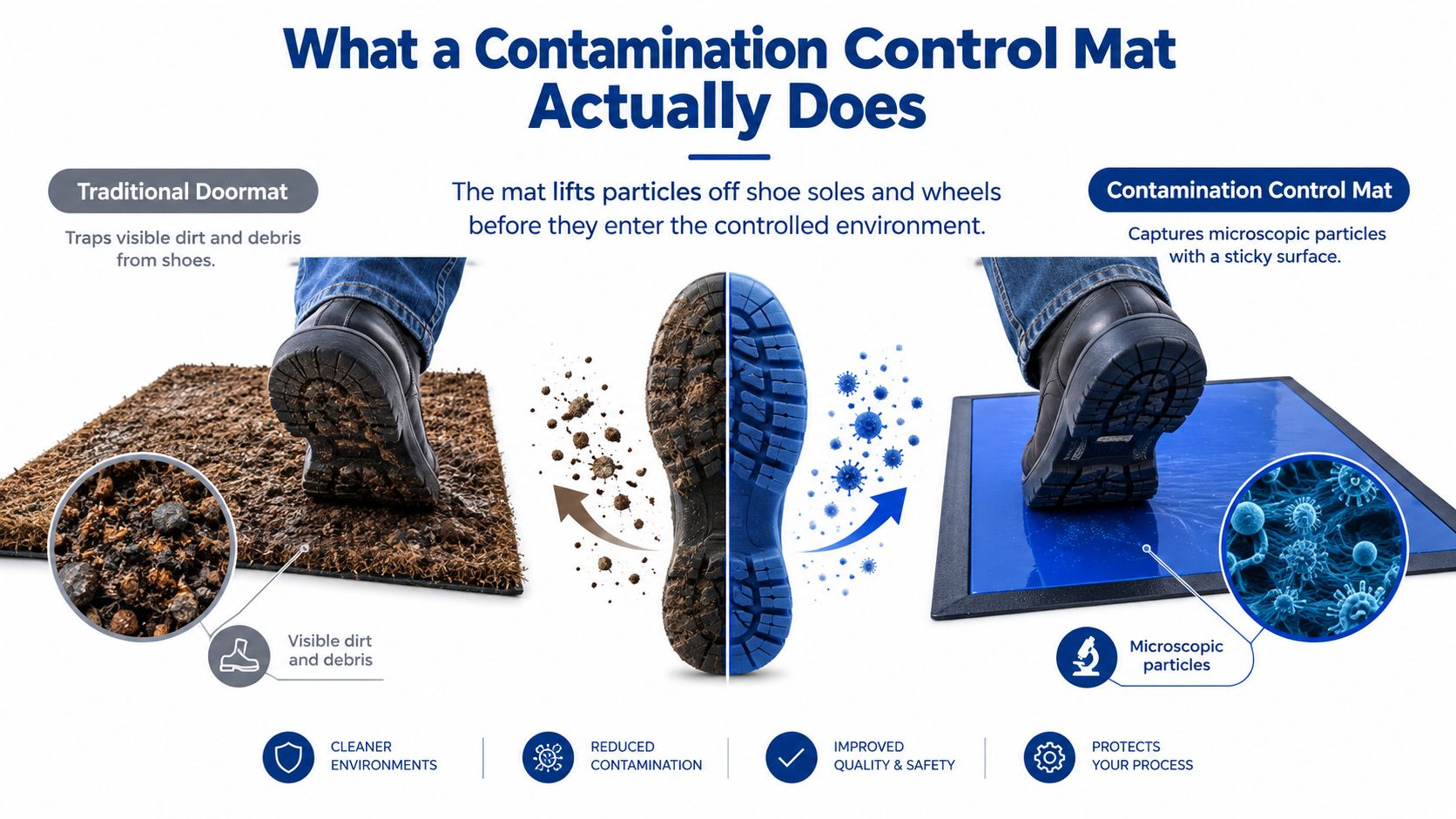
The two common constructions
Disposable adhesive mats contain multiple plastic-film layers. The exposed layer feels tacky and holds debris. Once loaded, you peel it away to reveal a fresh layer. Commercial versions commonly use polyethylene or polypropylene layers around 0.05 mm per layer, with mats often supplied in 30 to 60 layers, as described in the ASTM E2352 guidance sample. For a small lab, the routine is simple: use the surface, remove it, and avoid washing the mat.
Reusable polymer mats use a textured or slightly tacky elastomer surface. You clean and sanitize the mat according to its material and facility procedure, allow it to dry, then return it to service. This can reduce disposable waste, but it requires cleaning labor, drying time, and checks that the surface still captures particles as intended.
Both designs sit at the floor-level transition between spaces. Their role is entry control. Neither disinfects footwear, sterilizes wheels, removes airborne spores, or replaces cleaning. A mat also cannot correct a dirty threshold, damaged flooring, or a workflow that carries unclean tools straight to the bench.
For broader facility hygiene, floor-level capture is only one control layer. Information about office sanitizing services Toronto illustrates the wider role of cleaning and disinfection in occupied environments. In a home grow room, a mat makes sense when traffic crosses into a cleaner zone. It is less useful when no boundary exists or when the main contamination route is airborne or surface-based. Use it as one part of the entry routine, not as the entire control system.
How Mats Cut Bioburden at the Doorway
A clean grow can start losing control before the door closes. Shoes and cart wheels bring in more than visible soil. Fibers, skin flakes, dust, and biological particles can travel from the threshold to floors, sleeves, containers, carts, and work surfaces. A contamination control mat interrupts that route by capturing part of the incoming load at the entry point.
Testing shows why the surface matters. One tacky-mat report measured average removal efficiencies of 67.3% for particles larger than 0.3 microns, 70.0% for particles larger than 0.5 microns, 74.1% for particles larger than 1.0 micron, and 76.9% for particles larger than 5.0 microns after two dirty-boot steps (tacky-mat particle test report). That capture happens immediately, but it has limits. Soil loads the surface, adhesion changes, and repeated traffic can eventually create bypass points.
A mat is better understood as one layer in an entry-control system, not as a sterilizer. It reduces what reaches the cleaner zone. It does not disinfect footwear, remove airborne spores, or correct contaminated tools and surfaces. That distinction matters in mushroom work because a lower incoming particle load gives cleaning and handling practices less contamination to manage.
The material and traffic pattern also change the result. A Pharmaceutical Sciences study found that adhesive mats reduced particles by 20% to 52% depending on conditions, while polymeric flooring produced much larger reductions in its tests (Tim Sandle contamination-control review). Those findings do not predict performance in every home grow. They show why a small disposable mat may suit occasional foot traffic, while a reusable polymer surface may make more sense at a busy lab entrance.
A mat only contributes when it sits across the actual route. If people step around it, or wheels cross the threshold beside it, the control layer has a gap. The same source of contamination can then reach the room without passing over the capture surface.
The principle extends beyond cultivation. During renovation cleanup, efforts to stop recirculating construction dust reinforce the value of capturing contamination near its source rather than spreading it through a room. For mushroom growers, guidance on preventing mushroom contamination fits the same layered approach.
Every particle stopped at the threshold is one less particle available to settle near your cultures. Sticky mats make sense when they interrupt real, manageable traffic. Reusable polymer mats can suit repeated use when cleaning and inspection are practical. Mats alone are the wrong control layer when airborne movement, dirty equipment, or poor room hygiene drives the contamination risk.
Placing and Maintaining Your Mat for Maximum Effect
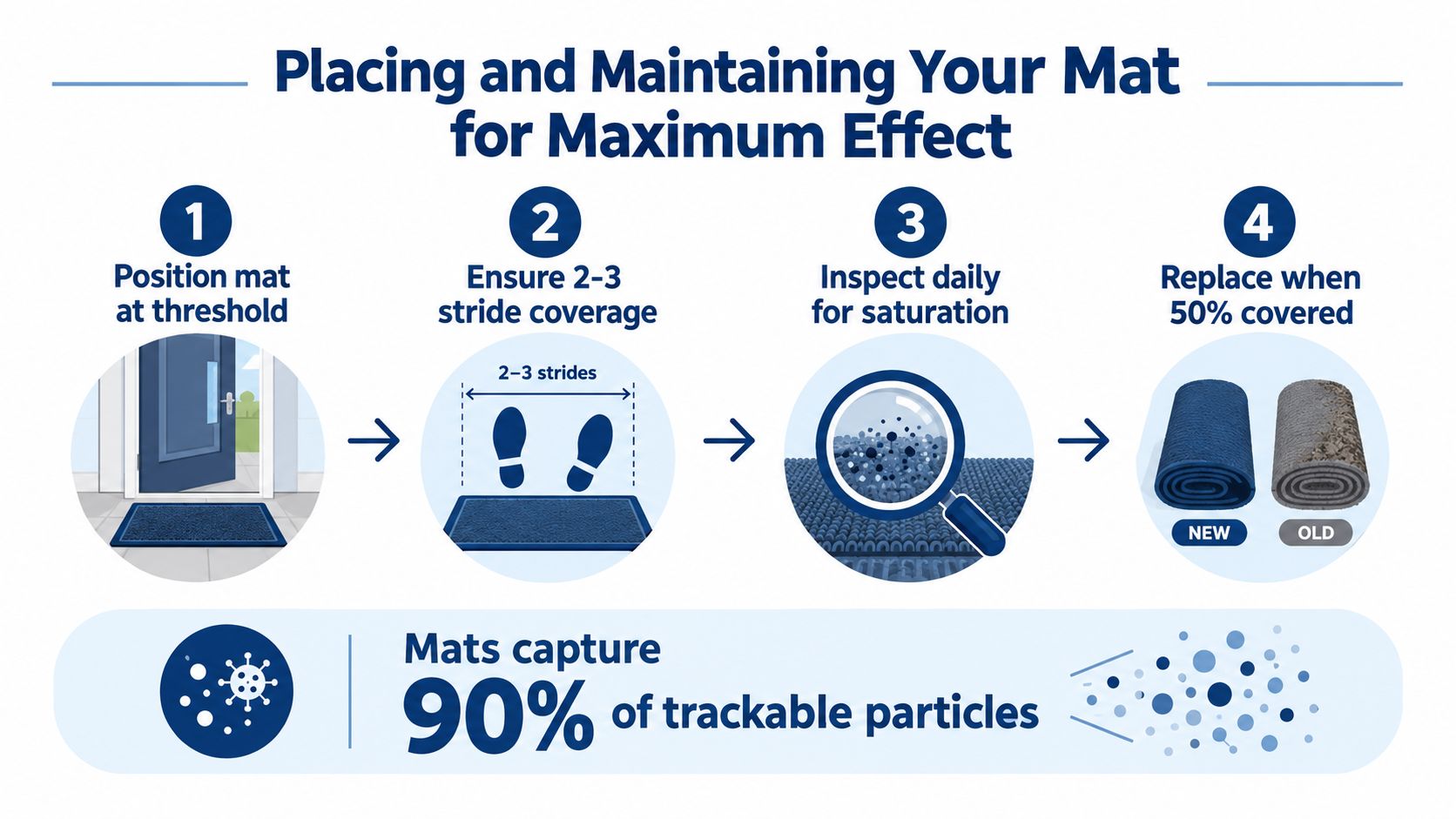
A mat works only when people and equipment cross it. Place it directly at the threshold, not several feet away where someone can step around it after opening the door. ASTM E2352 identifies mat size and placement as major determinants of debris removal, and practical guidance commonly recommends coverage for two to three steps before the person reaches the cleaner zone (ASTM E2352 guidance sample).
Build the entry around movement
For a single doorway, choose a mat long enough that a person naturally places multiple full steps on it. A narrow square that catches only the toe of one shoe creates the appearance of control without giving the surface much contact time. A hallway transition may need a wider or longer arrangement, especially if carts, bins, or shelving force people to turn as they enter.
Keep the mat flat. Carpet, loose thresholds, deep grout lines, and uneven flooring can create gaps, movement, or bypass routes. Wheel traffic needs special attention because casters may roll across an edge, turn sharply, or carry a larger concentrated load than a shoe. If the cart can't pass squarely over the active surface, the mat isn't controlling that route.
Refresh before performance collapses
Peel disposable layers before they become visibly saturated or lose their grip. The particle test cited earlier found measurable removal after only two dirty-boot steps, but that doesn't mean the same layer can handle unlimited traffic. Reusable mats need a defined cleaning method, a drying location, and an inspection step before reuse.
Keep a simple log near the entrance:
Traffic: Record when people, carts, or equipment enter.
Condition: Note visible soil, loose edges, moisture, or reduced tack.
Action: Write down when a layer was peeled or a reusable mat was washed.
Review: Compare the schedule with actual traffic and adjust it when the room becomes busier.
Don't copy a replacement schedule from another facility. A closet used by one person behaves differently from a small lab with repeated trolley traffic. The correct cadence is the one that keeps the active surface clean enough to capture particles without creating unnecessary waste. Before placing equipment inside, follow a consistent equipment sterilization workflow, because the mat only addresses the entry route.
Disposable Sticky Mats vs Reusable Polymer Mats
A home grower enters the room several times during a work session. A small lab may send people, carts, and equipment through the same doorway all day. Those two spaces need different entry controls, even if both use contamination control mats. Choose by traffic, cleaning capacity, floor conditions, waste tolerance, and how reliably the surface can be maintained.
Disposable sticky mats fit a low-traffic home entry or a temporary clean zone. Expose a fresh layer, check its condition, and remove it when it becomes dirty or loses grip. This is convenient when nobody has time or space to wash and dry a mat. It becomes less attractive when repeated foot or wheel traffic creates frequent layer changes, residue, or uneven wear.
Reusable polymer mats suit a regular entrance with an assigned cleaning routine. They require washing, sanitizing where appropriate, drying, and inspection before returning to service. That work can fit a lab that already records maintenance, but it can become a weak point in a home grow if the mat is left dirty or damp. A reusable product saves on routine film disposal only when someone maintains it consistently.
Decision criterion | Disposable Sticky Mat | Reusable Polymer Mat |
|---|---|---|
Up-front choice | Easy to deploy with little setup | Requires a suitable product and installation |
Ongoing cost | Repeated layer purchases | Cleaning supplies and staff or grower time |
Labor | Peel, discard, and expose the next layer | Wash, sanitize as required, dry, inspect, and replace |
Lifespan | Short service period for each exposed layer | Longer service life when cared for correctly |
Traffic profile | Light, occasional, or controlled entry | Regular pedestrian or wheel traffic |
Waste profile | Generates used film as layers are removed | Reduces routine disposable-film waste |
Floor conditions | Check for slipping, moisture, and adhesive residue | Check compatibility with the floor and cleaning method |
Best home fit | A small grow room with infrequent entry | A dedicated room with repeated use and a realistic cleaning schedule |
Best small-lab fit | Temporary zones or rapid changeover points | A busy entrance where upkeep can be assigned and documented |
Particle size can affect how useful either option is. As noted earlier, polymeric flooring may perform better than peel-off mats for smaller particles, while the difference can be less pronounced for larger particles. Treat that comparison as context from specific test conditions, not as a guarantee for every home or laboratory entrance.
A simple decision rule works well. Select disposable adhesive mats when traffic is light and fast turnover matters most. Select reusable polymer when traffic is persistent, waste reduction matters, and a named person can maintain the surface. If no one will clean, dry, or inspect it, the reusable mat is the wrong layer, regardless of its potential lifespan. In either case, the mat is an entry-control component, not a substitute for the rest of the grow-room workflow.
Fitting Your Mat Into a Full Sterile Workflow
A contamination control mat belongs at the outside edge of your workflow. It handles what enters on shoes and wheels. After that, the grower still needs to control hands, tools, surfaces, air movement, and contact with cultures.
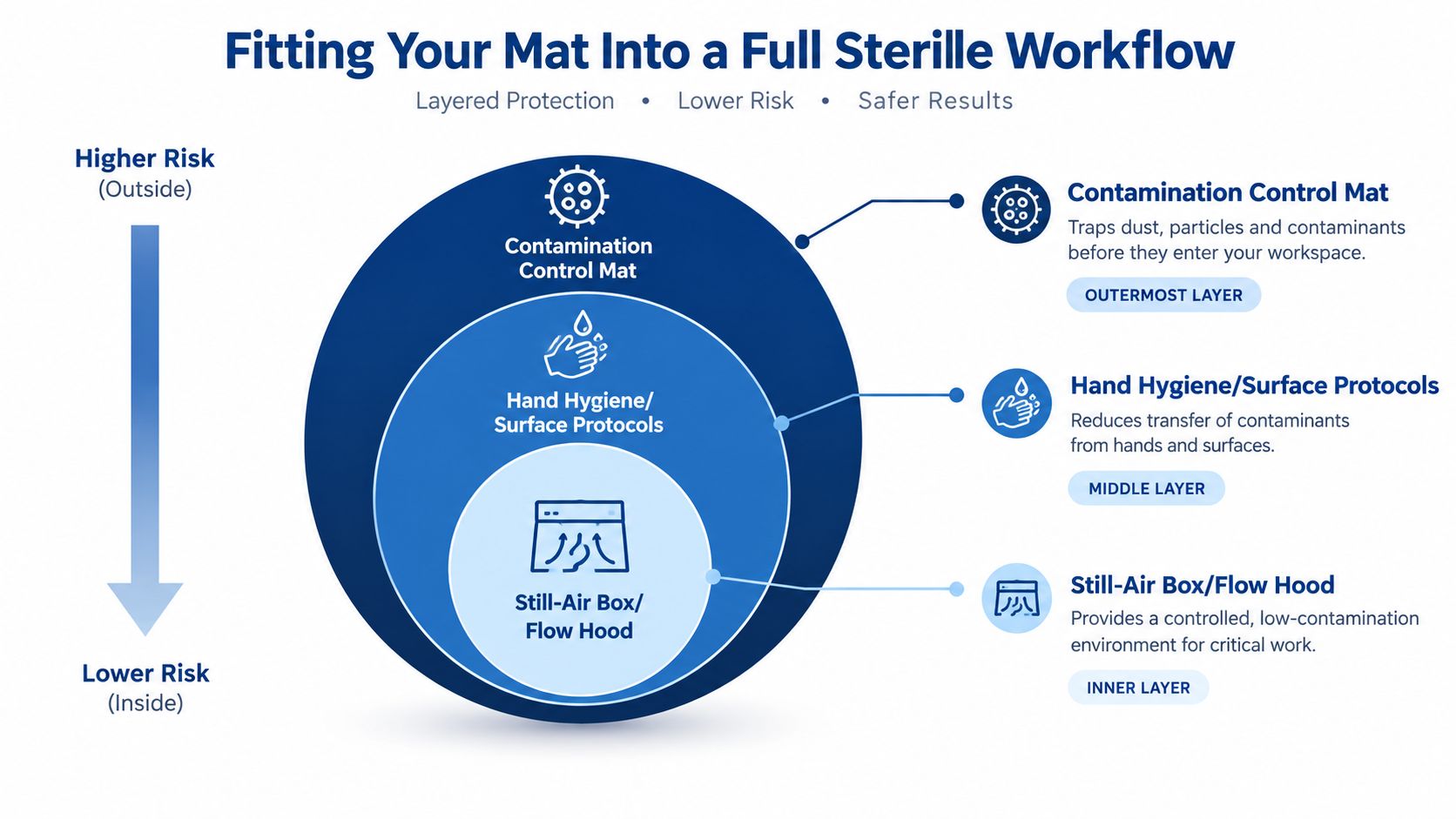
Think of the room as a series of filters rather than a single clean object. The doorway mat reduces floor-borne carry-in. Hand hygiene limits what your hands transfer. Surface cleaning removes settled material from the work area. A still-air box or flow hood then gives you a more controlled place to perform transfers.
Use the layers in a deliberate order
Control footwear and wheels. Cross the mat fully. Keep carts from bypassing the active surface.
Clean your hands. Wash before handling tools, containers, or cultures, then follow the procedure appropriate to your workspace.
Prepare the work surface. Clean and disinfect the still-air box, hood surfaces, nearby bench, and tools according to their materials and your established protocol.
Limit movement during the task. Extra movement stirs settled material and increases opportunities for contact.
Work inside the controlled zone. Keep sterile items protected until the moment you use them.
Air control still matters. ISO cleanroom limits demonstrate how narrow acceptable particle levels can be in controlled environments. An ISO 7 space allows 352,000 particles of 0.5 microns or larger per cubic metre, while ISO 5 allows 3,520, according to the cleanroom guidance summarized in the contamination-control review. A home grow room isn't automatically an ISO-classified space, but the comparison explains why floor control cannot stand in for filtration or controlled airflow.
The same layered reasoning applies to liquid handling and lab hygiene. Guidance on bacteriostatic water handling is a useful reminder that containers, hands, surfaces, and procedures all contribute to a clean process. A mat is the outermost layer, not the sterile field. This contamination control strategy can help you think about the workflow as connected controls rather than isolated products.
When a Mat Is Not the Right Tool for the Job
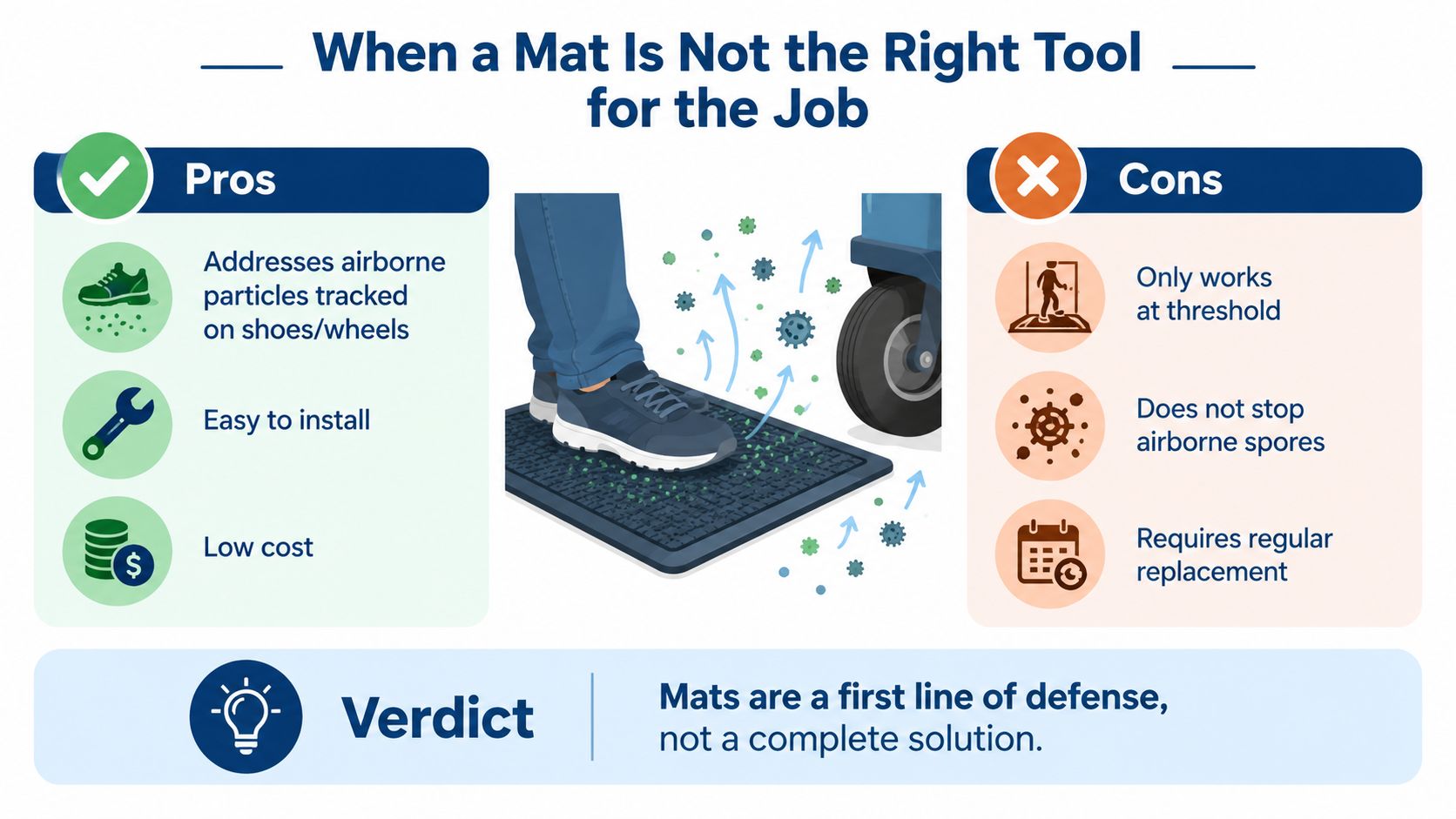
A grow can have a clean threshold and still fail inside the room. A contamination control mat affects material that crosses its surface. It does not remove airborne spores, clean a neglected bench, correct poor glove technique, or rescue a culture contaminated before it reached the doorway.
Room layout determines whether the mat encounters meaningful traffic. In a compact closet with the grow area inside cabinets, people may never walk directly toward the workbench. A mat there can become clutter rather than a control point. The same problem occurs when visitors step around it, carts enter from the side, or carpet and uneven flooring prevent full contact.
Know the limits before you buy
A mat is a poor fit when:
The doorway isn't the main route: If supplies enter through another opening, the mat misses the traffic that matters.
The floor prevents contact: Carpet, moisture, loose edges, and uneven thresholds let shoes or wheels bypass the active surface.
Air and surfaces are the main problem: A dirty workbench, uncontrolled airflow, or unnecessary movement can outweigh any floor-level improvement.
Maintenance won't happen: A saturated adhesive layer or dirty reusable polymer mat provides less dependable control.
The space has almost no foot traffic: In a cabinet-based setup, cleaning, container handling, and still-air technique may deserve attention first.
Mats also have a defined operating range. Performance comparisons show that sticky, peel-off layers can remove only part of the contamination carried by shoes and wheels under test conditions. That does not make them useless. It means the buyer must identify the route, traffic pattern, and surface condition before choosing a product. A reusable polymer mat may suit a busy entrance if washing, drying, and inspection fit the routine. A sticky mat may suit light traffic where quick replacement matters. Neither choice helps if people bypass the mat.
Verdict: If the workbench sits away from the entrance and nobody crosses the mat before handling cultures, spend your effort on the bench and workflow instead.
Repeated failures after a clean threshold call for a wider review. Check airflow, surface disinfection, tool handling, container integrity, and movement inside the workspace. A mat can lower floor-borne input at the entry point, but it cannot correct contamination introduced at any of those later steps.
A Simple Setup Checklist for Cleaner Grows
Start with a walk-through, not a product order. Stand outside the grow area and trace every route that a person, cart, bin, or piece of equipment uses to reach the room. Mark the actual doorway and any secondary entry point. A mat placed beside the route won't protect the route.
Use this checklist for a practical setup:
Map the threshold. Identify where shoes and wheels cross from the ordinary space into the cleaner grow area.
Create full contact. Place the mat so each entrant gets two to three full footfalls before reaching grain bags, cultures, a still-air box, or a flow hood, following the placement principle in ASTM E2352.
Choose for traffic. Use disposable adhesive layers where quick turnover is valuable and traffic is light. Consider reusable polymer for a busier entrance where cleaning and inspection can become part of the routine.
Make the schedule visible. Put a simple inspection and refresh note near the entrance. For adhesive mats, record peeling. For reusable mats, record washing, drying, and return to service.
Protect the edges. Keep the mat flat, dry, and difficult to step around. Check whether cart wheels cross the active area rather than catching only the edge.
Pair the threshold with hand hygiene. Wash hands before handling tools and cultures. Keep clean gloves, if used, from touching door handles, phones, or unclean containers.
Prepare the work zone. Clean the still-air box or hood, disinfect the bench, organize tools before beginning, and reduce movement during transfers.
Review failures carefully. If contamination appears, ask whether the mat was saturated, whether someone bypassed it, and whether the likely source was airborne, surface-based, or procedural.
A weekly review doesn't need elaborate paperwork. Count the people and carts using the entrance, inspect the active surface, and compare its condition with your refresh routine. If traffic rises, refresh sooner. If the mat remains unused and the risk sits elsewhere, redirect effort toward the control that matches the problem.
The best setup is repeatable. A clean grow comes from several modest barriers working together, with the mat handling one clearly defined route instead of carrying responsibility for the entire room.
Colorado Cultures helps home growers and small lab cultivators build cleaner, more reliable workflows with sterilized grain bags, substrates, grow kits, tools, and practical mycology education. Visit Colorado Cultures to find supplies, tutorials, classes, and support for improving your sterile technique from the doorway to the workbench.
Comments