
Cotton Tipped Sterile Applicators: A Practical Guide
The most common advice about cotton swabs is also the least useful: “If it's sterile, it's suitable for every laboratory task.” It isn't. Sterility protects your culture from microorganisms carried by the applicator, but it doesn't guarantee that the tip will recover a faint sample, release it efficiently, or behave well in your assay.
For a first-time cultivator, that distinction matters immediately. A sterile cotton tipped applicator can be an inexpensive, dependable way to move a small amount of material onto agar. It's a much less dependable choice when you're trying to prove that a surface is clean or measure how much biological material is present. Treat the swab as a transfer tool first, then choose a different sampler when recovery and sensitivity matter more than convenience.
What Sterile Cotton Tipped Applicators Actually Do
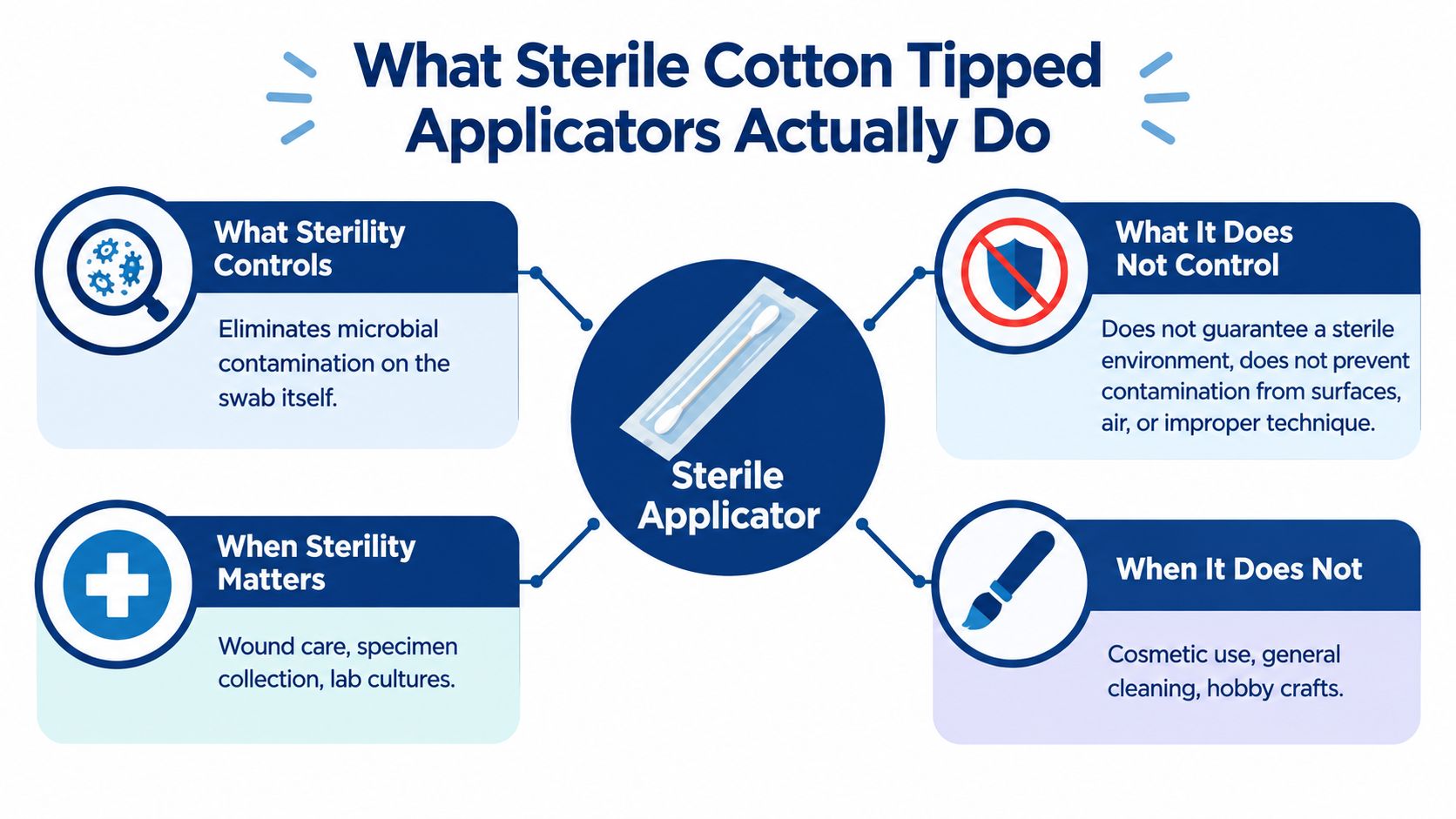
A sterile applicator starts with one narrow promise: the applicator itself has been processed and packaged to limit microbial contamination until use. It doesn't sterilize your hands, your workspace, the air around an open plate, or the surface you touch. It also doesn't make the cotton chemically neutral for every organism or downstream test.
That's why sterility and sensitivity are separate questions. Sterility asks, “Did the tool introduce unwanted microorganisms?” Sensitivity asks, “Did the tool collect and release enough of the target material for me to detect it?” CDC guidance illustrates the difference clearly. Some molecular and infectious-disease workflows prefer synthetic tips because cotton and certain shaft materials can interfere with enzymes or organism recovery, even when the swab is sterile. CDC specimen-collection guidance also describes situations where sterile cotton or polyester tips are acceptable, depending on the specimen and method.
A transfer job is different from a sampling job
Suppose you're moving a visible piece of mycelium or a small liquid inoculum onto a marked area of agar. You already have target material. The cotton tip gives you a controlled surface for holding and releasing it, and a sterile package reduces the chance that the applicator adds a competing organism. That's a sensible use.
Now suppose you swab a dry work surface and see no growth after incubation. A negative result could mean the surface was clean. It could also mean the target was sparse, the cotton held onto it, the contact was too light, or the transfer onto the receiving medium was incomplete. The result is ambiguous unless the sampling and recovery method has been validated for that purpose.
Practical rule: Use a sterile cotton swab to move known or suspected material. Don't treat a negative cotton-swab result as proof that a surface contains nothing.
The basic workflow is simple. Select a sealed applicator, inspect it before opening, expose the tip only when ready, make controlled contact, and roll or streak the tip across the receiving medium. That routine makes cotton tipped sterile applicators useful for localized work, but it doesn't turn them into precision analytical instruments.
A Short Origin Story From Baby Gays to the Lab Bench
The modern cotton swab began as a household-care idea. In 1923, Polish-American inventor Leo Gerstenzang developed a commercial cotton swab after seeing his wife attach cotton to toothpicks for cleaning an infant's ears. The product was first marketed as “Baby Gays,” and commercial manufacturing began in 1925. The branding became “Q-Tips Baby Gays” in 1926, followed by a “Q-Tips” trademark application in 1933. A separate early milestone was Hazel Tietjen Forbis's cotton-tipped applicator patent, dated December 6, 1927. These historical details are documented in the history of the cotton swab.
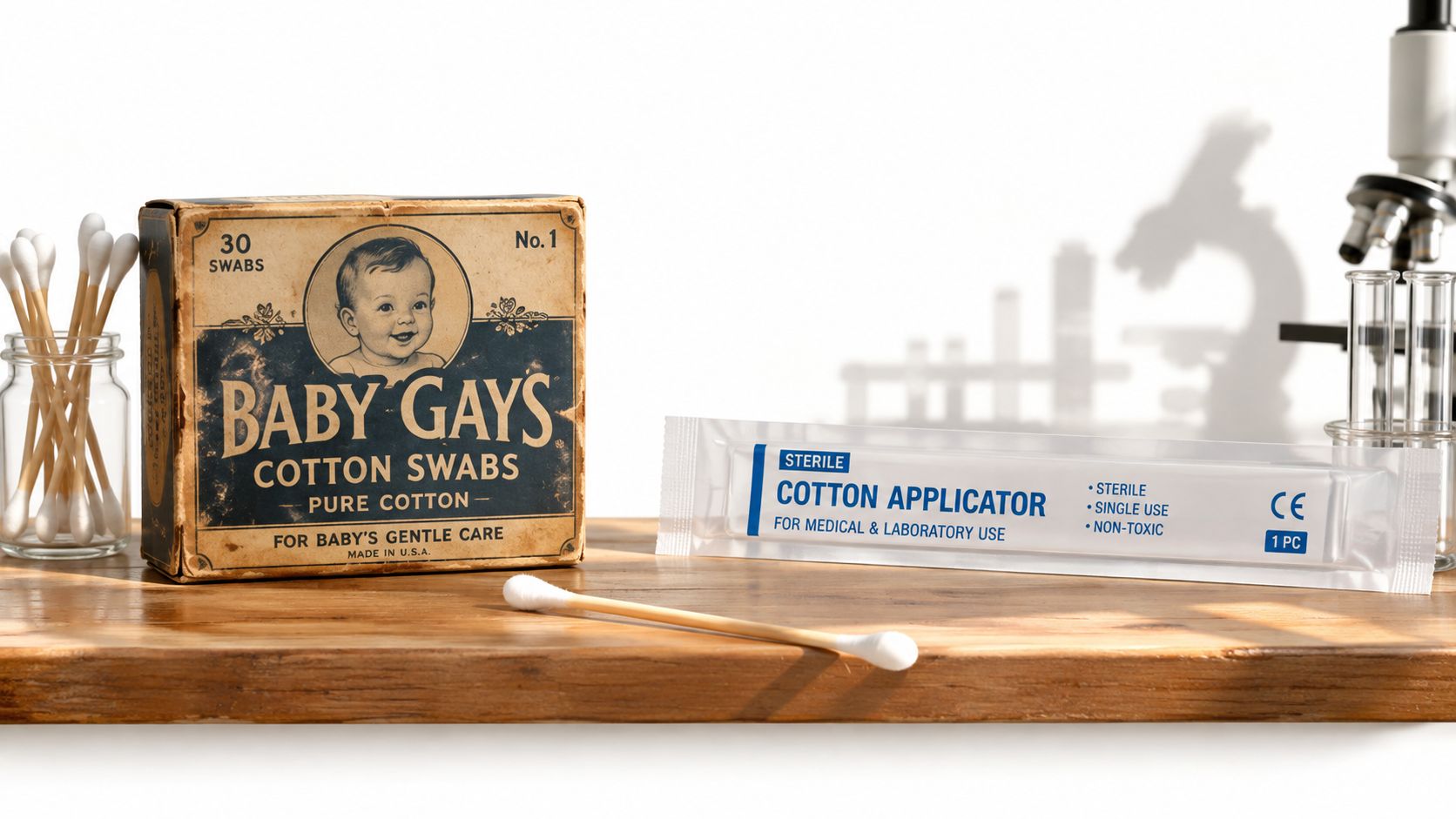
The design survived because it solves a few practical problems at once. Cotton absorbs a small amount of liquid, holds biological material on its fibers, and can release some of that material when rolled across agar or immersed in broth. The narrow shaft gives the user reach without putting fingers directly over the working area, while the disposable format removes the need to clean and reuse a small, porous tip.
Familiar shape, different specifications
A cosmetic cotton bud and a sterile laboratory applicator may look nearly identical, but appearance isn't a specification. A laboratory product may be individually packaged, sterilized by a validated process, assigned a lot or expiration record, and manufactured with a defined shaft and tip construction. A consumer swab generally isn't intended to support contamination-sensitive culture work.
That doesn't mean every sterile cotton applicator belongs in every protocol. It means the familiar shape has become a standardized platform. Labs, clinics, educators, and cultivators can select versions with different materials and packaging for different jobs. The sterile variant keeps the basic cotton-on-a-shaft design, then adds controlled processing and a sterile barrier.
Anatomy of a Sterile Cotton Tipped Applicator
Think of the applicator as three connected decisions: tip, shaft, and package. Each one affects how safely you can handle the tool and how confidently you can interpret the result.
Commercial sterile cotton applicators are commonly made as approximately 6-inch single-use tools, with cotton tips around 12.7 to 17.0 mm long and roughly 3.05 to 5.1 mm in diameter. Those dimensions give the tip enough surface to absorb and transfer a small amount of material without creating a broad inoculation footprint. The longer shaft keeps your fingers away from the working zone, especially inside a still-air box.
Component | Common options | Why it matters |
|---|---|---|
Tip | Cotton, polyester, flocked, rayon, dissolvable materials | Absorption, fiber retention, release, chemical compatibility, and recovery vary by material |
Shaft | Wood, polystyrene, plastic, aluminum | Rigidity, break behavior, extractable residues, and assay compatibility can change |
Package | Individual peel pouch, tube, bulk package | The sterile barrier protects the product until opening and supports traceability |
The tip does more than hold liquid
Cotton is absorbent and inexpensive, which makes it convenient for small transfers. It can also retain material strongly, leaving less available for release into broth, agar, or an extraction solution. A synthetic tip may be preferable when the workflow depends on recovery or molecular compatibility rather than simple application.
Shaft material deserves attention too. Wood is rigid and familiar, but it can introduce confusing culture effects in sensitive workflows. A clinical microbiology study found that cotton, rayon, alginate, and aluminum components weren't inhibitory to ureaplasmas, while the wooden shaft used to attach the tip could produce misleading culture results. The study on applicator components and culture effects is a useful reminder that "cotton-tipped" doesn't describe the whole product.
Packaging is part of the product
A sterile claim applies to the packaged item, not to an applicator after you've opened it or touched the tip. Inspect the peel pouch for punctures, failed seals, moisture, or missing lot and expiration information. Open it immediately before use, remove the applicator without contacting the tip, and discard it after the operation.
Product listings may mention CE marking, ISO 9001, ISO 13485, or FDA good-manufacturing-practice requirements, but those labels don't answer every compatibility question. Ask whether the item is sterile by lot, which sterilization method was used, what the shaft contains, and whether the receiving laboratory accepts cotton for the intended procedure. A useful starting point for comparing commercial configurations is this applicator and swab product range.
Where Sterile Cotton Applicators Earn Their Place
Cotton applicators work best when the task is small, localized, and transfer-oriented. They're easy to control, inexpensive to discard, and simple to use in a clean bench routine.
Targeted transfers
For a small inoculation, first identify the receiving spot on the agar. Touch the applicator to the liquid or biological material, then roll the tip across the target rather than pressing it straight down. Rolling exposes more of the cotton surface and helps release material gradually.
A cotton tip can also move a small amount of culture from one local area to another. If you're transferring a visible fragment of mycelium, a sterile scalpel or loop may provide more direct control, while a swab is useful for a thin liquid suspension or a small smear. Match the tool to the form of the inoculum rather than forcing every transfer through a swab.
Cleaning and small-area collection
A sterile applicator can help clean a narrow instrument surface or collect material from a confined location. It's useful when a sponge is too large and a bare shaft would be too rigid or abrasive. For a broader overview of equipment placement and bench habits, see this guide to aseptic technique equipment.
Small-area collection still needs a defined purpose. If you're collecting material for enrichment, place the swab into the appropriate medium promptly. If you're only checking a visible spot on a plate or tool, document where the contact occurred and keep the handling consistent between samples.
Where the tool stops being the right answer
A cotton applicator becomes a poor choice when the job requires quantitative recovery, broad surface coverage, or a downstream assay known to be sensitive to cotton or shaft residues. It's also the wrong tool when a protocol specifies polyester, flocked, rayon, foam, or another material.
The best swab isn't the one with the strongest “sterile” label. It's the one whose material and format match the next step in the workflow.
Cotton Is Not Always the Best Swab
Sterility and recovery are separate properties. A sterile cotton applicator can transfer material without introducing contamination, yet its fibers may retain part of what they collect. In a controlled comparison, cotton swabs recovered approximately 184 ng of bacterial DNA, compared with about 1,240 ng for flocked swabs, 533 ng for dental applicators, and 430 ng for dissolvable swabs. These figures come from the controlled comparison of swab recovery.
That distinction matters at the bench. Cotton may work well for moving a visible inoculum, like using an absorbent cloth to pick up a small drop. It is less dependable when the target is sparse and must be released into an extraction or culture system. A weak result may reflect material left in the swab rather than material absent from the surface.
Moisture and contact change recovery
Dry cotton on a dry surface often collects poorly. In another controlled study, premoistening increased recovery from 57.5% with dry swabs to 83.4% with wet swabs, while preenrichment increased sensitivity from 61.3% to 80%. The study also reported detection of Staphylococcus aureus on test surfaces 75% of the time with cotton and 81.3% with polyester. The surface recovery study provides the full comparison.
For cultivation work, wetting every swab is not automatically the answer. Use sterile saline or another validated diluent only when the workflow calls for it. Excess liquid can dilute a sample or alter the receiving medium. If you moisten the tip, use a controlled amount and apply the same method to comparable samples.
Choose by task, not by habit
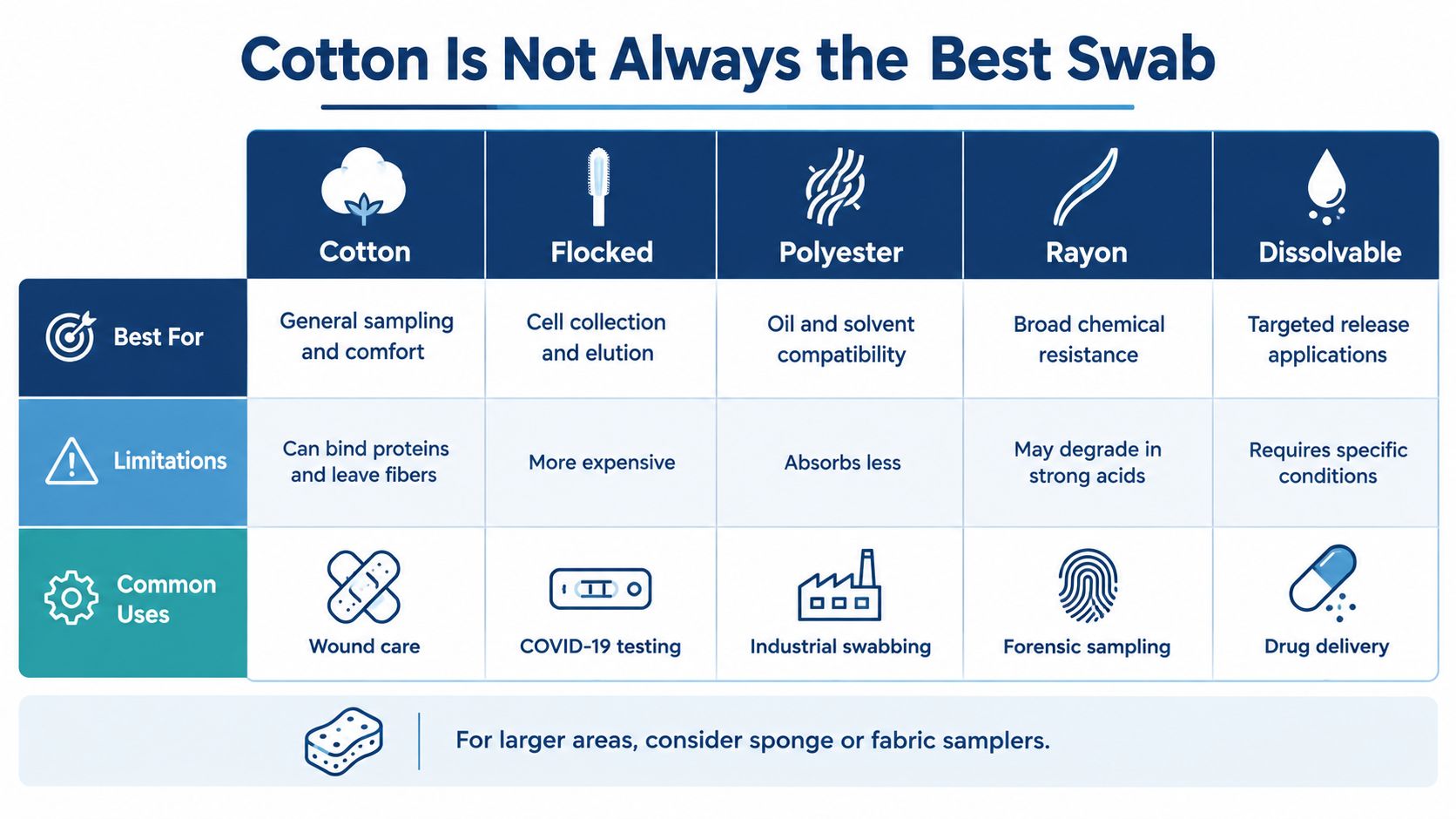
Cotton: Suitable for small transfers, general absorbency, and localized work where maximum recovery is not the objective.
Flocked: A stronger option when collection and release efficiency matter.
Polyester: Useful when cotton residues or molecular compatibility could affect the workflow.
Rayon: Worth considering when a protocol specifies a synthetic or cellulose-based tip with different culture behavior.
Dissolvable materials: Use only when the receiving method supports that material and its release conditions.
For areas larger than 100 cm², sterile sponges or fabrics are more appropriate than swabs under the surface-sampling guidance summarized for ISO 18593 horizontal surface sampling methods. A swab concentrates contact in a narrow area. Its sterile packaging does not turn it into a broad-surface sampler.
Sterile Technique for the Bench and the Still-Air Box
A sealed applicator only helps if you preserve its condition during use. Most failures happen after opening, when a user touches the tip, reaches across a work area, or leaves the swab exposed while preparing the next step.
A repeatable handling routine
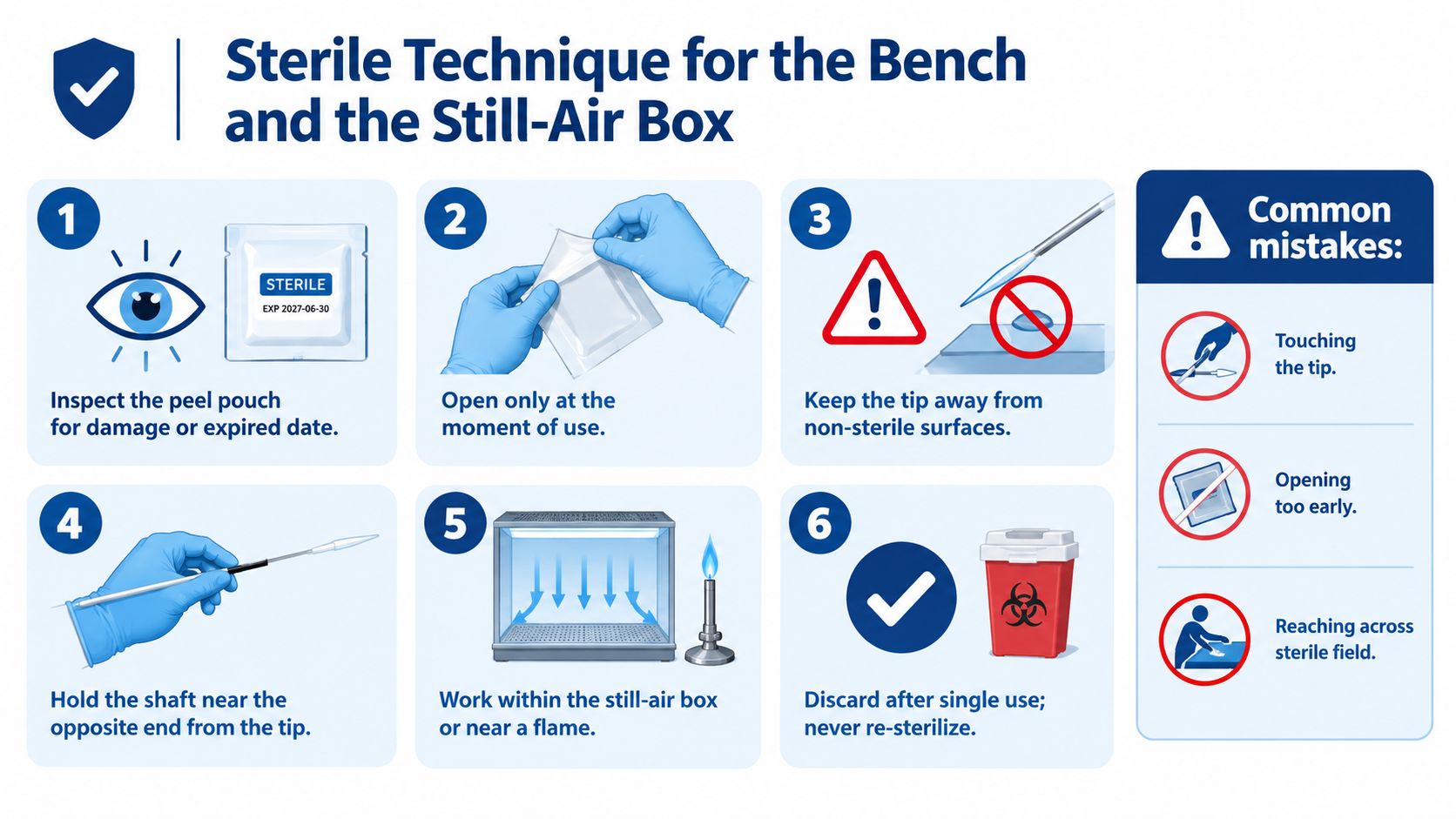
Inspect first. Check the pouch, seal, lot information, and expiration date before you bring the applicator into the active work area.
Prepare the receiving surface. Mark the plate, position the broth, or arrange the instrument before opening the package.
Open at the moment of use. Peel the pouch without dragging the cotton tip across the package or bench.
Hold the shaft at the opposite end. Keep fingers away from the cotton and avoid gripping so close to the tip that your hand enters the working zone.
Make controlled contact. Use firm rolling or streaking rather than stabbing. For sparse biomass, lightly moisten with sterile medium when the validated workflow calls for it.
Discard immediately. A single-use applicator belongs in the appropriate waste stream after one operation. Don't set it down for a second task.
Why rolling beats poking
A cotton tip doesn't release evenly when you jab it into agar. Stabbing can push fibers into the medium, damage the surface, and leave most of the collected material trapped inside the tip. Rolling or streaking spreads contact across the receiving area and gives the fibers a better chance to release what they hold.
Work in a still-air box or suitable controlled environment when possible. Keep movements slow, avoid reaching over open plates, and arrange materials so you aren't crossing the clean field. The same discipline applies to other contamination-sensitive procedures, including resources that explain how to reconstitute peptides safely. That guidance concerns a different application, but the shared principle is careful preparation, compatible materials, and controlled handling.
Store unopened applicators in their original packaging, dry and away from direct sunlight. Don't open packs in advance, don't reuse an applicator, and don't attempt to re-sterilize a disposable cotton tip at home. For broader laboratory workflow guidance, review aseptic technique in the lab.
Buying Tips and Common Mistakes to Avoid
A product page that says only “sterile cotton swabs” leaves important questions unanswered. Before buying, identify the task, the receiving medium or assay, and the material limits that could affect your result. Sterile is a starting requirement, not a complete performance specification.
Read the listing like a lab technician
Look for a clear statement about the sterile barrier and lot traceability. The package should tell you how sterility is maintained, whether the applicator is intended for single use, and what dates or identifiers support quality control.
Then check construction:
Shaft material: Choose wood or plastic with the downstream culture and assay in mind. If a sensitive workflow is involved, ask whether the shaft or adhesive has been evaluated for interference.
Sterilization method: Ethylene oxide, gamma irradiation, and other processes have different material and residual considerations. FDA-recognized ISO 11135 covers development, validation, and routine control of ethylene-oxide sterilization, while FDA guidance addresses control of residual ethylene oxide and ethylene chlorohydrin after processing.
Packaging format: Individual peel pouches are convenient for controlled opening and single-use handling. Bulk packaging can expose multiple items whenever the container is opened.
Compliance information: Claims such as CE marking, ISO 13485, or good-manufacturing-practice compliance may matter for your setting, but confirm what the claim covers.
Protocol compatibility: Ask whether your receiving laboratory accepts cotton, the selected shaft, and the intended sterilization history.
Mistakes that cause avoidable problems
The first mistake is buying for the word “sterile” while ignoring recovery. The second is substituting a cosmetic cotton swab for an applicator intended for laboratory or clinical work. Familiar appearance doesn't establish sterile packaging, traceability, or material compatibility.
Other errors are more practical:
Reusing a single-use tool: One transfer can carry material from a previous surface into the next culture.
Ignoring the shaft: Wood, plastic, and adhesives can behave differently in sensitive cultures.
Opening too early: Exposure time creates more opportunities for contact and airborne contamination.
Sampling too much area with one swab: Large surfaces need a sampler designed for coverage, not a longer list of swabbing motions.
Re-sterilizing at home: Heat, moisture, packaging, and chemical residues can change the applicator and invalidate the original sterile claim.
For hobbyists comparing pack sizes or adding supplies to a broader mycology order, this bulk and wholesale sourcing guide can help frame the purchasing decision.
A quick decision path keeps the choice practical. Routine mushroom transfers usually need a sealed, single-use applicator with a shaft length you can control. Classroom work benefits from individually packaged items and simple handling instructions. Environmental sampling needs a validated recovery method, and a sterile cotton tip may not be adequate for quantitative conclusions. A contamination-sensitive lab should follow its protocol first, then confirm the tip, shaft, sterilization, and packaging with the supplier.
Colorado Cultures offers six-inch sterile cotton wood swabs alongside sterilized grain, substrates, grow bags, and other mushroom cultivation supplies. If you're building a cleaner transfer routine or need practical guidance for your next bench setup, visit Colorado Cultures to compare supplies and learning resources.
Comments