
Dual Extracted Lion's Mane: What the Label Really Proves
The popular advice to always choose dual extracted lion's mane skips the question that matters most: what did the manufacturer recover? Using water and alcohol can broaden an extract's chemical profile, but the process name doesn't tell you which compounds survived processing, how much reaches each serving, or whether that preparation has been tested in people.
A more useful buying rule is to separate extraction method, measured composition, and human evidence. Those are different kinds of proof. A credible product needs more than an appealing answer to the first question.
What Dual Extracted Lion's Mane Actually Means
Dual extraction combines water-based and ethanol-based extraction of lion's mane, Hericium erinaceus, to recover compounds with different solvent preferences. A common sequence uses hot water first and ethanol afterward, although the term alone doesn't establish the order or manufacturing conditions.
Think of brewing tea, then using alcohol to recover constituents that water didn't dissolve efficiently. The analogy explains solvent selection, not completeness: neither solvent guarantees that every compound of interest will appear in the finished product.
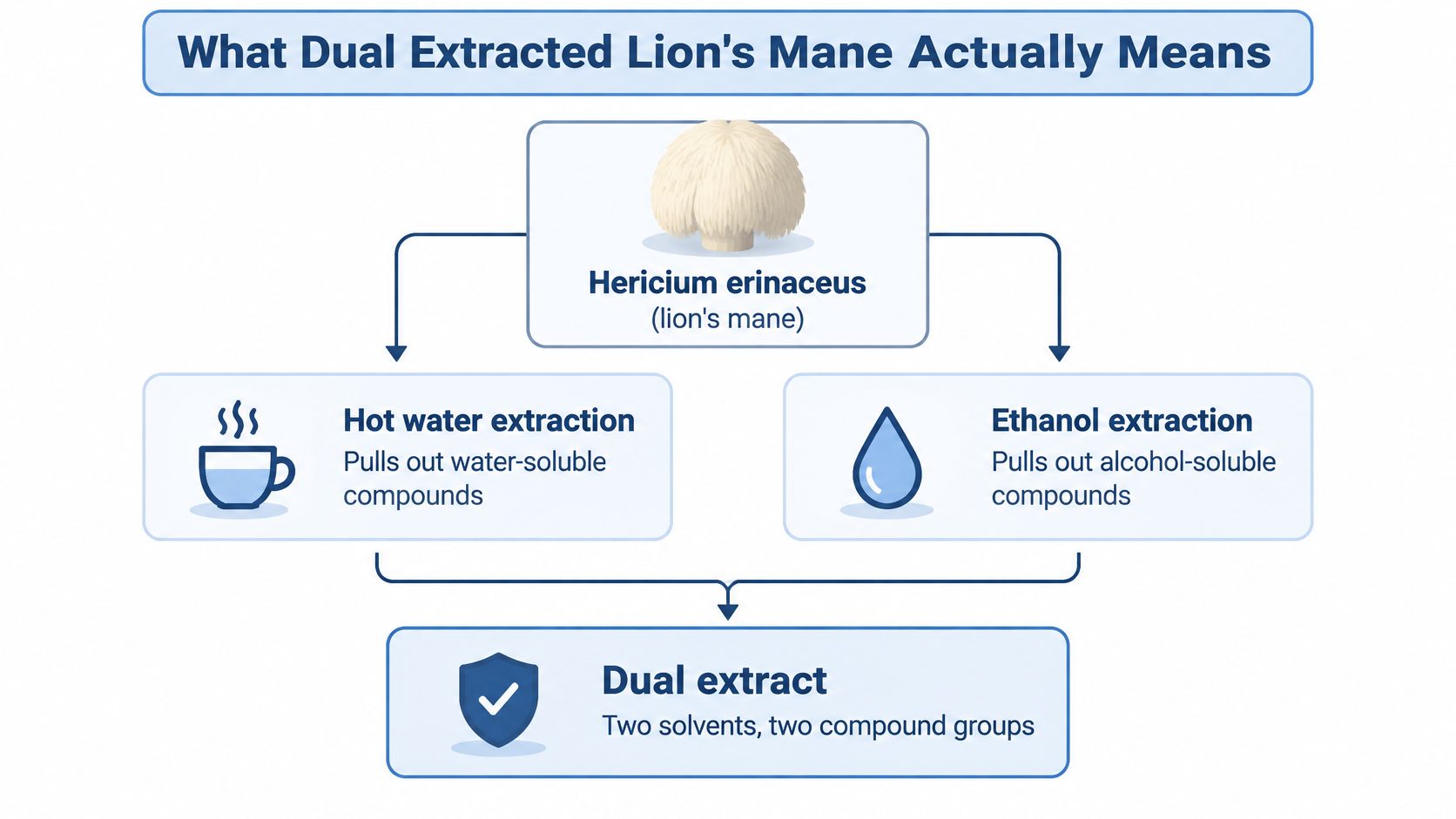
Compounds captured by each solvent
Water favors polysaccharides, including beta-glucans. Ethanol-containing solvents can improve recovery of less-polar constituents, but naming a compound family isn't the same as measuring it in the bottle.
Solvent | Main compound classes | Key result |
|---|---|---|
Hot water | Polysaccharides, including beta-glucans | Primarily targets high-molecular-weight polysaccharides |
Aqueous ethanol | Hericenones, erinacines, phenolic acids, sterols | Can recover less-polar constituents that water extracts less efficiently |
Dual, water then ethanol | Both solvent fractions combined | Improved recovery of ergothioneine, lovastatin, L-phenylalanine, and ergosterol under tested conditions |
A 2025 study in Molecules reported the most reliable overall extraction results with a 70:30 ethanol-water mixture, with the highest measured ergosterol concentration reaching 628 mg per 100 g dry weight in material grown on beech sawdust and wheat bran; antioxidant activity remained comparable across the tested 70%, 80%, and 95% ethanol conditions.
Ergosterol is a fungal sterol that can convert to vitamin D2 under ultraviolet exposure. Its presence alone doesn't establish the finished product's vitamin D2 content, and recovering more sterol doesn't automatically mean stronger antioxidant activity or greater clinical benefit.
For readers still learning the organism itself, the Mushrooms For Sale lion's mane guide offers introductory context. Keep that species-level background separate from evidence about a particular extract.
Practical rule: Treat dual extraction as a description of solvent use, not a certificate of potency.
The meaningful questions concern the starting mushroom material, solvent composition, cultivation substrate, and compounds measured. Without those details, the label describes a manufacturing category rather than a reproducible chemical product.
How Hot Water and Ethanol Extraction Differ
Manufacturers choose solvents because lion's mane contains chemically distinct fractions. Extraction yield describes what they recover under particular conditions, not what a person will absorb or experience after taking the extract.
The workflow below explains a sequential manufacturing approach. It isn't a home recipe: heating ethanol requires appropriate equipment and fire controls.
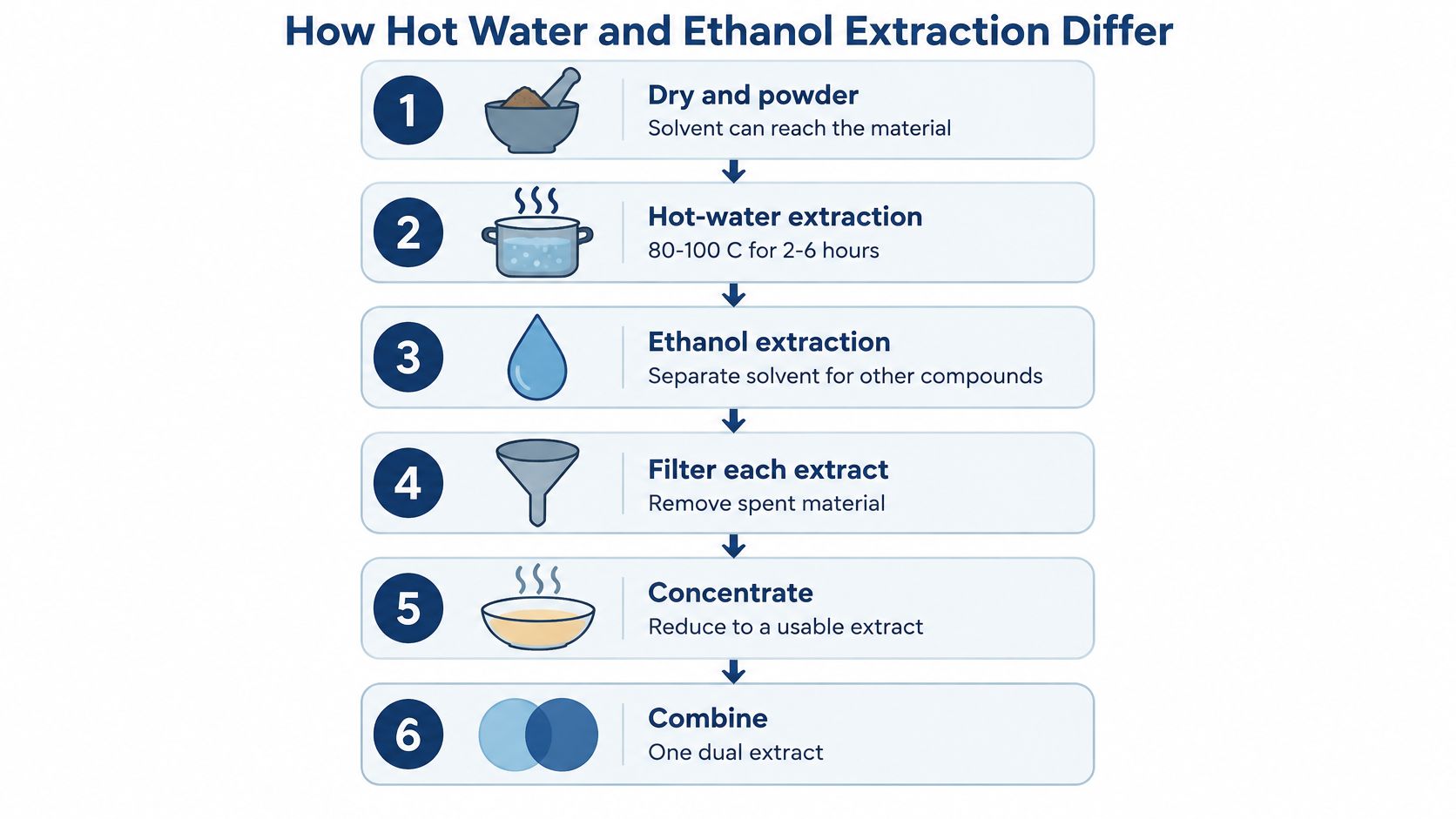
A sequential extraction workflow
Prepare the identified mushroom material. Drying and milling create material that solvents can contact more consistently. Record whether the input is fruiting body, mycelium, or a mixture before processing starts, because solvent choice can't compensate for an unidentified starting material.
Recover the water-soluble fraction. A technical review in Frontiers in Natural Products describes hot-water conditions of approximately 80–100 °C for 2–6 hours, commonly at a 1:20–1:40 solid-to-liquid ratio, with reported polysaccharide yields of 4.29–13.46% of dry weight. These are reported operating ranges, not a universal optimum or a finished-product beta-glucan specification.
Separate the liquid from the solids. Filtration preserves the aqueous fraction while retaining the residue for further extraction. Keeping the fractions identifiable helps a manufacturer investigate where material was recovered or lost.
Apply the ethanol-containing solvent. This stage targets medium-polarity and lipophilic constituents, including relevant terpenoid-related compounds and sterols. It doesn't guarantee detectable erinacines or hericenones if the starting material contains little of the target compound.
Filter, concentrate, and combine under controlled conditions. Manufacturers must account for the solvent used during extraction and the intended final formulation. A liquid tincture may intentionally retain ethanol, whereas a dried extract requires a different solvent-removal specification.
Measure the resulting composition. Testing individual fractions can help characterize the process; testing the finished batch establishes what buyers receive. A successful intermediate extraction doesn't prove that the final blend retains the same concentrations.
Why the settings matter
Longer extraction or stronger alcohol isn't automatically better. Temperature, exposure time, solvent composition, and the amount of liquid relative to solids all affect recovery, so a process needs a defined target rather than a general ambition to extract more.
For Colorado growers, another distinction matters: growing a recognizable mushroom and producing a standardized extract are separate tasks. Cultivation records help identify the input, but chemical assays are needed to characterize the output.
Our chaga mushroom tincture guide provides related context for mushroom extract terminology. Don't assume that a method suitable for another species establishes the right process or marker profile for lion's mane.
Claimed Benefits Versus Human Evidence
Lion's mane has a history as food and traditional medicine in China, Japan, and Korea. That history explains interest in the mushroom, but it doesn't establish that a modern concentrated extract treats a neurological or psychiatric condition.
The distinction between food, supplement presentation, and clinical preparation deserves attention.
A 2019 review of lion's mane and depression examined preclinical and clinical work while emphasizing the need for additional human trials to establish effectiveness and mechanisms. Interest in hericenones, erinacines, and polysaccharides is scientifically reasonable, but interest isn't confirmation of a consumer benefit.
Sort claims by the evidence behind them
Tested in humans with an identified preparation. These findings can support conclusions about that preparation, population, and outcome, subject to the trial's limitations.
Observed in animals or laboratory systems. These findings can justify further investigation, but they don't establish that an oral retail product produces the same effect in people.
Marketed without matching evidence. A general statement about memory, mood, or immunity remains unproven when the seller can't connect it to an appropriately tested preparation.
An encouraging cognitive result from an erinacine-A-enriched preparation doesn't validate every product carrying the same mushroom name. Enrichment changes the comparison: a generic dual extract may not provide a comparable marker amount.
Dual extraction is a processing method, not proof of effect.
For broader context, Sunridge Medical's discussion of boosting cognitive function naturally can help readers frame questions about cognitive care. It isn't evidence that a particular mushroom extract works.
Use this video as supplementary educational material, not a substitute for preparation-specific trial evidence.
Our overview of the health benefits of lion's mane mushrooms supplies additional topic context. For purchasing decisions, set narrower expectations: cognition claims need cognitive outcomes, mood claims need mood outcomes, and immune claims need relevant human evidence. None follows automatically from solvent selection.
Dosing in Human Studies Compared
Study doses aren't interchangeable serving recommendations. The table distinguishes preparations and outcomes rather than arranging products into a stronger-versus-weaker hierarchy.
The randomized crossover study and its discussion of earlier trials describe approximately 3 g/day for 16 weeks of powdered H. erinaceus, an enriched mycelial preparation providing 15 mg erinacine A/day for 49 weeks, and a single 3 g dose of a 10:1 fruiting-body extract, which produced no significant composite cognition or mood improvement despite one pegboard improvement at 90 minutes.
Human studies and the doses they tested
Study population | Preparation and dose | Duration | Reported outcome |
|---|---|---|---|
Adults with mild cognitive impairment | Powdered H. erinaceus, about 3 g/day | 16 weeks | Benefit reported in an earlier controlled study |
Adults with mild Alzheimer's disease | Erinacine-A-enriched preparation | Extended daily administration | Greater cognitive improvement than placebo reported |
People with mild Alzheimer's disease | Enriched mycelial preparation, 15 mg erinacine A/day | 49 weeks | Benefits reported in an earlier controlled study |
Participants in a single-dose crossover trial | 10:1 fruiting-body extract, 3 g once | Single session | No significant composite cognition or mood change; one pegboard measure improved |
Adults in a short daily-use study | Daily lion's mane preparation | Repeated administration | No significant cognition or memory gain; an acute task-speed improvement reported |
Caveat: The enriched Alzheimer's preparations shouldn't automatically be counted as independent confirmations. Different descriptions, schedules, and reporting conventions need checking against the original trial reports before combining results.
Powdered mushroom and enriched mycelium answer different questions. The former specifies an amount of mushroom preparation; the latter specifies an amount of a named marker. Neither tells you the effective dose of an unspecified dual extract.
Why an extraction ratio doesn't solve the comparison
An input-to-extract ratio describes manufacturing mass relationships when the supplier defines it that way. It doesn't reveal the concentration of beta-glucans, erinacines, or hericenones, and it doesn't establish clinical equivalence to raw mushroom powder.
The single-dose crossover result is particularly useful for challenging an immediate-focus claim. Improvement on an isolated motor-performance measure isn't the same outcome as a broad improvement in cognition or mood.
Likewise, a trial in people with diagnosed cognitive impairment doesn't establish an everyday performance benefit in healthy users. Population and treatment duration belong in the comparison alongside the ingredients.
When reviewing lion's mane mushroom capsules, distinguish the amount of preparation per serving from the amount of a measured marker per serving. Match both to the study before treating its dose as relevant. If the marker amount isn't disclosed, the comparison remains incomplete.
Safety, Usage and Who Should Avoid It
Abdominal discomfort, nausea, and diarrhea have been reported in human lion's mane research. Digestive symptoms matter even when a product is described as natural, and clinical interest shouldn't be mistaken for full safety evidence.
The available findings don't establish the safety of every extract, combination, or long-term routine. A change in starting material or concentration also changes what someone is exposed to.
When clinical advice comes first
Treat the following as reasons for individualized review, not as proof that a specific interaction has been established:
Pregnancy or breastfeeding. Don't infer safety for these circumstances from trials conducted in other adult populations.
Known mushroom allergy. Avoid self-experimentation and discuss suitability with a qualified clinician.
Anticoagulants or diabetes medication. Have a clinician or pharmacist assess the exact product alongside your medicines rather than relying on a general mushroom safety claim.
Planned surgery. Disclose supplements and extracts to the surgical team and follow its instructions.
Neurological or psychiatric diagnoses. Discuss any proposed supplement with the clinician managing the condition, especially if symptoms are changing.
A dual extract shouldn't replace prescribed treatment for cognitive decline or depression. A study of an enriched preparation doesn't establish that an unrelated retail product can substitute for a treatment plan.
A cautious routine for consumer products
These steps apply only to products explicitly intended for human consumption and judged suitable by a clinician where necessary.
Don't exceed the label. If use is appropriate, begin at the lowest labeled amount rather than trying to recreate a research dose with a different preparation.
Keep a dated symptom log. Record the product, amount, digestion, sleep, medication changes, and any new symptoms. Documentation makes a conversation with a clinician more useful.
Stop if a reaction develops. Seek medical advice for concerning symptoms; breathing difficulty or a severe allergic reaction requires urgent care.
Avoid introducing several mushroom products together. Changing several exposures at once makes it harder to identify the cause of an unwanted effect.
Safety boundary: A research-use label isn't an invitation to develop a personal dosing regimen.
Our Colorado Cultures products are intended for research purposes only. Buyers shouldn't treat them as consumer health products or apply supplement-use instructions to them.
The useful objective isn't to optimize a dose at all costs. It's to establish suitability, respect the product's intended use, and preserve enough documentation to recognize a problem.
Label Checks and the Buying Decision
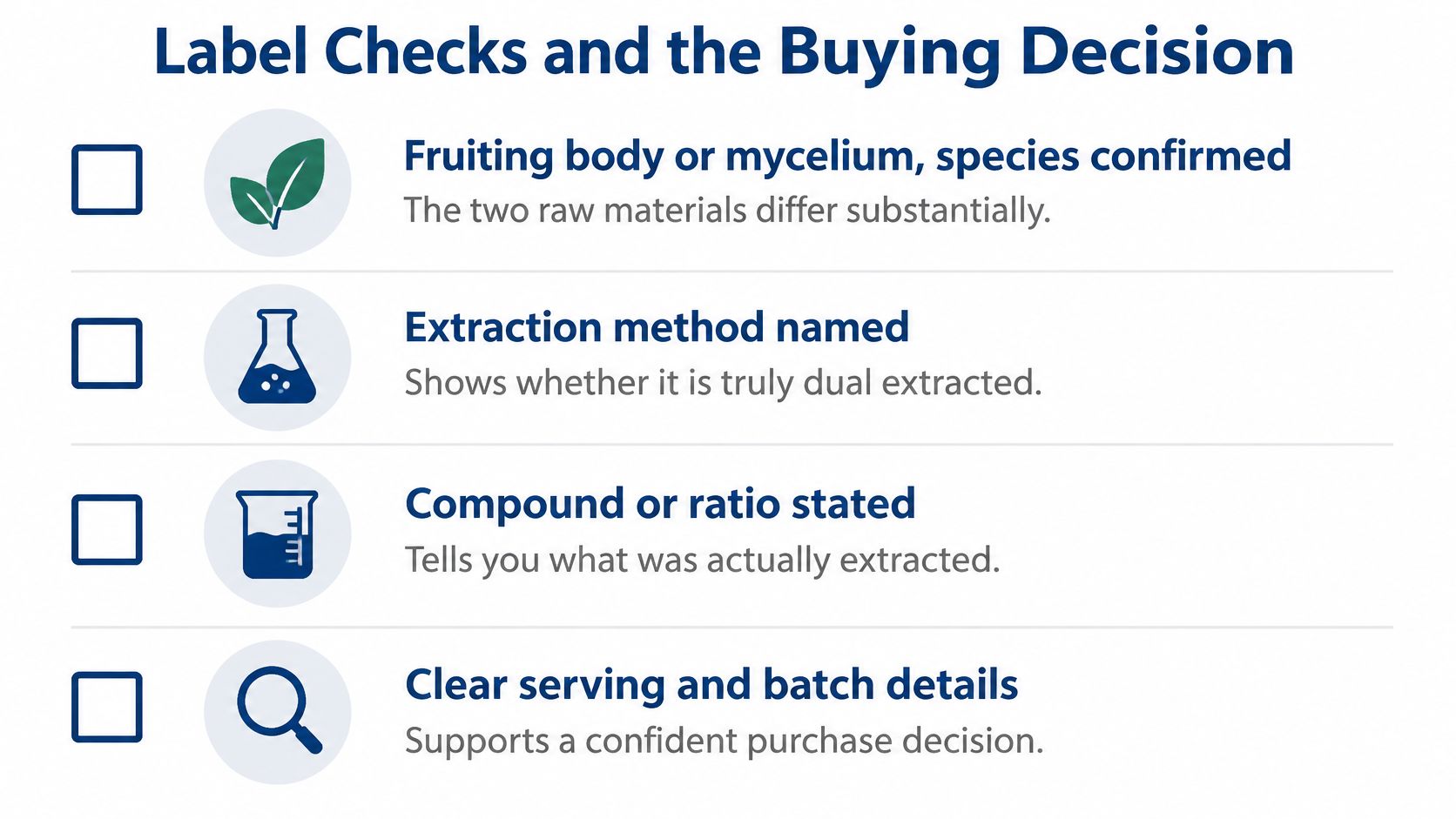
Start with the certificate of analysis, not the front-label slogan. A useful label tells you what the manufacturer intends to sell; a batch-specific analytical report helps establish whether the material matches that description.
What the label and supporting documents should prove
Species and raw material identity. Look for Hericium erinaceus and a clear statement of fruiting body, mycelium, or their combination. Neither origin should be treated as universally superior without considering the intended compounds.
Extraction solvents and their role. The documents should distinguish water extraction, ethanol extraction, and the final formulation. Alcohol appearing in a tincture ingredient list doesn't by itself document an alcohol-extraction stage.
Solvent controls. Request an explanation of removal or retention appropriate to the product format, supported by testing where applicable. Extraction solvent concentration and final alcohol content are different specifications.
Beta-glucans measured separately. A total-polysaccharide result isn't a substitute for a beta-glucan result. Don't accept the broader category as proof of the narrower one.
Named erinacine and hericenone markers. If the seller emphasizes these compounds, ask which individual markers were measured and how much was found in the finished batch.
Identifiable analytical methods. The report should name the assay and laboratory, with enough information to understand what was measured. An attractive certificate without methods leaves important questions unanswered.
Substrate and residual grain disclosure. Establish whether the final material includes cultivation substrate. Mycelium identity alone doesn't describe everything present in a mycelium-on-grain preparation.
What commercial testing reveals
A review of human and preclinical lion's mane evidence describes independent testing of 30 commercial samples, with beta-glucan results ranging from below 5% to 82%, while meaningful hericenone C and D levels weren't detected in the tested products; it also describes a 28-day study using 1.8 g/day that found no significant cognition or memory improvement despite an acute Stroop-task speed improvement.
Those findings answer different questions. Commercial assays examine composition, while a human trial examines outcomes under defined conditions. Neither can replace the other.
The sample testing also doesn't mean every commercial product lacks hericenones, or that the highest beta-glucan result identifies the best cognitive product. It shows why a buyer shouldn't infer a chemical profile from the species name.
For comparison with another supplement category, REVETIX's discussion of how to verify rhodiola supplement testing offers context for evaluating testing language. The documents needed for lion's mane must still identify lion's mane compounds and methods suitable for them.
Apply the evidence to a purchase
Confirm what you're buying. Separate mushroom genetics, cultivation supplies, research materials, and consumer supplements. They have different intended uses, even when the same species appears in their names.
Match the report to the batch. Check that the lot identifier corresponds to the product offered. A report from an unrelated ingredient or a previous production run doesn't establish the current batch's composition.
Evaluate the claimed benefit separately. Once composition is documented, compare the preparation with the relevant human trial. Good manufacturing documentation can justify confidence in identity without justifying a medical claim.
Consider a seller that advertises a broad-spectrum dual extract but supplies only a total-polysaccharide result. That document doesn't answer whether the advertised erinacines or hericenones are present. The sensible response is to leave the claim unverified, not fill the gap with assumptions about solvent chemistry.
A laboratory report also needs interpretation. Not detected isn't equivalent to absolute absence, because the assay has a detection limit; a generic pass doesn't establish a meaningful quantity either. Ask for results that distinguish measured concentration from a simple screening statement.
For cultivation-focused readers, our Genetics Catalog includes mushroom genetics such as Blue Oyster, Lions Mane, Golden Teacher, Reishi, and Turkey Tail. Genetics selection is an upstream research decision, not evidence about the composition or clinical performance of a finished extract.
Walk away when a seller can't identify the extraction method, won't provide relevant batch documentation, or presents disease-treatment promises without matching clinical evidence. A dual extracted lion's mane label is a starting point. Analytical documentation establishes composition, and human benefit still requires separate proof.
Colorado Cultures offers mycology and lab supplies for investigating mushrooms from cultivation onward, with products intended for research purposes only. Visit Colorado Cultures to explore supplies and educational resources, and approach lion's mane research with clear material identification, documented methods, and realistic conclusions.
Comments