
Lion's Mane Mushroom Capsules: Evidence and Dosing Guide
The most common advice about Lion's mane mushroom capsules sounds reassuringly simple. Pick a bottle with a big milligram number, take it daily, and expect sharper memory and focus. That shortcut skips the question that decides whether a comparison means anything at all.
A milligram is only a weight. It doesn't tell you what material was weighed, which part of the mushroom was used, whether the powder was extracted, or which compounds were measured. Two bottles can both say 600 mg and contain products that are hard to compare with each other, let alone with a clinical trial.
Read the label as a short technical description instead. Once you can decode species, part used, format, dose and testing, the marketing language gets much easier to judge.
What Lion's Mane Capsules Contain and How Formats Differ
Lion's mane mushroom capsules are capsules filled with powder or extract from Hericium erinaceus, a shaggy white mushroom that grows on hardwood. The capsule shell is the delivery method. What's inside determines what the milligram figure represents.
Think of whole powder as a bag of dried apple slices and an extract as apple juice concentrate. Both come from the same fruit, but a gram of each doesn't represent the same amount of starting material. That distinction is where beginners often get misled by Lion's mane mushroom capsules.
The diagram below separates the basic production routes before you compare labels.
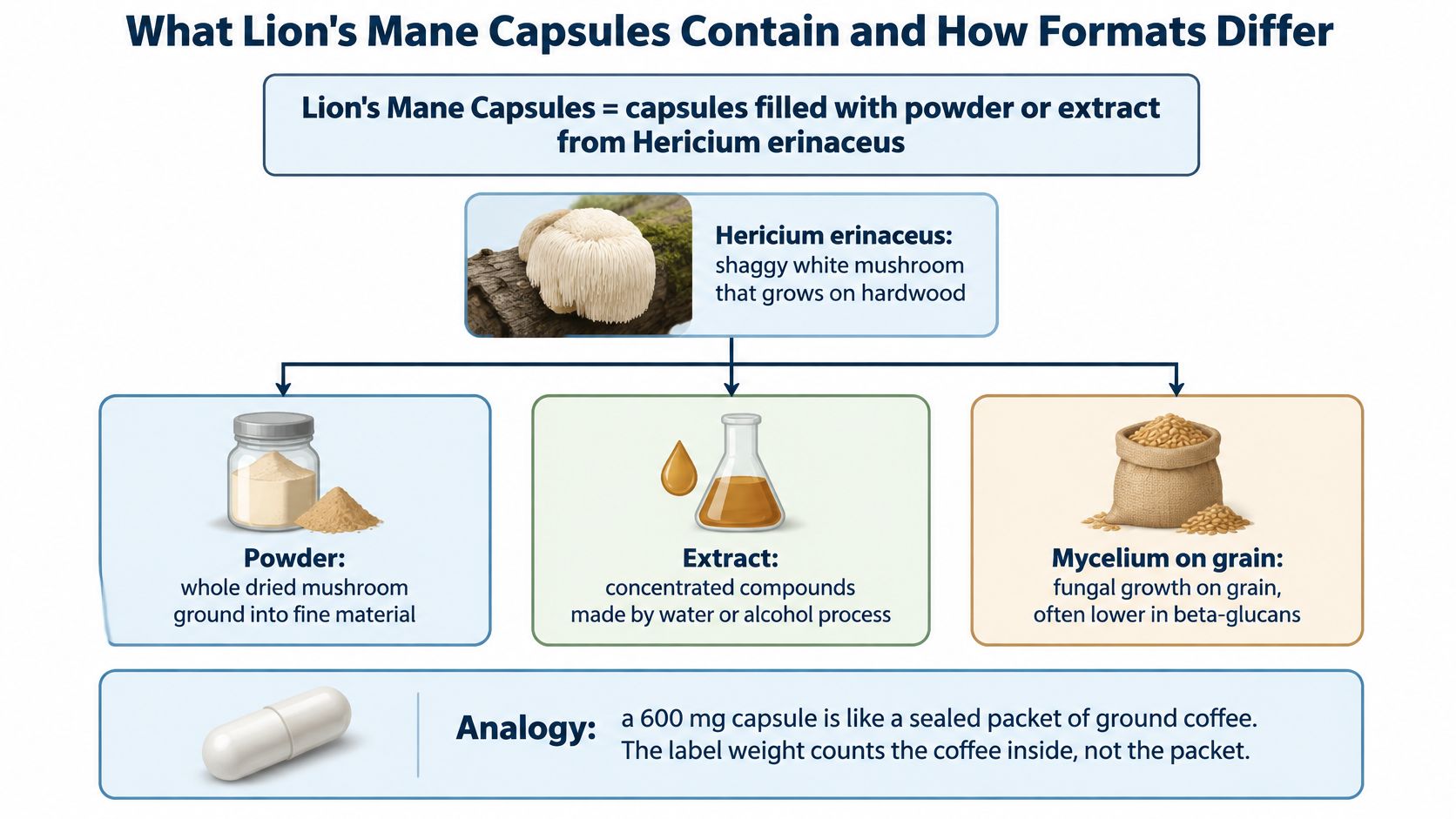
Four Ways to Fill the Same Capsule
Format | How it is made | What the label usually shows | Key caveat |
|---|---|---|---|
Whole fruiting-body powder | Dried mushroom ground to powder | Weight in mg, often no ratio | The milligram is raw material, not active content |
Hot-water or dual extract | Mushroom simmered in water, or in water and alcohol | Extract with a ratio such as 10:1 | Higher concentration, but active content still needs checking |
Standardized extract | Extract tested for a named marker compound | Marker name with a percentage or amount | Only meaningful when the assay method is stated |
Mycelium grown on grain | Fungus grown on a grain base, then harvested | Mycelium or myceliated grain | Grain adds weight, so check how much of the capsule is mycelium |
A product page such as the Moksha Focus 60-capsule supplement is useful as a practice label because it gives you concrete fields to inspect. Look past the product name and check species, part used, extraction ratio, capsules per serving and marker testing.
Compounds Researchers Try to Measure
A peer-reviewed review of lion's mane compounds and pharmacology identifies polysaccharides, glycoproteins, hericenones, erinacines and hericerin as principal bioactive classes. The same review describes preclinical work in which erinacines A and S were detectable in rat brain tissue within one hour of oral administration.
That animal result supports biological plausibility. It doesn't demonstrate a clinical benefit in people. A responsible specification therefore names the species, part used, extraction ratio, daily dose and analytical confirmation of a marker. The word "standardized" alone doesn't tell you what was standardized or how it was measured.
Working rule: A label milligram tells you the weight of material in the capsule, not the amount of any active compound. The format decides what that number means.
What the Human Studies Measured and Found
The same milligram figure on a capsule label can represent materials that were tested in very different ways. Human trials have examined specific preparations, doses and outcomes, so their results apply most directly to the formulation and participants in each study. The evidence for lion's mane capsules is early and mixed: some trials found a change on one task at one time point, while others found no broad improvement in cognition or mood.
A 2025 systematic review in Frontiers in Nutrition summarized five randomized controlled trials, four of them involving healthy participants. Researchers assessed cognition, dementia-related decline, mood, anxiety, depression, menopause symptoms and mild cognitive impairment. These studies asked different questions and used different preparations with small groups. Combining their outcomes into a single claim that lion's mane improves brain function would blur important distinctions.
Timing Changed the Result
One capsule trial tested both an immediate dose and several weeks of use. Participants completed a Stroop processing-speed task faster shortly after dosing, but broader cognitive and memory measures did not improve significantly after the supplementation period. Subjective stress showed only a trend.
A quicker score on one timed task is a narrow finding. It does not establish better everyday memory, prevent dementia or treat cognitive impairment.
A separate acute trial used a concentrated fruiting-body extract. Composite global cognition and mood did not change, although one pegboard measure improved at a later time point. As in the capsule trial, the result applied to a particular task, not cognition in general.
Study | Participants | Dose and duration | Main finding |
|---|---|---|---|
2023 pilot trial | 41 healthy adults aged 18 to 45 | 1.8 g/day (3 × 600 mg), 28 days | Faster Stroop task at 60 min (p = 0.005); no significant broad cognitive or memory gains after 28 days |
2025 double-blind trial | 18 healthy adults aged 18 to 35 | Single 3 g dose of 10:1 fruiting-body extract | No change in global cognition or mood; one pegboard task improved at 90 min |
Systematic review trial | Participants in one of five RCTs | Single 1 g dose | Changes in selected cognitive tasks |
The table shows why the dose alone is not enough to compare products. A single dose of concentrated fruiting-body extract is not the same preparation as a daily powder, even if their label amounts appear similar. The preparation, schedule and outcome all shape what a trial can tell us.
Why Small Signals Need Careful Language
Small samples can suggest a possible signal, but leave substantial uncertainty. Healthy young adults also do not stand in for older adults, people with dementia or people taking medication. Different powders, extracts and blends add another limit: a result for one preparation does not automatically apply to a shop product with the same common name.
For a plain-language guide to understanding lion's mane cognitive studies, compare the explanation with the trial details: who participated, what material they took and which outcome changed. A broader overview of reported health benefits of lion's mane mushrooms can provide context, but it cannot replace a close match between a product and the preparation studied.
A statistically significant result on one task is a measured finding, not a promise of a noticeable benefit for every buyer.
Adverse effects in the reviewed evidence were generally limited, though headache, stomach discomfort, diarrhea and nausea appeared occasionally. The evidence supports a modest conclusion: researchers have recorded specific short-term signals, but current trials do not establish disease prevention or reliable cognitive improvement in the general population.
Reading a Label Before You Buy
Read the bottle in the order you'd scan it in a shop. Each field answers a different question, and a missing field limits what you can conclude about Lion's mane mushroom capsules.
The checklist below gives you the sequence.
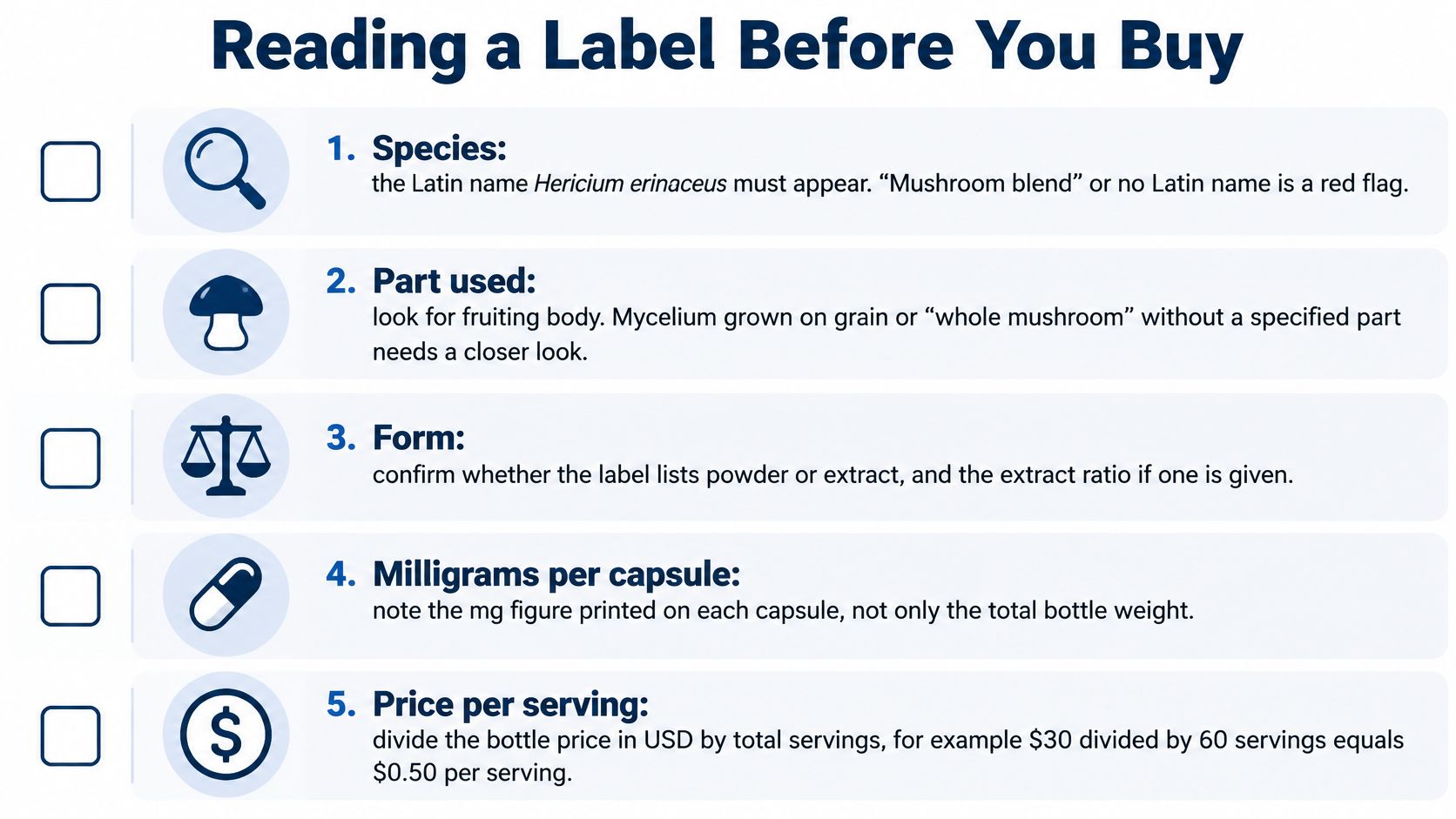
Seven Fields to Check
Species: Look for the Latin name Hericium erinaceus. A vague "mushroom blend" or a missing Latin name is a red flag because you can't confirm the organism.
Part used: The label should say fruiting body or mycelium. If it doesn't identify the part, you don't know what material supplies the listed weight.
Form and extract ratio: Raw powder and extract aren't interchangeable. A ratio such as 10:1 describes concentration in principle, while the word "extract" with no ratio leaves the process unclear.
Milligrams and serving size: Combine mg per capsule, capsules per serving and servings per day. A proprietary blend that hides the lion's mane amount blocks any dose calculation.
Marker compound: "Standardized" should be followed by a named compound and measured amount. Without both, the claim can't be checked.
Beta-glucan content: A measured beta-glucan figure shows that something specific was tested. Don't treat a large general "polysaccharide" number as proof of a cognitive effect.
Analytical method and lab: A named test method shows how the number was produced. A badge saying "quality tested" doesn't.
Why Missing Details Break Comparisons
A Kymata Health review of lion's mane preparations notes that human research has used erinacine-enriched mycelium, whole mushroom powder, extracts and mushroom-containing foods, with doses ranging from about 1.05 g/day to 10 g/day and durations from acute use to 49 weeks. It also notes the lack of standardized pharmacopoeial methods for quantifying erinacines, hericenones and beta-glucans.
That range explains the practical problem. You're not choosing between identical units with different prices. You may be choosing among materials that differ in source, processing and measurable content.
Say one bottle lists 600 mg of fruiting-body powder and another lists 600 mg of extract without a ratio or marker. The first gives you a defined raw-material weight. The second uses a stronger-sounding word but gives you less usable information.
Decision rule: If a label can't identify the species, part, format and amount per serving, you can't meaningfully compare it with a trial product.
Vetting the Supplier Behind the Bottle
A tidy label can still sit on a weak supply chain. Ask what evidence connects the printed claims to the capsules in your hand.
Questions a Supplier Should Answer
Can I see the batch report: Ask for a third-party lab report tied to the batch or lot number printed on the bottle. A generic certificate for a different production run doesn't verify your product.
What exactly was tested: The report should name the marker and test method, not just display a "quality tested" badge. Identity testing matters too, because potency numbers are useless if the species wasn't confirmed.
Where did the material come from: Look for the growing source and whether the ingredient began as fruiting body or mycelium. A supplier that won't say where the mushroom material originated leaves a basic gap.
Who can answer a technical question: Find a named contact route for testing and sourcing questions. Check the return policy before buying, particularly for unopened or incorrectly described products.
Do the claims match the evidence: Promises to treat memory loss or dementia are a red flag. So is "clinically proven" when the cited work used a different extract, dose or population.
Do cited studies match this format: A powder seller shouldn't borrow credibility from an extract trial without disclosing the difference. The study must resemble the product in material, amount and duration.
What is the price per gram: Calculate cost per gram of labeled material so bottle sizes don't distort the comparison. Price still can't prove potency, but it stops a larger bottle from looking automatically better.
A Worked Bottle Comparison
Say two bottles cost about the same. One lists 600 mg of whole fruiting-body powder per capsule. The other lists 600 mg of 10:1 extract per capsule.
The extract represents more starting material in principle, so its capsule is more concentrated by weight. But concentration isn't the same as verified marker content. If only the powder supplier provides a matching batch report, its claim is the one you can inspect. If the extract supplier provides identity testing, the extraction details and a marker result for that batch, you have a stronger basis for comparison.
Don't reward fluent sales copy when documentation is missing. A supplier who won't share a certificate, identify the material or explain a test has already answered your quality question.
Turning Label Milligrams Into a Daily Dose
Dose arithmetic is simple once you separate capsule weight, serving size and material type. The process below shows the calculation sequence.
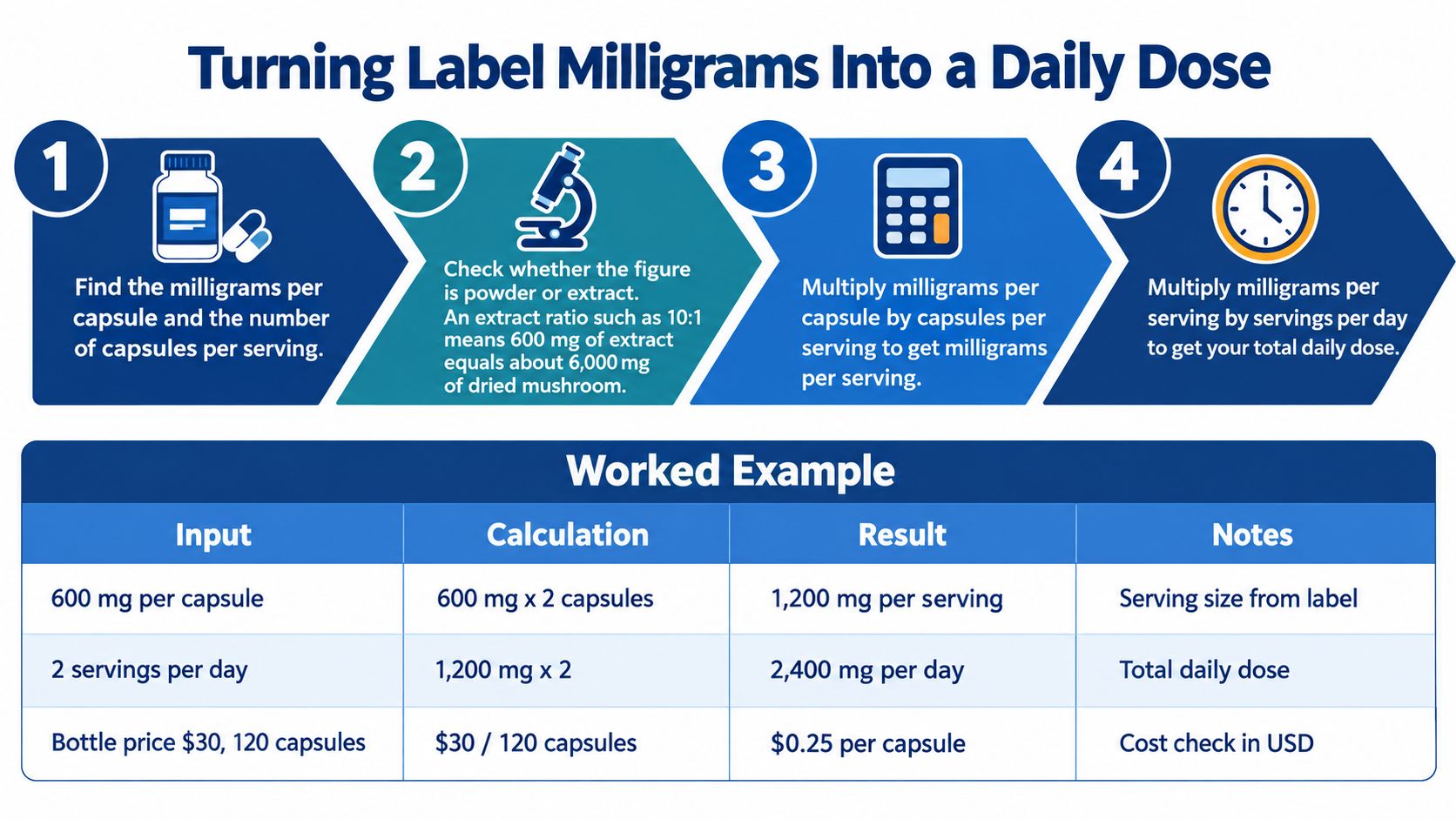
Five Steps From Label to Total
Find the capsule amount and serving size: Multiply milligrams per capsule by capsules per serving. Then multiply by servings per day.
Identify powder or extract: A 300 mg amount of 10:1 extract represents about 3 g of raw mushroom by weight in principle. That's a starting-material calculation, not a measure of active compounds.
Choose a comparison target: Use a studied amount as an arithmetic reference, such as 1 g, 1.8 g or a single 3 g extract dose. A reference target isn't a personal recommendation.
Divide and round up: Divide the target in milligrams by the amount per capsule, then round up to a whole capsule. Recalculate the actual total because rounding can push you over the target.
Start low and observe: Begin at the lower end of your chosen range and track sleep, digestion and symptoms for two weeks before changing the amount. Don't adjust several supplements at once, or you won't know what caused a change.
The clearest anchor comes from the 2023 randomized, double-blind, placebo-controlled pilot trial, in which 41 healthy adults aged 18 to 45 took three 600 mg capsules daily for 28 days, totaling 1.8 g per day. Researchers also tested participants 60 minutes after a single dose and recorded faster Stroop performance, while broader outcomes after 28 days weren't significant.
Capsule fill weight | Capsules for 1.8 g target |
|---|---|
500 mg | 4 capsules (2,000 mg, or 2.0 g) |
600 mg | 3 capsules (1.8 g) |
1,000 mg | 2 capsules (2,000 mg, or 2.0 g) |
The table is arithmetic only. Four 500 mg capsules don't reproduce the trial material unless the species, part, format and processing also match. Likewise, 1.8 g of extract isn't interchangeable with 1.8 g of whole powder.
The video below is useful for walking through label figures slowly before you apply the same calculation to a bottle you're considering.
Write the final daily amount on the bottle or in a note. That habit prevents the common error of remembering the per-capsule figure and forgetting how many capsules make a serving.
Safety Checks Before You Start
A capsule's milligram figure describes its contents, not whether those contents are safe for you. Before starting, consider the reported reactions, possible medication interactions and gaps in the safety evidence.
What Is Known and What Isn't
The LiverTox summary for lion's mane reports no established link to clinically apparent liver injury. In longer human studies, mild abdominal discomfort, nausea or diarrhea were reported in fewer than 10% of treated subjects.
Those findings offer limited reassurance, not proof that every product is safe for long-term use. Available human evidence has not documented widespread toxicity, but interaction and long-duration data remain incomplete. Unclear product ingredients add another layer of uncertainty: the label may not tell you exactly what you are taking.
Medical guidance summarized with the safety evidence raises possible effects on blood clotting and blood sugar. If you use anticoagulants, antiplatelet drugs or diabetes treatments, ask a clinician before starting. A product's capsule count or milligram total cannot tell you whether it is suitable alongside your medication.
Animal toxicology results cannot be converted into a human capsule dose. Differences in metabolism, body size, preparation and study design make a rat dose a poor guide to what a person should take.
Situation | Why it matters | What to do |
|---|---|---|
Taking anticoagulant or antiplatelet drugs | Possible effect on blood clotting | Ask a prescriber before starting |
Taking diabetes medication | Possible effect on blood sugar | Seek clinician review and monitor glucose |
Known mushroom allergy | Risk of an allergic reaction | Avoid; stop if a rash develops |
Stomach discomfort, nausea or diarrhea | Reported in fewer than 10% of treated subjects in longer studies | Reduce or stop; seek care if symptoms persist |
Pregnancy, breastfeeding or children | Not covered by the trials reviewed here | Follow professional advice; do not self-dose |
Long-term daily use | Long-term safety evidence is limited | Reassess periodically with a clinician |
Animal toxicology results | Animal findings do not establish a human capsule dose | Do not use them to set a personal dose |
General information on lion's mane for brain health and focus support does not replace advice about your specific medications. Bring the bottle, or a photo of its supplement facts panel, to a clinician so they can review the product form and labeled amount.
Stop and seek medical care for a rash, an allergic reaction, breathing difficulty or persistent stomach symptoms.
Choose Capsules, Powder or Your Own Grow
The best route depends on whether you want a measured serving, a food ingredient or a growing project. Those goals aren't interchangeable, even when they involve the same mushroom.
Five Routes and Their Trade-Offs
Standardized extract capsules offer the most measurable serving, but only when the label names the marker, amount and assay method. Without those details, "standardized" is just an adjective. Whole-powder capsules give an approximate dose by powder weight and should identify species, part used and drying process.
Bulk powder or extract lets you adjust the amount and mix it into drinks or food. You'll need a small scale, a labeled container and the discipline to measure instead of estimating with a spoon. That flexibility is useful, but it introduces more room for daily variation.
Growing at home from grain spawn gives you control over species and growing conditions. It also takes weeks and produces fresh mushrooms, not a milligram-defined supplement. A practical overview of a lion's mane mushroom grow kit can help you judge the workspace, timing and technique involved before treating home cultivation as the simple option.
Fresh culinary mushrooms are food rather than a measured supplement. You can enjoy their texture and use them in meals, but a serving on a plate doesn't give you a controlled amount of a named marker compound.
Choose This If
Choose standardized capsules if: You want a repeatable serving close to a studied amount and you've checked the batch report.
Choose bulk powder if: You cook or make drinks daily, want flexible amounts and will weigh each serving.
Choose fresh mushrooms if: Your main goal is food and flavor, not dose tracking.
Choose a grow kit if: You enjoy the process, want control over cultivation and accept that the harvest isn't a standardized dose.
Finish with three actions. First, check the label for species, part, format, amount and testing. Second, convert capsules into an actual daily total and compare like with like. Third, speak with a clinician before starting if medication, allergy, pregnancy or a medical condition could change the risk.
If growing your own lion's mane is the route you want to explore, Colorado Cultures offers grain spawn, sterilized grow bags, substrates, grow kits and hands-on mycology guidance for home cultivators. Visit Colorado Cultures to check current product details, compare beginner-friendly options and find practical support before you start your first grow.
Comments