
Mushroom Grow Kit Reviews: Which Kit Is Worth Buying
The most popular grow-kit advice is to choose the one with the highest star rating and follow the instructions. That skips the details that often decide whether you get mushrooms: the temperature and humidity your home can sustain, how well the seller explains airflow, and whether the kit arrives in good condition.
Good mushroom grow kit reviews describe the species, growing conditions, time to harvest, yield across flushes, contamination, and the help available when something stalls. Use the comparison below as a starting point, then judge each listing against your home and your goals.
Mushroom Grow Kit Types Compared for Beginners
Judge a kit by the conditions it demands and the cleanup it expects, not by the glow of its listing. Four criteria carry most of the weight. Ease means how many decisions the kit leaves to you, and whether the instructions give practical targets instead of vague advice such as “keep warm.” Success rate needs a definition: does it mean any mushrooms at all, a first flush, or the full expected yield, and was it measured with beginners under stated conditions?
Sterilization describes how the substrate was prepared and whether it arrives sealed and dated. Support means more than a help email address: look for printed troubleshooting, video instructions, a reachable person, and a clear replacement policy for a contaminated bag. For a first grow, ease and substrate preparation matter most; responsive support can turn a failed attempt into a useful diagnosis.
Kit type | Beginner ease (1–5) | Time to first harvest | Sterilization method | Support to expect |
|---|---|---|---|---|
Oyster mushroom kit | 5 | A few weeks | Pasteurized straw or sterilized substrate block | Printed steps and email help |
Lion's mane kit | 3 | Several weeks | Usually sterilized sawdust or grain | Email help; video walkthroughs are common |
Shiitake sawdust block | 3 | Months | Sterilized sawdust block | Printed guide and email help |
Wine cap (Stropharia) kit | 4 | Months | Outdoor wood-chip or straw bed, not sterile | Often limited; confirm before buying |
Psilocybe cubensis kit | 2 | Several weeks | Sterilized grain | Legal limits apply; confirm before buying |
These ease scores are practical judgments, not lab results. Oyster kits are usually the most approachable choice for a first attempt: they're commonly sold ready for fruiting, and their broader tolerance makes them less demanding than a kit that needs steadier conditions. Still, “easy” doesn't mean maintenance-free. Check the instructions for misting, fresh-air exchange, and what to do if the surface dries out.
Match the kit to the time you have
Read each row as a home-environment requirement. Oysters fit a typical counter or shelf because they accept a wider range of conditions. Lion's mane makes sense if you want a different texture and can give the kit a steadier, cooler spot. Shiitake sawdust blocks suit a patient grower who's willing to wait, while wine cap kits are designed for an outdoor bed, where a shaded area and prepared wood-chip or straw substrate matter more than countertop convenience. Wine cap sellers may offer less troubleshooting detail, so ask what support comes with the kit before ordering.
Food safety starts the moment mushrooms appear. Harvest with clean hands and clean tools, chill edible species promptly, and throw out any block or bed that shows sour odor, spreading mold, or slimy decay. A kit that produces food also produces waste: spent substrate, contaminated bags, and mushroom remnants need to leave the kitchen cleanly.
For any kit, treat the seller's “success rate” as a claim to investigate rather than a universal prediction. Ask how the company defines success and whether its figure applies to first-time growers using the kit as sold. A product can be simple to set up yet still frustrate a beginner if its care instructions leave out humidity and airflow.
Psilocybe cubensis kits need a separate legal check, not just a place in a beginner comparison table. Rules can differ by product and location, so don't assume a kit is lawful because it's listed online.
How to Read Reviews and Success Rate Claims
A 5.0-star score from five reviews is weaker evidence than a 4.6-star score from hundreds when the larger set includes photos, harvest dates, measured yields, contamination reports, and growing conditions. Star averages can overstate a kit's real performance when they rest on a handful of reviews or when reviewers never describe the space they grew in. A kit fruited in a humid basement faces a different test than the same kit on a dry, heated countertop, and the average alone won't tell you which environment produced each rating.
The number matters less than what sits behind it.
Review checklist
Look for growing details. Useful reviews name the species, delivery condition, temperature, humidity, time to first pins, harvest date, and yield.
Separate kit problems from growing problems. Shipping damage, an old culture, low humidity, poor sanitation, or the wrong temperature can all lead to a poor harvest without proving the kit itself was defective.
Read contamination complaints as food-safety information. You're eating what the kit produces, so reports of mold appearing alongside fruiting bodies deserve more weight than a missed yield target.
Watch for repeated patterns. Similar complaints from independent reviewers carry more weight than one dramatic failure or one glowing account.
Ask what "success" means. Colorado Cultures advertises a company-reported 95% success rate for first-time cultivators. Before treating that figure as a buying guarantee, ask what counts as success, which conditions and how many kits it covers, and what happens if a sealed bag arrives contaminated.
For comparing yield claims, use one consistent measure rather than a headline harvest weight. Colorado Cultures' guide to mushroom grow-kit yield is a practical reference for what a seller's total-yield figure includes, so you can compare kits on the same basis before ordering.
Environment Each Kit Needs at Home
Cornell Small Farms recommends indoor incubation at or below 80°F, with about 70°F considered ideal. For many cultivated species, its general fruiting guidance is temperatures in the 60s°F and relative humidity above 85%, though species-specific needs still apply. The Cornell Small Farms cultivation guidance also supports judging a kit by how well its design and instructions help a grower maintain those conditions.
Species | Fruiting temperature |
|---|---|
General guidance from Cornell Small Farms | 60s°F for many species |
Oyster | 60s°F is a practical starting point; check the strain instructions |
Lion's mane | Approximately 60–70°F |
Shiitake | Check the strain and block instructions; no single target is provided here |
Wine cap (Stropharia) | Outdoor conditions; no single target is provided here |
Psilocybe cubensis | Check current, lawful cultivation guidance; no target is provided here |
A Denver home can be warm enough for incubation but still too dry for fruiting, especially when indoor heating is running. A humidity-retaining bag or tent, clear misting directions, and specific fresh-air guidance can be more useful than a kit that promises “set and forget” care. Keep the kit away from heating vents, direct sun, and cold window glass, where conditions can swing or dry out quickly.
Start with the simplest tools: a clean spray bottle, a place to check room temperature, and the kit's own humidity cover or bag. Mist according to the directions, and allow fresh air in through the opening or ventilation method the seller specifies. Don't keep the block waterlogged; surface moisture and standing water aren't the same thing.
Record the species, incubation temperature, fruiting temperature, humidity range, time to first pins, and any drying or deformation. That makes it easier to tell a climate mismatch from a defective kit. For another practical reference on bag care, see Colorado Cultures' all-in-one grow bag fruiting conditions.
Sterilized Versus Pasteurized Substrate Choices
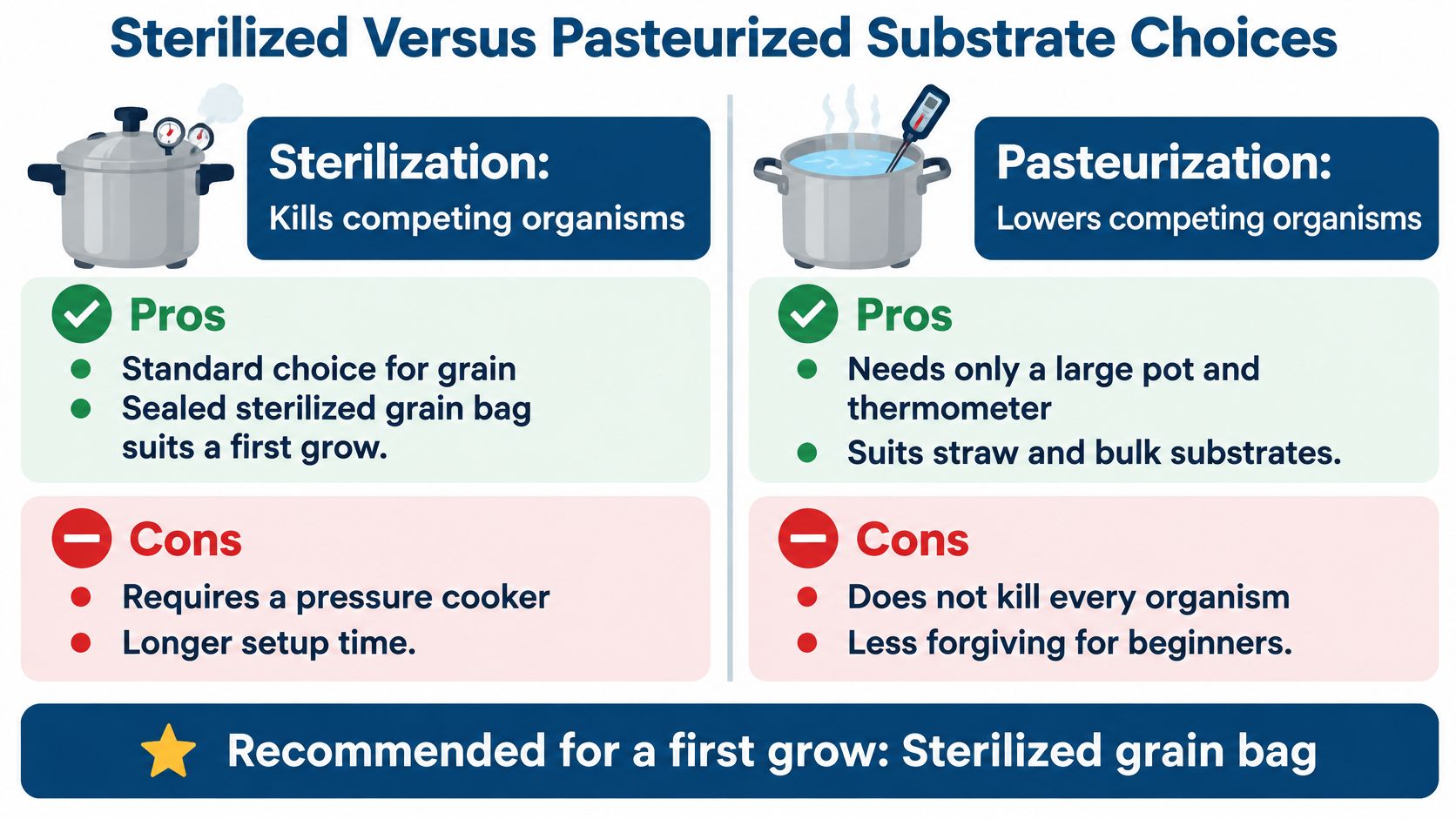
Sterilization offers a cleaner starting point for grain; pasteurization is a lower-heat option used for substrates such as straw. The right choice depends on how the kit is prepared and handled, not on the label alone.
Sterilization, commonly done under pressure, kills competing organisms in the substrate. A sealed, dated sterilized grain bag is a straightforward option for a first grow, provided it arrives intact and the seller gives clear inoculation or fruiting instructions. Pasteurization uses lower heat and is common for straw and bulk substrates. It can be practical and economical, but it doesn't eliminate every organism, so careless handling can give contaminants an opening.
Compare yield fairly
Biological efficiency (BE) compares fresh mushroom yield with dry substrate weight: divide fresh yield by dry substrate weight and multiply by 100. That makes it more useful than gross mushroom weight when kits contain different amounts of substrate. In independent cultivation research, oyster mushrooms reached 81.8% BE on a bean-straw and maize-cob mixture and 76% on wheat straw, while other tested substrates produced lower values, according to the substrate study.
A large first flush can look impressive but still tell you little about overall performance. The kit might contain much more substrate, or it might produce few later flushes. Ask the seller for dry substrate weight, first-flush yield, total yield across flushes, days to first harvest, flush count, and contamination rate.
Compare kits using the same species and similar growing conditions. Substrate recipe, preparation, strain, and environment all affect BE, so one yield result shouldn't be treated as a promise for a different kit. If you're preparing substrate yourself, Colorado Cultures' mushroom substrate pasteurization guide offers a practical reference for the process.
Troubleshooting Symptoms and Fixes
A disappointing flush often points first to environmental conditions, not bad genetics. Temperature, humidity, airflow, and carbon dioxide work together, so changing one without checking the others can leave the underlying problem untouched. Indoor enoki research found that increasing carbon dioxide from 1,000 ppm to 10,000 ppm reduced average cap diameter by more than 50%, showing that poor ventilation can affect the mushrooms themselves, not just how they look, as described in the indoor enoki cultivation study.
Symptom | Likely cause | First fix and when to assess it |
|---|---|---|
Pins form and stall | Low humidity or carbon dioxide buildup | Mist according to the kit instructions and add fresh-air exchange; reassess the next day |
Long, leggy stems with small caps | Too little fresh air | Increase air exchange using the kit's fan or opening method; reassess within a day |
Dry or cracking caps | Humidity below target | Raise humidity with misting and the kit's cover; look for improvement over the next few days |
Wet or slimy spotting | Standing water or bacterial risk | Stop misting the wet area, improve airflow, and inspect the block; reassess within a day |
Slow colonization after three weeks | Cold conditions or an old culture | Move the kit toward about 70°F if the species instructions allow, and check the spawn date; reassess over a week |
Green, black, or pink patches | Contamination | Isolate and discard the block; follow the food-safety guidance below |
The table gives a first response, not a diagnosis that fits every species. For example, extra misting won't solve long stems if the kit needs more fresh air, and adding moisture to an already slimy surface can make the problem worse. Make one change at a time and record what you did.
Practical rule: Change one variable, wait through a full growth cycle, and record the result before deciding the kit is defective.
The cheapest or simplest kit isn't necessarily the easiest if it gives weak airflow and humidity instructions. Clear troubleshooting guidance can save more effort than a low sticker price.
Which Kit Fits Your Budget and Goals
Compare cost per gram, not just the price on the listing. Divide the kit price by the total grams harvested across all flushes. This gives you a better way to weigh a kit that costs more upfront but fruits repeatedly against a cheaper kit with a smaller overall harvest.
For a hypothetical comparison, a $35 kit yielding 400 g across three flushes costs about $0.09 per gram. A hypothetical $20 kit yielding 150 g costs about $0.13 per gram. These examples aren't market prices; they show why flush count can change which kit offers better value.

Match the purchase to the experience you want:
A quick first grow: Choose an oyster kit if you want a comparatively fast route to a harvest and can follow its humidity and airflow directions.
A different gourmet mushroom: Consider lion's mane if you're comfortable waiting longer. Its value depends on the total harvest the seller reports, not the first flush alone.
A long-horizon project: Shiitake or wine cap may fit a patient grower, particularly if you have a suitable outdoor space for wine cap and can wait for the harvest.
Before ordering, ask for the total expected grams across flushes and how the seller measured them. If that information isn't available, you can't make a meaningful cost-per-gram comparison; set the price ranking aside and choose based on conditions, instructions, and support instead. A seller who explains what the yield figure includes gives you more to work with than one who advertises a large number without context.
Confirm Colorado Rules and Order Your First Kit
Gourmet kits for oyster, lion's mane, and shiitake are a different purchase from anything involving psilocybin-producing species. Colorado's recent state rules on natural psychedelics differ from federal law, and local rules can vary within the state, so a state-level change does not settle whether a given sale or cultivation setup is lawful. Before ordering a psilocybin-containing kit, check current state guidance or consult a Colorado attorney. This is general information, not legal advice.
Food safety deserves the same scrutiny as legality. Mushrooms spoil readily, so harvest into breathable packaging, refrigerate them promptly, and skip sealed containers that trap condensation against the caps. The National Center for Appropriate Technology's mushroom cultivation guidance flags substrate provenance for the same reason: chemical residues can move from the substrate into the mushrooms even when no pesticide is applied during cultivation.
Ask whether the seller identifies its substrate ingredients and treatment, explains how to tell normal mycelium from suspicious growth, and states when a contaminated block should be discarded. Risk does not stop at fruiting. Preparation, spawning, harvest, storage, and transport all shape the condition of the food you end up eating, so a kit that grows well but ships with vague handling instructions is only half a product.
When contamination is uncertain, discard the block rather than eating around it. Odd colors or odors are grounds for disposal on their own.
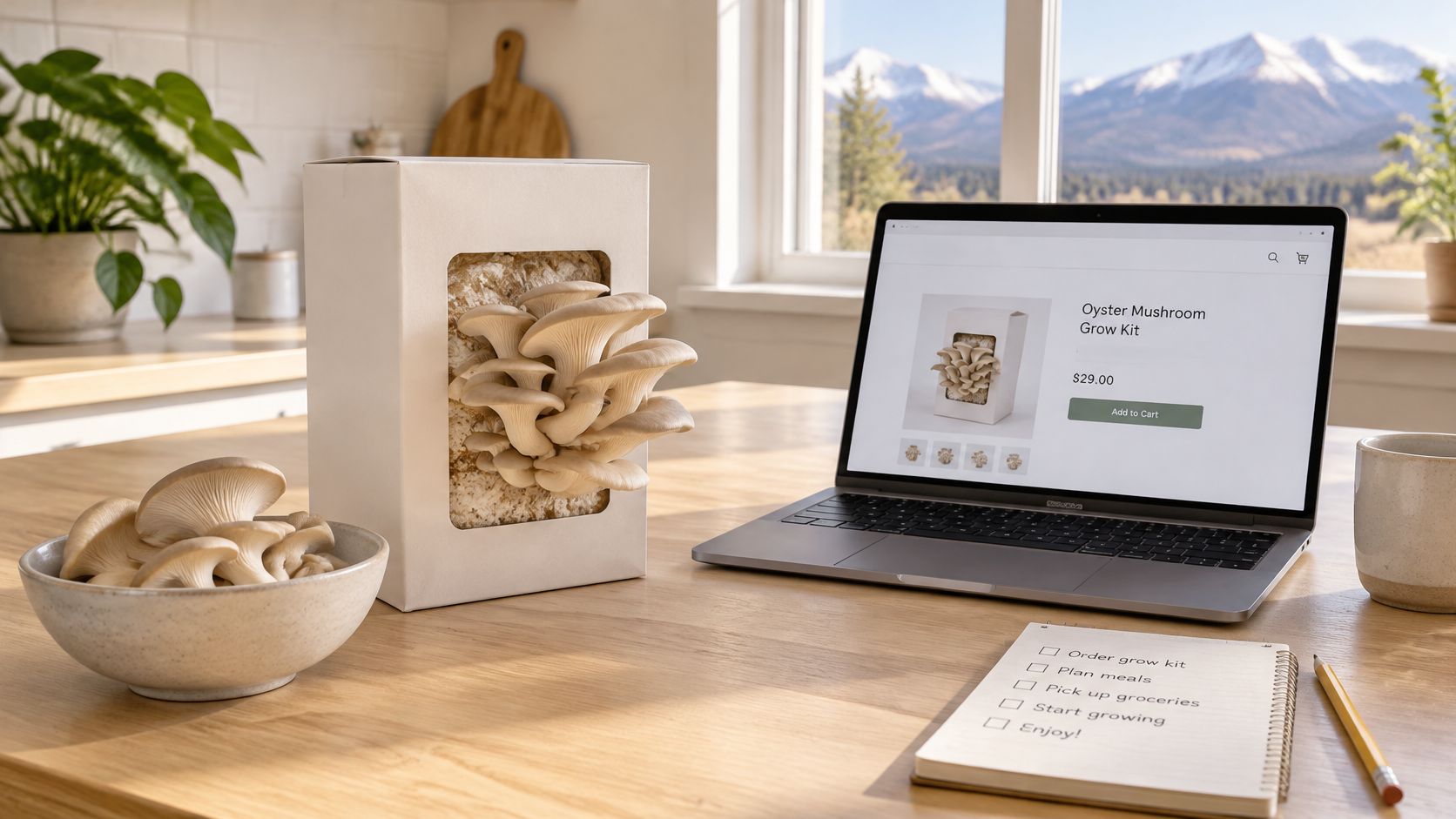
Take these steps before you order:
Match the kit to the humidity and temperature you can hold at home through fruiting.
Ask the seller what its success figure measures and how it handles contaminated bags.
Choose a first kit with printed instructions and support you can reach when you need it.
Plan the harvest side before the kit ships: breathable storage in the refrigerator and a decision point for when to pick.
Colorado Cultures sells sterilized grain bags, all-in-one grow bags, substrates, and grow kits, with printable instructions, video tutorials, and support by email, phone, or in person at its Lakewood and Englewood storefronts. Compare its products and guidance against the criteria in this guide, then visit Colorado Cultures to choose a kit that fits the conditions you can maintain.
Comments