
Why Is Aseptic Technique Important for Mushroom Growing
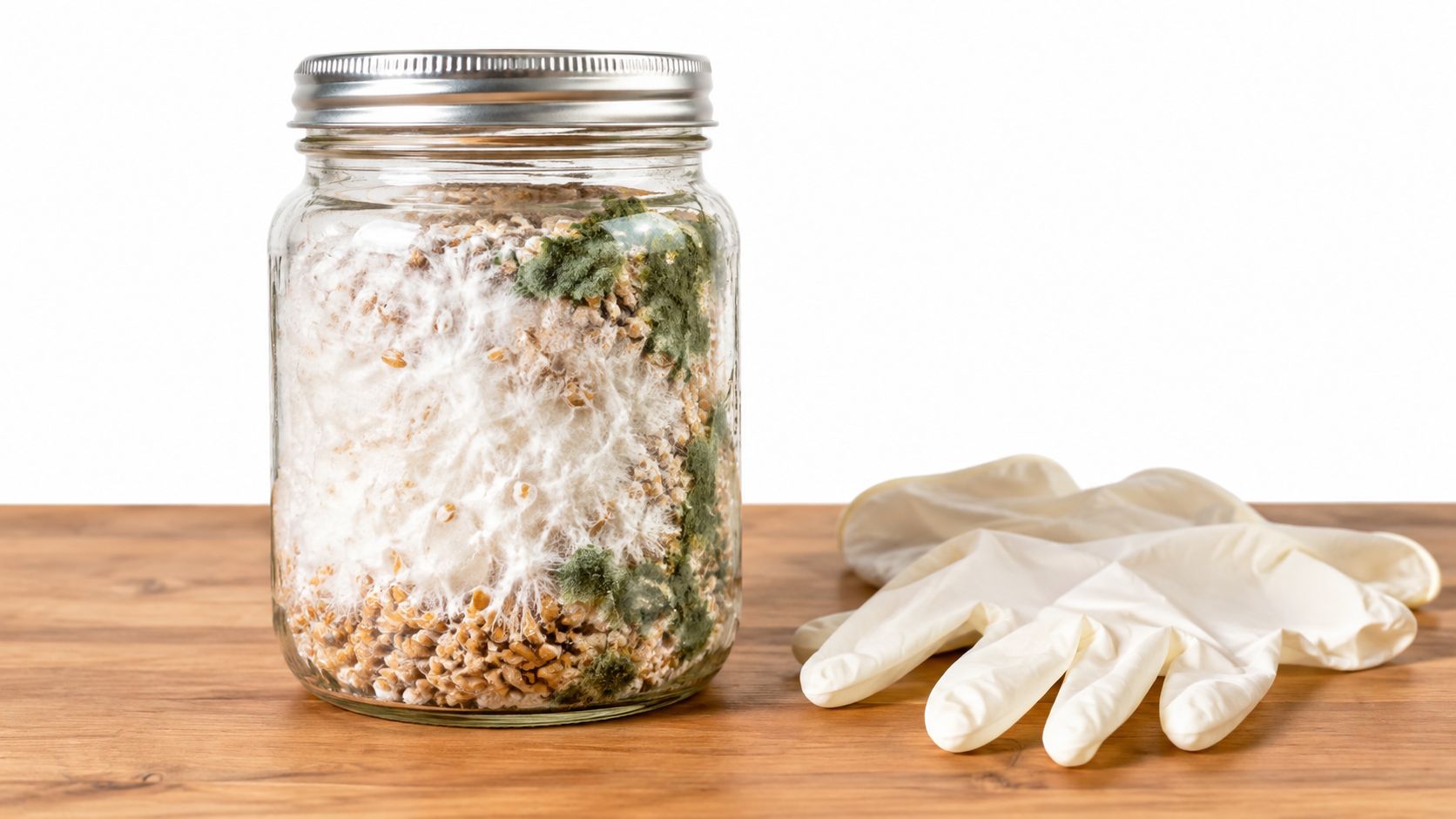
You set a grain jar on the shelf, check it twice a day, and wait for the white to take over. Then one morning the jar smells sour, or a patch of green shows up where clean white growth should be, and the whole project stops being exciting and starts feeling like a lesson in invisible mistakes. That's the moment aseptic technique stops sounding like lab jargon and starts looking like the difference between a harvest and a trash bag.
For mushroom growers, why is aseptic technique important comes down to one simple truth, the fastest organism usually wins. Mycelium grows with purpose, but contaminants like mold and bacteria are built to move fast when nutrient-rich grain, wet surfaces, and open air give them a chance. Aseptic habits keep that chance small.
If you've been setting up a grow space in a spare room, garage, or basement, it helps to think about the room itself as part of the culture work. A practical walkthrough like how to set up a grow room gives that environment a real role instead of treating it like background noise. That's the right mindset, because clean handling and a clean space work together.
Introduction Why Your Grow Lives or Dies Before Fruiting
A first grow can look healthy until the day it stalls. The jar appears normal, the spawn seems active, and then an unfamiliar color or smell shows up where progress should be. By that point, the cause may have entered during a brief exposure of grain, agar, or an inoculation port.
For hobby growers, aseptic technique is a yield and consistency system. It protects the early stages, when sterile material meets air, tools, hands, and nearby surfaces. A contaminant that lands during that short window can compete with mycelium before you see any warning. Preventing that introduction is usually easier than diagnosing a failed jar later.
The history helps explain the principle. Louis Pasteur connected fermentation and decay with microorganisms, while Joseph Lister applied antiseptic practice to surgery in 1867. Semmelweis had already shown in the 1840s that hand hygiene could reduce puerperal fever mortality from roughly 18% to under 2% source. Their work established a practical idea that still applies at a Denver grow table: invisible organisms can change an outcome before visible symptoms appear.
A grow room does not need to resemble a hospital. A spare room, garage, or apartment can support reliable work when you control the parts of the process you can control. Guidance on setting up a grow room shows why the surrounding space belongs in your workflow, rather than serving as an overlooked backdrop.
Practical rule: if a surface, tool, or hand touched something dirty, treat it as dirty until you clean or replace it.
That rule turns asepsis into a sequence of decisions. Clean handling may be enough for some later tasks, while exposed sterile transfers demand tighter control. Each careful contact gives mycelium more time to establish, improving the chance of a stable culture and a usable harvest.
What Aseptic Technique Really Means for Mushroom Growers
Aseptic technique is a discipline, not a single trick. It means keeping unwanted environmental microorganisms out of sterile materials while they're exposed to air, surfaces, and operators source. For mushroom growers, that's the difference between a clean transfer and a plate that gets covered by something faster and messier than the organism you meant to grow.
Think like a kitchen, not a crime scene
The easiest analogy is raw chicken on a cutting board. You wouldn't slice vegetables on the same board without cleaning it first, because invisible contamination matters even when the surface looks fine. Mushroom work is similar, except the “food” is your culture, and the contamination you're trying to avoid can come from the room, your gloves, the rim of a jar, or a tool you set down for two seconds.
That's why asepsis is a workflow, not a vibe. A clean workspace lowers risk, sterile tools reduce transfer, gloved hands avoid direct contact, and filtered or still air keeps stray spores and dust from drifting onto exposed material. A weak link in any one of those steps can undo the rest. A fast contaminant doesn't need a big opening, it just needs one unguarded moment.
Colorado Cultures' sterile technique principles are useful here because they frame the process around control, not perfection. That matters in home grows, where people often assume they need a full cleanroom when they really need repeatable habits and a protected work zone. If you've ever seen bench setups that resemble clean room gowning benches, you already know the underlying idea, give the work a clean boundary and keep your hands inside it.
Why the system matters more than one step
Aseptic handling works because the parts support each other. Clean surfaces help, but they don't protect a plate if you talk over it. Sterile tools help, but not if they touch the table between cuts. Gloves help, but only if you treat them like part of the sterile chain instead of a replacement for attention.
Rule of thumb: the goal isn't to make the room sterile, it's to keep sterile materials from meeting dirty ones.
That's the right mental model for mushroom growing. You're not winning a war against all microbes, you're giving your culture a fair start.
Why Aseptic Technique Matters for Contamination Prevention and Yield
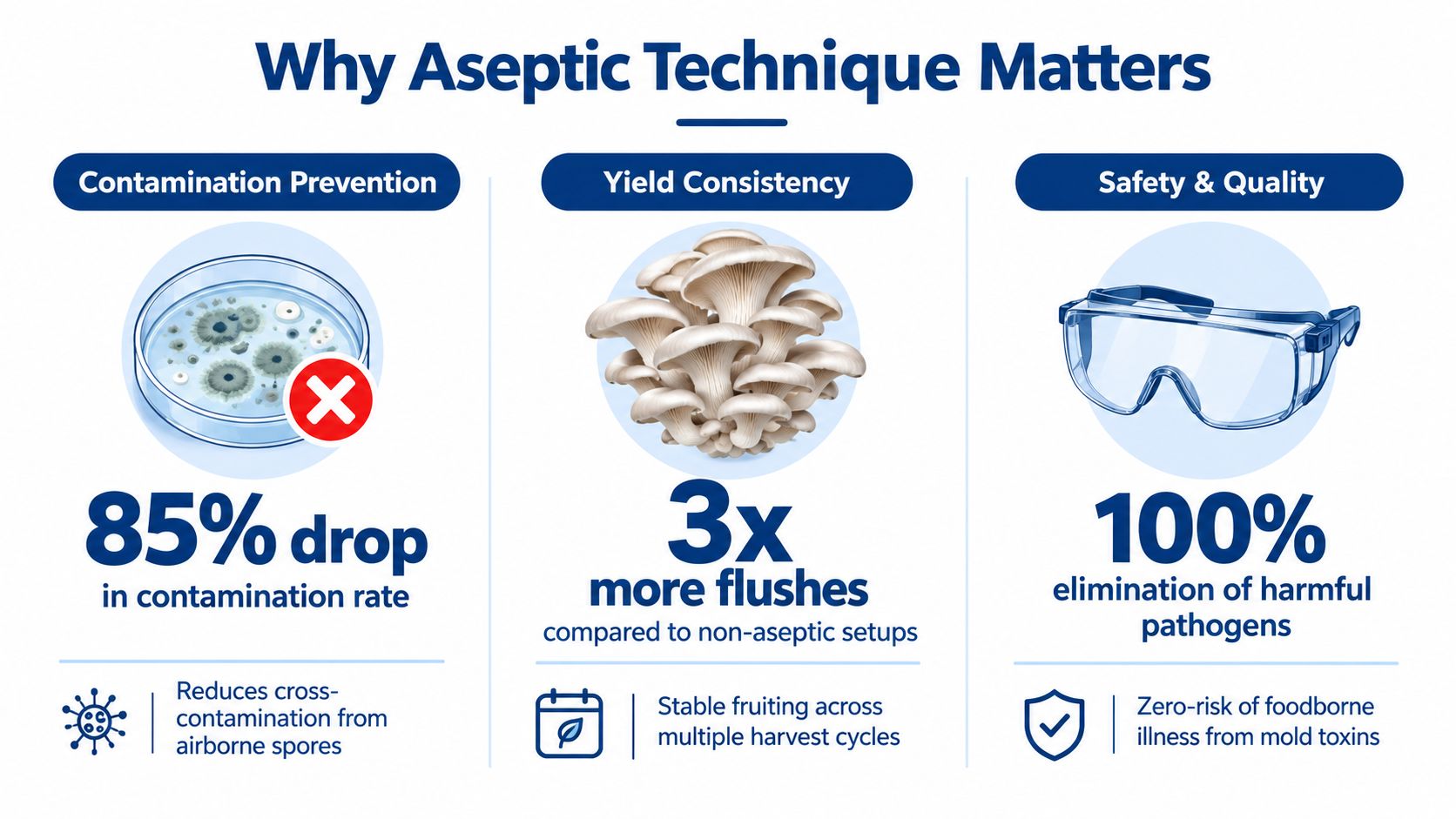
A grow can look perfect on transfer day, then show contamination before the first flush. The loss is larger than one jar. You may spend more grain, time, and attention rebuilding a culture, while the original schedule slips. For hobby growers, aseptic technique works as a yield and consistency system because it reduces the number of failed starts that make results unpredictable.
Contamination is measurable, not theoretical
Research outside mushroom cultivation shows how handling quality affects contamination. In a PubMed-indexed study of sterile syringe preparation, a trained pharmacy operator achieved 0.0% contamination versus 6.9% for nurses. Contamination among nurses ranged from about 2% to 17%, depending on experience source.
A separate systematic review found 3.7% contamination across 10,272 doses prepared in clinical settings, compared with 0% across 6,280 doses in pharmaceutical settings. These results are not mushroom-growing measurements, so they should not be treated as a direct prediction for your jars. They do show the practical pattern: tighter handling standards reduce opportunities for contamination.
For a grower, one lapse can spread through a chain of work. A contaminated transfer may affect a plate, a jar, and the later expansion built from it. Preventing that first failure protects more than the material immediately in front of you.
Yield depends on clean starts
Before fruiting, grain and agar function as a competition zone. Their nutrients support the mushroom culture, but they can also support bacteria, molds, and other unwanted organisms. If a contaminant establishes early, it may outgrow the intended culture, change the smell of a jar, or obscure what is happening on a plate.
A clean start gives your mushroom culture more time and space to colonize the substrate. That improves the chance that later fruiting reflects the culture and conditions you chose, rather than an unseen competitor.
Safety and reproducibility matter too
Aseptic work also makes troubleshooting easier. If your workflow stays consistent, a failed jar gives you a narrower set of possible causes. You can compare batches, identify weak points, and repeat the parts that worked instead of relying on guesswork.
Key point: asepsis saves time by preventing contamination that forces a restart.
For home cultivators, the payoff is less waste, steadier harvests, and a process you can trust next month. Clean habits do not promise perfection. They make each decision more likely to produce a usable result.
Aseptic Versus Clean Technique and When Each Is Enough
You have wiped the table, arranged your tools, and are ready to transfer culture. That preparation is useful, but it does not provide the same protection as working aseptically. Clean technique lowers the number of microbes around the work. Aseptic technique creates a stricter barrier when exposed material cannot tolerate added contamination source.
For mushroom growers, the right choice depends on what is open and how vulnerable it is. Cleaning a bench before setting out supplies is a lower-risk task. Opening a sterile grain bag or transferring culture to agar exposes nutrient-rich material, so small lapses can give competing organisms an opportunity.
Aseptic vs Clean Technique for Growers | Technique Needed | Why |
|---|---|---|
Wiping a bench before prep | Clean technique | Removes grime and reduces surface contamination |
Organizing tools and jars before a transfer | Clean technique | Keeps the workspace orderly without treating it as sterile |
Agar work, inoculation, grain transfers | Aseptic technique | Exposed material needs the strongest practical protection |
Handling a fully colonized, sealed container | Clean technique | The container is closed, so contact with room air is limited |
The Cleveland Clinic guidance helps separate contamination reduction from stricter sterility. A grower does not need the same controls for every action. Applying full asepsis to routine preparation can add time and complexity, while using casual cleanliness during an open transfer can waste the culture and substrate already invested.
Use the least demanding method that reasonably protects the material. A still-air box may suit a simple home transfer when the work area is prepared and movements stay controlled. More controlled conditions make sense for delicate agar work, open grain, or repeated culture expansion. The goal is not to make every task resemble surgery. It is to match protection to exposure and risk.
That choice also supports more consistent yields. Clean technique can be enough for closed, established material. Aseptic technique earns its extra effort when a transfer could determine whether the next jar or plate develops as intended.
Ask one practical question before each step: What level of protection does this material need while it is exposed?
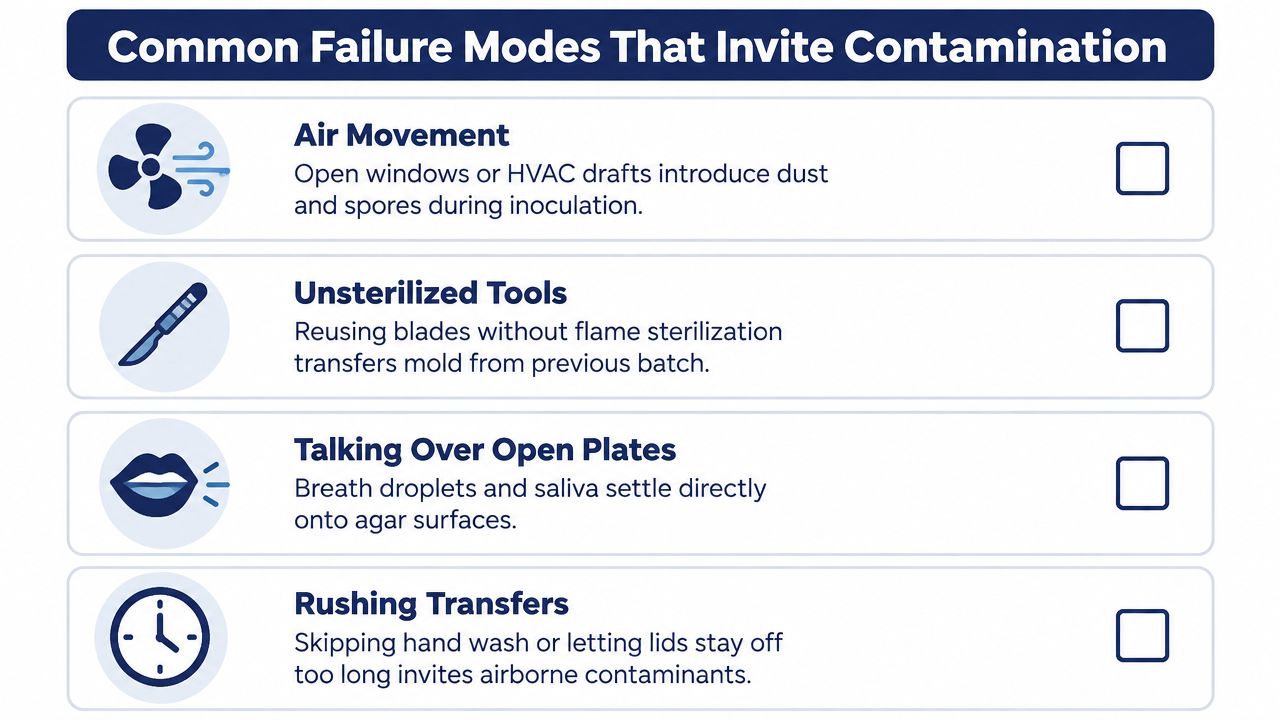
Common Failure Modes That Invite Contamination
Most contamination problems come from ordinary habits, not one giant mistake. A grower opens a jar too long, talks over a plate, sets a tool down on the table, then picks it back up and wonders why the culture went sideways. Microbes don't need a dramatic opening, they need a path.
Four failure points to watch first
Air movement: Open windows, fans, or HVAC drafts can push dust and spores into an exposed transfer zone.
Unsterilized tools: A blade or needle that wasn't reset properly can carry contamination from the previous step.
Talking over open plates: Breath droplets and saliva settle fast when the work is exposed.
Rushing transfers: The longer lids stay off, the more chances airborne contaminants have to land.
These aren't abstract warnings. A 2025 study of blood culture contamination noted rising contamination rates during and after the COVID-19 pandemic, and a 2025 non-touch trial found contamination under 1% was achievable, with sterility maintained for at least 6 hours after preparation source. That tells you two things. Contamination is still a live problem, and process design can make a real difference.
The environment usually gets blamed too late
People often blame bad luck, but the room matters. A cluttered desk, a blowing vent, or a poorly timed movement around the work area can be enough to shift a clean transfer into a contaminated one. The problem isn't that you weren't careful enough in a general sense, it's that the workflow gave contaminants an opening.
Practical rule: if the work area is unstable, your hands have to work twice as hard to make up for it.
Audit the habits, not just the outcome
When a jar or plate fails, look backward. Was the lid open too long? Did you sterilize the tool between touches? Did you work in still air or in a room with constant movement? That kind of review is how growers improve from batch to batch, because it turns contamination into data instead of disappointment.
Practical Ways to Implement and Maintain Asepsis at Home
A home grow doesn't need a hospital budget to work well. It needs a repeatable routine that keeps dirty things out of clean ones. If you can standardize the order of your movements, the way you handle tools, and the way you set up the room, you'll remove a lot of the noise that causes contamination.
Start with the work zone
Pick one spot and make it the sterile zone for the session. Clear away extra jars, paper, drink cups, and anything else that doesn't belong. Wipe the surface, then stage only what you'll use so you're not reaching across clutter while a plate is open.
Colorado Cultures' guide on how to sterilize equipment fits naturally into that approach because sterilization only helps if you don't undo it at the table. Treat each tool as clean only until you touch something you shouldn't.
Build the workflow in a fixed order
Wash and dry your hands first.
Set out sterile materials before opening anything.
Keep lids and caps off for the shortest practical time.
Use flame or chemical sterilization where your setup calls for it.
Move slowly enough that you don't create unnecessary air disturbance.
Keep the sterile side sterile, and return everything else to the dirty side.
That rule sounds simple because it is. The challenge is repeating it every time, especially when you're eager to finish a transfer before the culture dries out or a bag cools down.
Match the setup to the task
A still-air box can work well for many home procedures because it reduces drafts and gives you a protected field. A flow hood adds another level of control if you have one. Either way, the point is the same, create a calmer environment around the exposed material so airborne contaminants have fewer chances to land.
For inoculation, agar transfers, and opening sterile grain, gloves and tool discipline matter as much as the room. For break-and-shake or storage, the main goal is to avoid reintroducing contamination after the bag or jar was already clean. Once the container is sealed, your job changes from sterile handling to careful protection of that seal.
Don't confuse cleanliness with sterility
A wipe-down and a tidy shelf help, but they don't replace disciplined handling. Aseptic technique is the chain that connects clean surfaces, sterile tools, and good habits. If one link breaks, the whole chain is weaker.
The growers who get consistent results usually aren't the ones with the fanciest gear. They're the ones who use the same method every time, notice where contamination enters, and tighten the process one step at a time.
Building Consistent Results With Sterile Habits Over Time
A reliable grow is built through repeatable choices, not a single perfect transfer. After the biology and workflow are in place, track each run: record transfers, note when containers stayed open too long, and identify the moment contamination appeared. Then tighten one habit before starting again.
Consistency grows from a simple system. Use the same controlled workspace, prepare sterile tools, and follow the same handling sequence even when you are tired or rushing. Repetition makes mistakes easier to spot. It also helps separate a weak process from an unlucky result.
For a home grower, this turns aseptic technique into a yield and consistency system. Every contaminated jar or bag costs time and material. Cleaner transfers give the intended culture more opportunity to colonize its substrate, while consistent handling makes successful results easier to repeat.
The goal is not to create a perfect laboratory at the kitchen table. Match the level of cleanliness to the task, protect exposed cultures carefully, and reserve stricter sterile habits for steps where contamination can spread through an entire run. A calm, repeatable routine usually contributes more than expensive equipment used inconsistently.
Colorado Cultures offers sterilized grain bags, substrates, all-in-one grow bags, tools, and classes for home mycology work. Visit Colorado Cultures for supplies and guidance that can support a cleaner routine on your next run.
Comments